WellnessTastic is reader-supported. When you buy through links on this page, we may earn an affiliate commission at no extra cost to you. As an Amazon Associate, we earn from qualifying purchases. Learn more.
Finding the best air purifier for smoke is harder than choosing one for dust or pollen. Smoke is not just one pollutant. It is a mix of extremely fine particles and hundreds of gases, many of which cause the lingering smell. A purifier that handles dust well can still struggle with smoke odor, and one with a thin carbon layer may barely touch it.
In this guide, we explain what really matters when choosing an air purifier for smoke, compare models with strong particle filtration and substantial activated carbon, and show you how to use them for wildfire smoke, cigarette smoke and cooking smoke. We also explain honestly what an air purifier cannot do, because no air cleaner removes every pollutant in smoke.
Quick picks: The IQAir HealthPro Plus is our top overall pick for smoke, combining a CADR of 260 CFM with a substantial gas and odor filter. For heavy smoke odors and gases, the Austin Air HealthMate packs about 15 pounds of activated carbon and zeolite. For wildfire smoke in large rooms, the Blueair Blue Pure 211i Max and Levoit Core 600S deliver high airflow for fine particles. For small rooms, the Austin Air HealthMate Jr. offers over 6.5 pounds of carbon.
Why Smoke Is So Hard to Clean
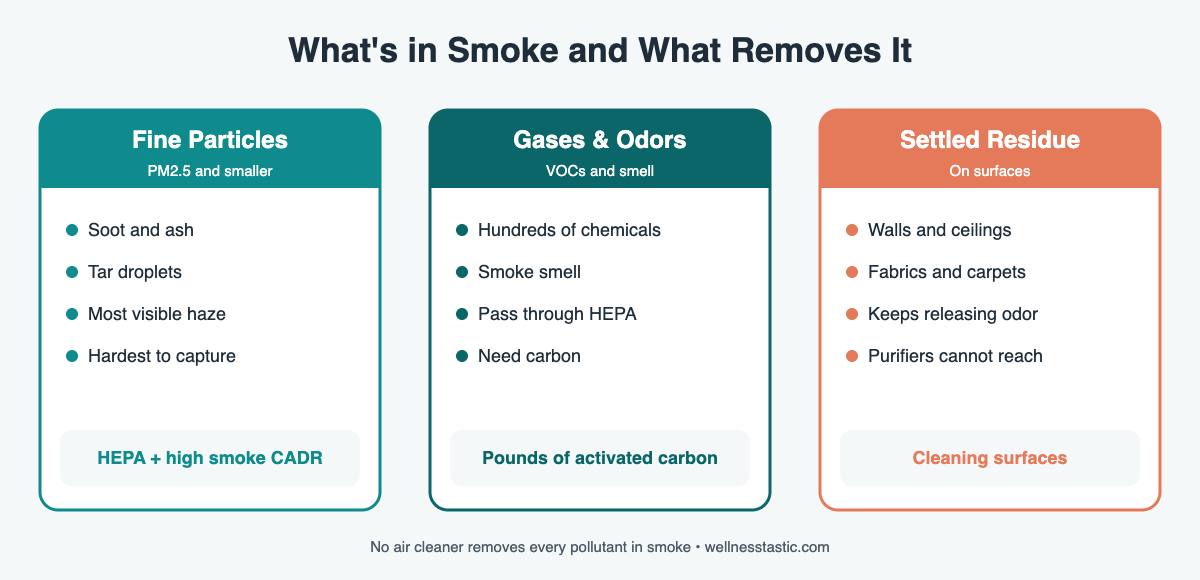
Smoke contains two very different types of pollutants, and a good smoke air purifier needs to handle both:
| Part of smoke | What it is | What removes it |
|---|---|---|
| Fine particles (PM2.5 and smaller) | Tiny particles of soot, ash and tar, many far smaller than a human hair | A HEPA or HEPA-grade particle filter with a high smoke CADR |
| Gases and VOCs | Hundreds of chemicals, including those responsible for the smell | Activated carbon, ideally several pounds of granular or pelletized carbon |
| Settled residue | Smoke particles and chemicals that stick to walls, fabrics and furniture | Cleaning surfaces; air purifiers cannot remove it |
HEPA filters are excellent at capturing smoke particles, but they do not remove gases. Activated carbon adsorbs some gases and odors, but thin carbon-coated sheets saturate quickly. That is why the amount and type of carbon matters so much for smoke. Our guide to HEPA vs activated carbon explains the difference in detail.
What to Look for in the Best Air Purifier for Smoke
1. A high smoke CADR
The smoke CADR measures how quickly a purifier removes smoke-sized particles. It is usually the lowest of the three CADR numbers because smoke particles are the hardest to capture. Choose a smoke CADR of at least two-thirds of your room’s floor area, and go higher for wildfire smoke. See our CADR guide.
2. True HEPA or verified HEPA-grade filtration
Look for true HEPA filtration or independently verified equivalent performance for fine particles. Avoid vague “HEPA-type” claims.
3. Substantial activated carbon
For smoke odor and gases, carbon weight matters. Thin carbon-impregnated fabric may help with light odors but saturates quickly. Purifiers with several pounds of granular or pelletized carbon, such as those from IQAir and Austin Air, perform much better for persistent smoke odors.
4. A sealed filter housing
Fine smoke particles can slip around poorly fitting filters. Premium purifiers use sealed or gasketed housings so air must pass through the filter rather than around it.
5. No ozone
Avoid ozone generators, which the EPA warns against, and look for models that meet California Air Resources Board (CARB) ozone limits. Some purifiers include optional ionizers; if you are concerned about ozone, keep them switched off.
6. Realistic running costs
Carbon filters saturate over time, especially with heavy smoke. Check how long filters last and how much replacements cost before you buy.
How We Chose the Best Air Purifiers for Smoke
We have not yet completed our own hands-on smoke testing of every model on this list. We chose these purifiers using data you can verify: AHAM Verifide or clearly labeled manufacturer CADR ratings, published carbon filter specifications, and results from established independent testers who run smoke and odor removal tests. Read more on our How We Research page.
The Best Air Purifier for Smoke: Our Top Picks
1. IQAir HealthPro Plus: Best Overall Air Purifier for Smoke
The IQAir HealthPro Plus combines strong particle filtration with a dedicated gas and odor stage, making it one of the most complete smoke solutions available for home use. It has a CADR of 260 CFM, which covers about 406 square feet at 4.8 air changes per hour, and uses a three-stage system: a PreMax pre-filter, a V5-Cell gas and odor filter containing roughly 5 pounds of granular carbon, and a HyperHEPA particle filter. It does not produce ozone, and independent testers have reported outstanding smoke removal results.
| Spec | Details |
|---|---|
| CADR | 260 CFM |
| Room size at 4.8 ACH | About 406 sq ft |
| Carbon | V5-Cell gas and odor filter, roughly 5 lb of carbon |
| Particle filter | HyperHEPA (H12/13 class) |
| Ozone | None |
| Price range | Premium |
Why it works for smoke:
- Handles both smoke particles and gases
- Sealed, high-quality construction
- No ozone and no ionizer
- Long-lasting filters
Things to consider:
- Expensive to buy and to replace filters
- Large and heavy
- Few smart features
Best for: people who are sensitive to smoke and anyone dealing with regular smoke or odors in living rooms and bedrooms.
2. Austin Air HealthMate: Best for Heavy Smoke Odors and Gases
When the priority is odor and gas removal, the Austin Air HealthMate stands out for the sheer amount of carbon it uses: about 15 pounds of activated carbon and zeolite, combined with a true HEPA filter. That large carbon bed gives it more capacity to adsorb smoke odors and VOCs before it saturates. It is simple to use, with no smart features, and its filter is designed to last several years under typical use.
| Spec | Details |
|---|---|
| Carbon | About 15 lb activated carbon and zeolite blend |
| Particle filter | True HEPA |
| Filter life | Several years under typical use (manufacturer); sooner with heavy smoke |
| Features | Simple controls, no smart features |
| Ozone | None |
| Price range | Premium |
Why it works for smoke:
- One of the largest carbon beds in a home purifier
- Excellent for smoke odors and chemical smells
- Long filter life reduces yearly costs
Things to consider:
- Lower particle CADR than the IQAir according to independent testing
- Heavy, basic design with no auto mode
Best for: homes with persistent smoke odors, chemical sensitivities or nearby wildfire smoke.
3. Blueair Blue Pure 211i Max: Best for Wildfire Smoke in Large Rooms
During wildfire smoke events, the main goal is removing huge amounts of fine particles quickly. The Blueair Blue Pure 211i Max has an AHAM-verified CADR of 410 CFM and is rated for 635 square feet at 4.8 air changes per hour, making it one of the fastest options for large living spaces. It includes a carbon layer for light odors, but it is designed primarily for particles.
| Spec | Details |
|---|---|
| CADR | 410 CFM (AHAM verified) |
| Room size at 4.8 ACH | 635 sq ft |
| Carbon | Light carbon layer |
| Noise | 23–53 dB (manufacturer) |
| Power | About 46 W |
Why it works for smoke:
- Very high verified particle CADR
- Quiet and energy-efficient for its size
- Honest room sizing
Things to consider:
- Carbon layer is not designed for heavy smoke odor
- Uses electrostatic HEPASilent technology
Best for: wildfire smoke in large living rooms and open spaces.
4. Levoit Core 600S: Best Value for Wildfire Smoke
The Levoit Core 600S offers large-room airflow at a lower price, with a manufacturer-rated CADR of 391 CFM covering about 606 square feet at 4.8 air changes per hour. Its air quality sensor and auto mode ramp up when smoke levels rise. Levoit no longer labels this filter “True HEPA,” but independent testers report strong particle removal.
| Spec | Details |
|---|---|
| CADR | 391 CFM (manufacturer) |
| Room size at 4.8 ACH | 606 sq ft |
| Carbon | Activated carbon layer |
| Smart features | Air quality sensor, auto mode, app |
Why it works for smoke:
- High airflow for the price
- Auto mode reacts to smoke
- Good choice for smoke drifting in from outside or neighbors
Things to consider:
- Carbon capacity is modest for heavy indoor smoke
- Loud at top speed
Best for: wildfire season and apartments where smoke drifts in intermittently.
5. Austin Air HealthMate Jr.: Best for Small Rooms With Smoke Odor
The Austin Air HealthMate Jr. brings Austin Air’s carbon-heavy approach to a smaller unit. It contains more than 6.5 pounds of carbon pellets and covers rooms up to about 185 square feet at 4.8 air changes per hour. Independent testing found it excellent at odor and smoke smell removal, though less strong on airborne particles than higher-CADR models.
| Spec | Details |
|---|---|
| Carbon | More than 6.5 lb of carbon pellets |
| Room size at 4.8 ACH | About 185 sq ft |
| Particle filter | True HEPA |
| Filter life | Long-lasting (manufacturer) |
Why it works for smoke:
- Large carbon capacity for a small unit
- Strong odor removal in small spaces
Things to consider:
- Lower particle CADR
- No smart features
Best for: small bedrooms and offices with smoke odor from neighbors or occasional exposure.
Best Air Purifier for Smoke: Comparison Table
| Model | Particle CADR | Room size (4.8 ACH) | Carbon | Best for |
|---|---|---|---|---|
| IQAir HealthPro Plus | 260 CFM | ~406 sq ft | ~5 lb (V5-Cell) | Best overall |
| Austin Air HealthMate | Lower (tested) | Medium rooms | ~15 lb carbon + zeolite | Heavy odors and gases |
| Blueair 211i Max | 410 (AHAM) | 635 sq ft | Light layer | Wildfire smoke, large rooms |
| Levoit Core 600S | 391 (mfr) | 606 sq ft | Carbon layer | Wildfire smoke on a budget |
| Austin Air HealthMate Jr. | Lower (tested) | ~185 sq ft | 6.5+ lb | Small rooms, odor |
As a rule of thumb: for wildfire smoke, prioritize high particle CADR; for smoke odors and gases, prioritize carbon weight; for both, choose a model that combines strong particle filtration with several pounds of carbon.
Best Air Purifier for Smoke by Situation
| Your situation | What matters most | Our pick |
|---|---|---|
| Wildfire smoke in a large living room | High particle CADR | Blueair Blue Pure 211i Max |
| Wildfire smoke on a budget | CADR per dollar | Levoit Core 600S |
| Smoke drifting in from a neighbor | Carbon plus steady airflow | IQAir HealthPro Plus or Levoit Core 600S |
| Persistent smoke odor or chemical smells | Carbon weight | Austin Air HealthMate |
| Small bedroom with smoke odor | Carbon in a compact unit | Austin Air HealthMate Jr. |
| Smoke-sensitive household | Particles and gases together | IQAir HealthPro Plus |
| Emergency, tight budget | Fast particle removal | DIY box fan filter with MERV 13 filters |
Apartments and shared walls
In apartments, smoke often drifts in through gaps around doors, outlets and shared ventilation. Seal obvious gaps with weatherstripping, keep a purifier running on auto in the most affected room, and choose a model with a meaningful amount of carbon. Talk to your landlord or building manager if smoke from neighboring units is a regular problem.
Homes near busy roads or industrial areas
Traffic and industrial pollution add fine particles and gases similar to smoke. A purifier with both HEPA filtration and substantial carbon, such as the IQAir HealthPro Plus or Austin Air HealthMate, is a good fit. Keep windows closed during rush hour and on high-pollution days.
Homes with fireplaces or wood stoves
Even well-maintained fireplaces and wood stoves can release smoke into a room, especially when lighting a fire or opening the door. Run a high-CADR purifier nearby while the fire burns, make sure the chimney drafts properly and has been inspected, and never burn trash or treated wood.
How to Use an Air Purifier During Wildfire Smoke
Wildfire smoke can travel hundreds of miles and seep into homes through gaps, vents and open doors. The EPA recommends creating a “clean room,” a room with as few windows and doors as possible where you can spend time with cleaner air. Here is how to set one up:
- Check air quality: use AirNow.gov to track outdoor smoke levels.
- Choose a room: ideally a bedroom with few windows, where you can spend most of your time.
- Close windows and doors and set your HVAC system to recirculate, if possible.
- Run a properly sized HEPA purifier on high in that room, and keep it running.
- Avoid adding indoor smoke: no candles, incense, frying or vacuuming with a non-HEPA vacuum.
- Upgrade your HVAC filter to MERV 13 or the highest your system supports.
- Monitor indoor PM2.5 with an air quality monitor to confirm the room stays cleaner.
If you are sensitive to smoke or have a health condition, follow guidance from local health authorities and your healthcare provider during wildfire events.
Air Purifiers and Cigarette Smoke: The Honest Truth
Many people search for an air purifier for cigarette smoke, so it is important to be clear. An air purifier with HEPA and substantial carbon can reduce airborne smoke particles and some odors, and it can make a noticeable difference when smoke drifts in from a neighbor or a shared wall.
However, no air purifier can make indoor smoking safe. Air cleaners and ventilation cannot remove all of the harmful components of tobacco smoke, and smoke residue also settles on surfaces. The only way to fully protect people from secondhand smoke indoors is to keep smoking completely outside the home and car. If you live with a smoker, an air purifier is a helpful extra, not a solution.
Cooking Smoke and Fireplace Smoke
Cooking, especially searing and frying, produces fine smoke particles. A range hood vented outdoors is the most effective solution, with an air purifier as backup to clear particles that escape. For fireplaces and wood stoves, make sure the chimney drafts properly and has been inspected, and run a purifier in the room while they are in use. Our guide on how to improve indoor air quality covers these sources.
Budget Option: A DIY Box Fan Filter for Wildfire Smoke
If you need affordable smoke filtration quickly, a do-it-yourself air cleaner made from a box fan and MERV 13 furnace filters, often called a Corsi-Rosenthal box, can deliver a lot of particle-removing airflow. These DIY cleaners do not remove gases or odors, are louder and bulkier than commercial purifiers, and should be used safely and never left unattended, but they are a practical emergency option for wildfire smoke.
How Big Should an Air Purifier for Smoke Be?
| Room size | Minimum smoke CADR | Recommended for wildfire smoke |
|---|---|---|
| 150 sq ft | 100 CFM | 150+ CFM |
| 250 sq ft | 165 CFM | 250+ CFM |
| 400 sq ft | 265 CFM | 400+ CFM |
| 600 sq ft | 400 CFM | 500+ CFM or two units |
For smoke, going above the minimum is especially worthwhile, because it lets the purifier remove particles faster and run more quietly. Our air purifier size guide explains the formula.
Tips to Get the Most From a Smoke Air Purifier
- Run it continuously during smoke events, on high at first and then on auto or medium.
- Close doors and windows in the room you are cleaning.
- Place it in the room where you spend the most time, with space around it for airflow.
- Replace carbon filters when odors return: carbon saturates faster with heavy smoke than manufacturers’ typical estimates.
- Clean surfaces: wash fabrics, wipe hard surfaces and vacuum with a HEPA vacuum to reduce residue.
- Measure results: an indoor air quality monitor shows how quickly PM2.5 drops.
How Long Do Carbon Filters Last With Smoke?
Activated carbon works by adsorbing gas molecules onto its surface. Once that surface is full, the filter stops removing odors, and smells can return quickly. Carbon filter life depends on how much carbon there is and how much smoke it faces.
- Thin carbon-coated filters may saturate within weeks under heavy smoke.
- Filters with a few pounds of granular carbon last much longer and handle stronger odors.
- Very large carbon beds, such as the Austin Air HealthMate’s roughly 15 pounds, offer the longest life, although heavy smoke will still shorten it.
- A sign it is time to replace: odors come back soon after the purifier has been running, even on higher speeds.
After a major wildfire season or heavy smoke exposure, plan to replace carbon filters sooner than the manufacturer’s standard estimate.
Cleaning Up After Smoke
An air purifier removes smoke that is still in the air, but smoke particles and residue also settle on surfaces. After a smoke event:
- Wash curtains, bedding and washable fabrics.
- Wipe hard surfaces with a damp cloth rather than dry dusting.
- Vacuum carpets and upholstery with a HEPA vacuum.
- Replace your HVAC filter, which may have captured a lot of smoke particles.
- Ventilate once outdoor air quality has improved.
- Check indoor readings with an air quality monitor to confirm levels have returned to normal.
Common Mistakes When Buying an Air Purifier for Smoke
- Relying on a thin carbon layer for heavy smoke odor: it will saturate quickly.
- Choosing by advertised room size: use smoke CADR instead.
- Buying an ozone generator or “smoke eliminator” that produces ozone: ozone is a lung irritant.
- Expecting a purifier to make indoor smoking safe: it cannot.
- Running it only occasionally: smoke particles keep coming in; continuous operation matters.
- Forgetting the source: close windows during wildfire smoke and use the range hood when cooking.
Smoke and Air Purifier Myths
- “If I cannot smell smoke, the air is clean.” Many of the finest smoke particles have no smell. An air quality monitor that measures PM2.5 gives a much better picture than your nose.
- “Any HEPA purifier will get rid of smoke smell.” HEPA captures particles but not gases. Odor removal depends on the amount and quality of activated carbon.
- “Ozone generators eliminate smoke.” Ozone may mask some odors, but it is a lung irritant, and the EPA advises against using ozone generators in occupied spaces.
- “Opening windows clears wildfire smoke.” During wildfire events, outdoor air is often the source of the smoke. Keep windows closed and filter indoor air instead.
- “Air purifiers make indoor smoking safe.” They cannot remove all harmful components of tobacco smoke. A smoke-free home is the only complete solution.
Understanding these myths helps you spend money on the features that actually reduce smoke exposure: a strong smoke CADR, real HEPA filtration and enough activated carbon for the odors you face.
Frequently Asked Questions
What is the best air purifier for smoke?
For most homes, the IQAir HealthPro Plus is our top pick because it combines strong particle filtration with a substantial carbon gas and odor filter. For heavy odors, the Austin Air HealthMate’s 15 pounds of carbon is hard to beat. For wildfire smoke in large rooms, a high-CADR purifier such as the Blueair Blue Pure 211i Max is ideal.
Do air purifiers really remove smoke?
HEPA air purifiers can remove a large share of airborne smoke particles, and carbon filters can reduce some smoke gases and odors. However, no air cleaner removes all pollutants in smoke, and purifiers cannot remove residue that has settled on surfaces.
Will an air purifier get rid of cigarette smell?
A purifier with several pounds of activated carbon can reduce cigarette smell in the air, especially when smoke drifts in from elsewhere. It will not remove smoke residue from walls and fabrics, and it cannot make indoor smoking safe.
What size air purifier do I need for wildfire smoke?
Choose a smoke CADR of at least two-thirds of your room’s floor area, and ideally more. For a 300 sq ft bedroom, aim for 200 CFM or higher.
How long does it take an air purifier to clear smoke?
It depends on the room size, smoke level and CADR. A properly sized purifier running on high can noticeably reduce airborne smoke particles within an hour, though odors and heavier smoke may take longer. An air quality monitor shows your actual progress.
Should I run my air purifier all day during wildfire season?
Yes. During wildfire season, smoke can enter your home whenever outdoor levels rise, so running your purifier continuously, on auto or at least on a low setting, keeps indoor particle levels consistently lower. Turn it up to high when outdoor air quality worsens or when you notice a smoke smell indoors.
The Bottom Line
The best air purifier for smoke combines strong particle filtration with enough activated carbon for the gases and odors you face. The IQAir HealthPro Plus is our top overall pick, the Austin Air HealthMate is best for heavy odors and chemical smells, the Blueair Blue Pure 211i Max and Levoit Core 600S are excellent for wildfire smoke, and the Austin Air HealthMate Jr. suits small rooms. Pair any purifier with smart habits, and remember that no air cleaner can make indoor smoking safe.
Sources
- U.S. EPA: Guide to Air Cleaners in the Home
- AirNow.gov: Air Quality Index
- California Air Resources Board: Air Cleaners and Ozone
- AHAM Verifide: Air Cleaner Certification Program
Specifications are based on AHAM Verifide data, manufacturer information or independent testing at the time of writing, as labeled. This article is for general information and is not medical advice. See our Affiliate Disclosure and Disclaimer.