WellnessTastic is reader-supported. We may earn a commission from links on this page at no extra cost to you. Learn more.
“What size air purifier do I need?” is one of the most important questions to answer before you buy, and one of the most confusing. Boxes promise coverage of “up to 1,500 square feet,” yet the same purifier may struggle in a 300-square-foot living room. Getting the size right is the difference between a purifier that quietly keeps your air clean and one that runs loudly on high without keeping up.
This guide explains exactly what size air purifier you need, using the same simple formula professionals use. You can use our free calculator below, check the quick reference charts, and learn how ceiling height, allergies and smoke change the numbers. For product recommendations, see our guide to the best air purifiers for home.
Quick answer: Choose an air purifier with a smoke CADR of at least two-thirds of your room’s floor area in square feet. For example, a 300 sq ft room needs a smoke CADR of at least 200 CFM. For higher ceilings, allergies, pets or smoke, choose a higher CADR.
Air Purifier Size Calculator
Air Purifier Size Calculator
Enter your room dimensions to find the minimum smoke CADR you need.
Estimates only. Based on the formula CADR = room volume × air changes per hour ÷ 60. Choose a purifier with at least this smoke CADR.
What Size Air Purifier Do I Need? The Two-Thirds Rule
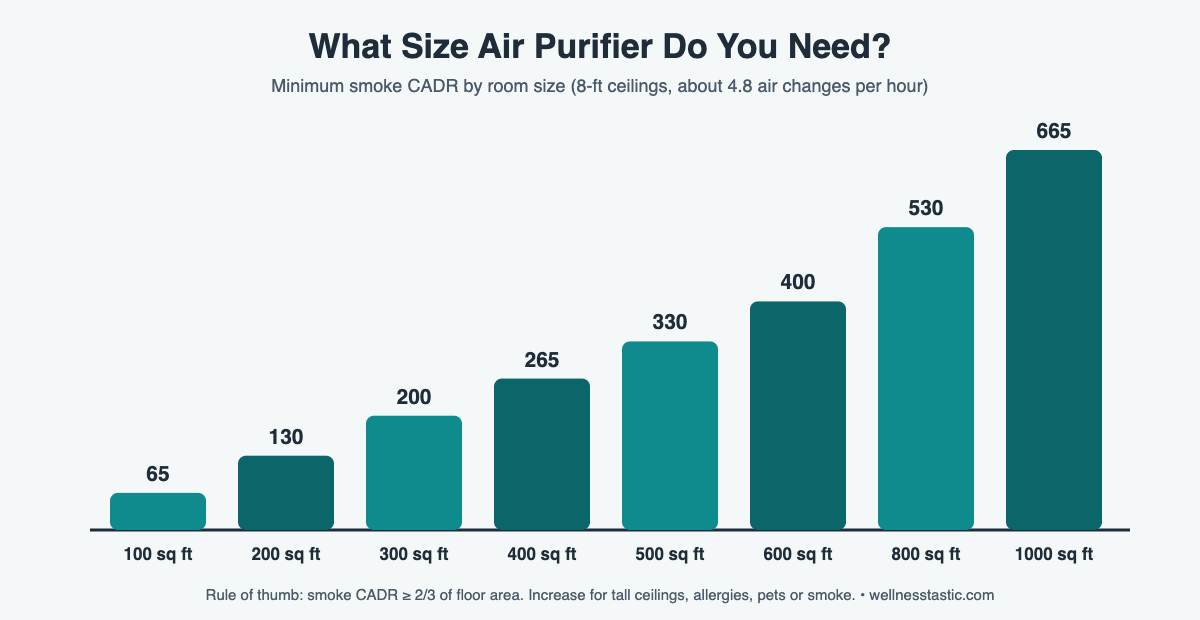
The Association of Home Appliance Manufacturers (AHAM) recommends a simple rule of thumb: an air purifier’s smoke CADR should be at least two-thirds of the room’s floor area in square feet, assuming 8-foot ceilings.
This rule delivers roughly 4.8 air changes per hour (ACH), meaning the purifier cleans the full volume of air in the room almost five times an hour. That is enough to remove most airborne particles efficiently in typical conditions.
| Room size | Minimum smoke CADR | Typical room |
|---|---|---|
| 100 sq ft | 65 CFM | Small nursery or office |
| 150 sq ft | 100 CFM | Small bedroom |
| 200 sq ft | 130 CFM | Average bedroom |
| 250 sq ft | 165 CFM | Large bedroom |
| 300 sq ft | 200 CFM | Primary bedroom or small living room |
| 400 sq ft | 265 CFM | Living room |
| 500 sq ft | 330 CFM | Large living room |
| 600 sq ft | 400 CFM | Family room or great room |
| 800 sq ft | 530 CFM | Open-plan living area |
| 1,000 sq ft | 665 CFM | Large open floor plan |
These minimums closely match the EPA’s own estimates for portable air cleaners. If you are between sizes, round up.
What Is CADR and Why Does It Matter?
CADR stands for Clean Air Delivery Rate. It measures how many cubic feet of filtered air a purifier delivers per minute (CFM), tested separately for three particle types:
- Smoke: the smallest particles and the hardest to remove, so the smoke CADR is usually the lowest number.
- Dust: medium-sized particles.
- Pollen: the largest particles, usually giving the highest CADR number.
Because smoke CADR is the most demanding, it is the best number to use for sizing. Learn more in our CADR rating guide.
How to Calculate the Right Size Yourself
If you want to do the math yourself, the formula is straightforward:
Required CADR (CFM) = Room area (sq ft) × Ceiling height (ft) × Air changes per hour ÷ 60
- Measure the room: multiply length by width to get square feet.
- Measure the ceiling height: most rooms are 8 feet, but many newer homes have 9- or 10-foot ceilings.
- Choose your target air changes per hour: 4.8 for general use, around 6 for allergies or pets, and 7 to 8 for smoke.
- Multiply and divide by 60 to convert from per hour to per minute.
Worked examples
| Room | Size | Ceiling | Use | Required smoke CADR |
|---|---|---|---|---|
| Bedroom | 12 × 14 ft (168 sq ft) | 8 ft | General (4.8 ACH) | About 108 CFM |
| Bedroom with allergies | 12 × 14 ft (168 sq ft) | 8 ft | Allergies (6 ACH) | About 135 CFM |
| Living room | 18 × 20 ft (360 sq ft) | 9 ft | General (4.8 ACH) | About 260 CFM |
| Great room | 20 × 24 ft (480 sq ft) | 12 ft | Smoke (7.5 ACH) | About 720 CFM |
As the last example shows, tall ceilings and smoke can push the requirement well beyond what one purifier delivers. In those cases, two purifiers are often the best solution.
Understanding Air Changes per Hour (ACH)
Air changes per hour describes how many times a purifier can filter the entire volume of air in a room in one hour. It is the key to understanding why some purifiers look powerful on paper but disappoint in real rooms.
| Air changes per hour | What it means | Good for |
|---|---|---|
| 1–2 ACH | The air is filtered once or twice an hour | Often used in marketing claims; too slow for most needs |
| 3–4 ACH | Moderate cleaning | Light everyday use in low-pollution homes |
| About 4.8 ACH | The AHAM two-thirds rule standard | General use in most homes |
| 5–6 ACH | Faster cleaning | Allergies, pets, bedrooms |
| 7+ ACH | Very fast cleaning | Smoke, wildfire events, very sensitive households |
Because air is constantly mixing and new particles keep entering, higher air change rates keep particle levels consistently lower. When comparing purifiers, look for coverage stated at 4 to 5 air changes per hour, or calculate it yourself from the smoke CADR.
How Ceiling Height Changes the Size You Need
The two-thirds rule assumes 8-foot ceilings. Taller ceilings hold more air, so you need more cleaning power:
| Ceiling height | Multiply the 8-ft CADR by | Example: 300 sq ft room |
|---|---|---|
| 8 ft | 1.0 | 200 CFM |
| 9 ft | About 1.13 | About 225 CFM |
| 10 ft | About 1.25 | About 250 CFM |
| 12 ft | About 1.5 | About 300 CFM |
| Vaulted (average 14 ft) | About 1.75 | About 350 CFM |
For vaulted ceilings, use the average height between the lowest and highest points.
What Size Air Purifier for Each Room?
Bedroom
Most bedrooms are between 120 and 250 square feet. Because you want the purifier running quietly all night, choose one rated for a bit more than your room. For a 200 sq ft bedroom, a purifier with around 150 to 250 CFM of smoke CADR can run on a low, quiet setting and still clean effectively. See our bedroom guide.
Living room
Living rooms are often 300 to 500 square feet and may connect to hallways or kitchens. Measure the full connected space. For a 400 sq ft living room, look for at least 265 CFM, and more if the room opens onto other areas.
Kitchen
Kitchens generate cooking particles in bursts. A range hood vented outdoors is the main solution; a purifier helps clear what escapes. Place a purifier near, but not right next to, the stove, and size it for the kitchen plus any open dining area.
Basement
Basements are often large and may have lower ceilings. Size for the area you actually use, and remember that basements often need a dehumidifier more than a purifier to control dampness and mold.
Home office
Home offices are usually small, but air can get stuffy during long work sessions. A compact purifier with 100 to 150 CFM is usually enough for particles; open a window or door to control CO2, which purifiers do not remove.
Nursery
Nurseries are typically small. A quiet, compact purifier sized for the room, placed safely out of reach, is ideal. Choose one with a dimmable or switch-off display.
Open floor plans
For open kitchens, dining and living spaces, add up the entire connected area. Many open plans of 700 square feet or more are best served by two purifiers. See our open floor plan guide.
When to Choose a Bigger Air Purifier
The two-thirds rule is a minimum. Choose a larger purifier when:
- Someone has allergies or asthma: more air changes help keep airborne allergens lower. See our allergy guide.
- You have pets: pets add dander and hair continuously. See our pet guide.
- You deal with smoke: wildfire and other smoke require faster particle removal. See our smoke guide.
- You want quiet operation: a larger purifier can clean on a low, quiet setting, while a smaller one must run on high.
- The room is open to other spaces: air from adjoining rooms flows in, so you effectively need to clean a larger area.
Can an Air Purifier Be Too Big?
Not in terms of air quality. A larger purifier simply cleans the air faster and can run at lower, quieter speeds. The downsides are practical: bigger purifiers cost more, take up more floor space and often have more expensive filters. For most people, choosing one size up from the minimum gives the best balance.
How to Decode Manufacturer Room Size Claims
Manufacturers often advertise room coverage based on just one or two air changes per hour, which makes purifiers look far more powerful than they are. To get a realistic number, use the CADR instead:
Realistic room size (sq ft) ≈ Smoke CADR × 1.5 (for 4.8 ACH and 8-foot ceilings)
| Advertised claim | Smoke CADR | Realistic room size (4.8 ACH) |
|---|---|---|
| “Up to 1,000 sq ft” | 150 CFM | About 225 sq ft |
| “Up to 1,560 sq ft” | 328 CFM | About 510 sq ft |
| “Up to 2,000 sq ft” | 400 CFM | About 625 sq ft |
If a product lists coverage “at 4.8 ACH” or “at 5 air changes per hour,” the number is realistic. If it does not say, assume it is optimistic.
Recommended Air Purifiers by Room Size
| Room size (8-ft ceiling) | Minimum smoke CADR | Our pick | Guide |
|---|---|---|---|
| Up to 220 sq ft | Up to 145 CFM | Levoit Core 300 (143 CFM, AHAM) | Small rooms |
| 220–390 sq ft | 145–250 CFM | Levoit Vital 200S (250 CFM, AHAM) | Bedrooms |
| 390–510 sq ft | 250–330 CFM | Coway Airmega 400S (328 CFM) | Large rooms |
| 510–635 sq ft | 330–410 CFM | Blueair Blue Pure 211i Max (410 CFM, AHAM) | Large rooms |
| 635–930 sq ft | 410–594 CFM | Medify MA-112 (594 CFM reported) | Open floor plans |
How Size Affects Noise and Energy Use
Size does not just affect how clean your air gets; it also affects how the purifier feels to live with:
- Noise: a purifier that is too small must run on its highest setting to keep up, which is usually the loudest. A properly sized or slightly larger purifier can run on low or medium, which is much quieter.
- Energy: larger purifiers use more power at top speed, but running on lower speeds most of the time often balances this out. Energy Star certified models are the most efficient.
- Filter life: larger filters can last longer in the same room because they load more slowly, although they may cost more to replace.
In practice, the quietest and most efficient setup is usually a purifier sized one step above the minimum, running on auto or low most of the day.
Air Purifier Sizing Checklist
Before you buy, run through this quick checklist:
- Measure the room length, width and ceiling height.
- Include any open, connected spaces in the area.
- Calculate the minimum smoke CADR with the two-thirds rule or our calculator.
- Increase the target for tall ceilings, allergies, pets or smoke.
- Compare products using smoke CADR, not advertised room size.
- Check noise levels at low and medium speeds.
- Check replacement filter prices and lifespan.
- Confirm the purifier fits the space with clearance around it.
Following these steps helps you avoid the most common mistake: buying a purifier that looks big enough on the box but cannot keep up in real life.
One Purifier or Several?
Portable air purifiers are designed for a single room or area. If you want cleaner air throughout your home, you have a few options:
- Start with the bedroom: it is where most people spend the most continuous time.
- Add a purifier to the main living area as a second step.
- Use two purifiers in large or L-shaped rooms for more even coverage.
- Upgrade your HVAC filter to MERV 13 if your system supports it, for whole-home filtration. See our MERV guide.
Common Sizing Mistakes
- Trusting the box: advertised room sizes often assume only one or two air changes per hour.
- Using pollen CADR instead of smoke CADR: pollen numbers are usually highest and can overstate performance.
- Ignoring ceiling height: a 10-foot ceiling needs about 25% more CADR.
- Forgetting open doorways: connected spaces effectively make the room larger.
- Buying the minimum for a bedroom: you will end up running it on a louder setting at night.
Frequently Asked Questions
What size air purifier do I need for a 12×12 room?
A 12 by 12 foot room is 144 square feet. With 8-foot ceilings, you need a smoke CADR of at least about 95 CFM. A compact purifier such as the Levoit Core 300 (143 CFM, AHAM verified) covers it comfortably.
What size air purifier do I need for 500 square feet?
For 500 square feet with 8-foot ceilings, look for a smoke CADR of at least about 330 CFM. For allergies or smoke, aim for 400 CFM or more.
Is it better to get a bigger air purifier?
Generally, yes, within reason. A purifier rated for a slightly larger room can clean faster and run more quietly. Just check that it fits your space and that replacement filters are affordable.
How many air changes per hour do I need?
About 4.8 air changes per hour, the level behind the AHAM two-thirds rule, is a good target for general use. Many people aim for 5 to 6 for allergies or pets, and higher for smoke.
Does ceiling height matter for air purifier size?
Yes. The standard sizing rule assumes 8-foot ceilings. Increase the CADR by about 13% for 9-foot ceilings, 25% for 10-foot ceilings and 50% for 12-foot ceilings.
What size air purifier do I need for a studio apartment?
Size the purifier for the whole open space. A studio of 400 to 550 square feet needs a smoke CADR of roughly 265 to 365 CFM. See our guide to air purifiers for small rooms and apartments.
The Bottom Line
To find what size air purifier you need, measure your room and choose a smoke CADR of at least two-thirds of the floor area, then adjust upward for tall ceilings, allergies, pets or smoke. Use our calculator for a quick answer, ignore inflated coverage claims, and when in doubt, size up so your purifier can run quietly while still keeping your air clean.
Sources
Calculator results are estimates for general guidance. Product CADR figures are based on AHAM Verifide data, manufacturer information or independent reviews, as labeled. See our How We Research page.