WellnessTastic is reader-supported. When you buy through links on this page, we may earn an affiliate commission at no extra cost to you. As an Amazon Associate, we earn from qualifying purchases. Learn more.
When you compare air purifiers, you will see two filter types mentioned again and again: HEPA and activated carbon. They are often sold together, which leads many people to assume they do the same job. They do not. Understanding HEPA vs activated carbon is the key to choosing a purifier that actually solves your problem, whether that is dust and pollen, smoke, pet odors or chemical smells.
In this guide, we explain how each filter works, what each one removes and cannot remove, why many air purifiers combine both, and how to judge the quality of a carbon filter. For more on particle filtration, see our HEPA air purifier guide.
Quick answer: HEPA filters capture particles such as dust, pollen, pet dander and smoke particles. Activated carbon filters capture some gases and odors, such as cooking smells, pet odors and some VOCs. HEPA does not remove odors, and carbon does not remove particles effectively, which is why the best air purifiers for odors and smoke combine both.
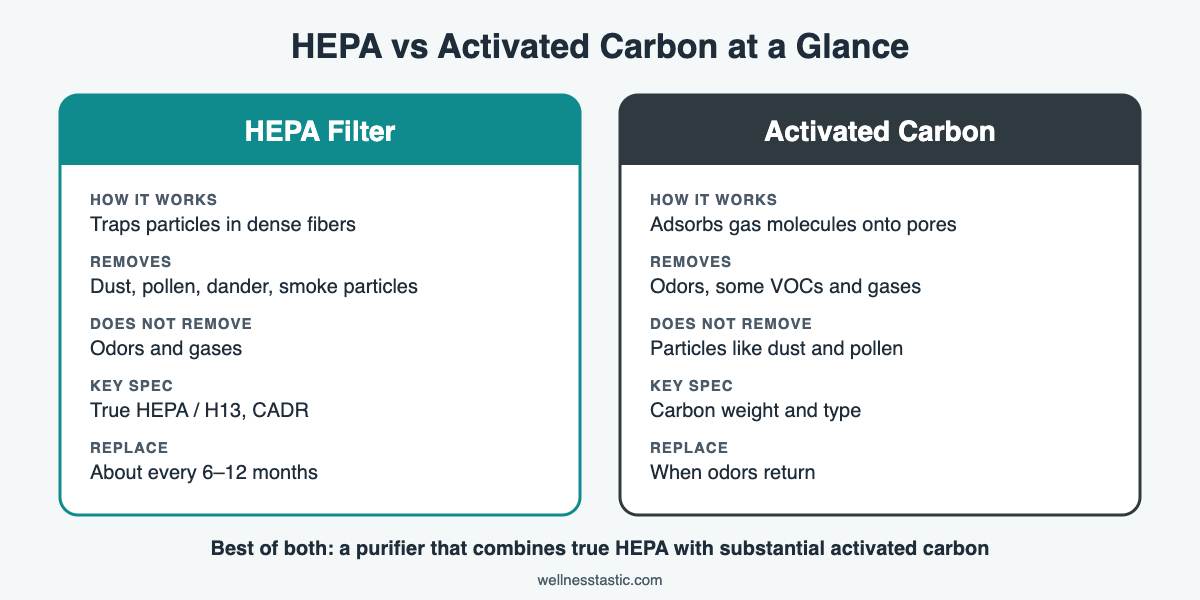
HEPA vs Activated Carbon at a Glance
| HEPA filter | Activated carbon filter | |
|---|---|---|
| What it is | A dense mat of fine fibers | Carbon treated to create a huge internal surface area |
| How it works | Traps particles as air passes through | Adsorbs gas molecules onto its surface |
| Removes | Dust, pollen, pet dander, mold spores, smoke particles | Odors, some VOCs and some gases |
| Does not remove | Odors, gases, VOCs | Particles such as dust and pollen |
| Key quality measure | True HEPA or H13 rating, plus the purifier’s CADR | Amount (weight) and type of carbon |
| Typical lifespan | About 6–12 months | Varies widely; ends when it saturates |
| Can it be washed? | Usually no | No; it cannot be restored at home |
How HEPA Filters Work
A HEPA filter is a pleated mechanical filter made of very fine fibers. As air passes through, particles are captured by impaction, interception and diffusion. A true HEPA filter is designed to capture at least 99.97% of particles 0.3 microns in size under standard test conditions, and captures larger and smaller particles even more efficiently.
HEPA filters are excellent for particles, but gases pass straight through them. Gas molecules are far too small to be trapped by fibers. That is why a HEPA-only purifier may clear the haze of smoke but leave the smell behind.
How Activated Carbon Filters Work
Activated carbon is carbon, often made from coconut shells, wood or coal, that has been treated to create a network of tiny pores. This gives it an enormous internal surface area, often hundreds or even more than a thousand square meters per gram.
Instead of trapping things like a sieve, activated carbon works by adsorption: gas molecules stick to the surface of the pores as air passes through. Once the surfaces are full, the carbon is saturated and stops working, and odors return.
What activated carbon is good at
- Cooking odors
- Pet and litter box odors
- Smoke odor
- Some volatile organic compounds (VOCs) from paints, cleaners and new furniture
- Musty smells in the air (though not the moisture problem causing them)
What activated carbon struggles with
- Formaldehyde and some very light gases: standard activated carbon is relatively weak against these; some purifiers use specially treated (impregnated) carbon to improve performance.
- Carbon monoxide and carbon dioxide: carbon filters do not remove these.
- Radon: not a solution for radon.
- Particles: carbon is not designed to capture fine particles.
Adsorption vs Absorption: A Simple Explanation
People often say carbon “absorbs” odors, but the correct word is adsorbs. The difference matters for understanding how carbon filters behave:
- Absorption is when a substance soaks into another, like water into a sponge.
- Adsorption is when molecules stick to a surface, like dust clinging to a charged balloon.
Activated carbon works by adsorption. Its huge internal surface gives gas molecules countless places to stick. Once those spots are occupied, the carbon cannot hold any more, which is why carbon filters eventually saturate and need replacing. More carbon means more surface, more capacity and longer life.
Why Carbon Quantity Matters So Much
Not all carbon filters are equal. The most important factor is how much carbon the filter contains, followed by how long air stays in contact with it.
| Carbon filter type | Typical amount | Best for |
|---|---|---|
| Carbon-coated fabric or foam | Very little (grams) | Light, occasional odors |
| Thin carbon layer bonded to a HEPA filter | Small to moderate | Everyday household odors |
| Granular or pelletized carbon bed | Several pounds | Stronger odors, smoke smell, VOCs |
| Large carbon bed | About 5–15 pounds or more | Heavy odors, chemical sensitivity, smoke |
A thin carbon-coated sheet can help with mild smells but may saturate within weeks under heavy use. A purifier with several pounds of granular carbon has far more capacity and lasts much longer. If odors or smoke are your main concern, check the carbon weight in the specifications.
Why Many Air Purifiers Combine HEPA and Carbon
Most homes deal with both particles and odors, so combining the two filters covers both. In a typical combination purifier, air flows through several stages:
- Pre-filter: catches hair and large dust.
- Activated carbon: adsorbs odors and some gases.
- HEPA filter: captures fine particles.
Some purifiers use separate carbon and HEPA filters, which you can replace independently. Others use a bonded “combination” filter, where both layers are replaced together. Separate filters can be more economical if your carbon saturates faster than your HEPA filter clogs, or vice versa.
Which Do You Need: HEPA, Carbon or Both?
| Your main concern | What you need | Why |
|---|---|---|
| Dust and allergies | HEPA (carbon optional) | Allergens are particles |
| Pollen | HEPA | Pollen is a particle |
| Pet dander and hair | HEPA plus pre-filter | Dander is a particle; pre-filter catches hair |
| Pet odors or litter box smell | HEPA plus meaningful carbon | Odors are gases |
| Wildfire smoke | High-CADR HEPA, plus carbon for smell | Smoke has both particles and gases |
| Cigarette smoke drifting in | HEPA plus substantial carbon | Both particles and odors |
| New furniture or paint smell | Substantial carbon, plus ventilation | VOCs are gases |
| Cooking odors | Carbon, plus a vented range hood | Odors are gases; hood removes them at the source |
For most households, a purifier that combines true HEPA with a reasonable amount of carbon is the best all-round choice. If odors or smoke are the main problem, prioritize carbon weight.
HEPA and Carbon for Specific Situations
Wildfire or neighbor smoke
Smoke contains both fine particles and odor-causing gases. Prioritize a high smoke CADR for particles, and choose a purifier with several pounds of carbon if the smell is strong. See our smoke guide.
Homes with pets
Pet dander is a particle, so HEPA matters most. Litter box and pet bedding odors are gases, so carbon helps. A washable pre-filter protects both by catching hair. See our pet guide.
New furniture, flooring or paint
New materials release VOCs, which are gases. Ventilation is the most important step, but a purifier with substantial carbon can help reduce lingering chemical smells. HEPA alone will not help with VOCs.
Kitchens and cooking
Cooking releases both fine particles and odors. A range hood vented outdoors is the best solution; a HEPA and carbon purifier nearby can help with what escapes.
Musty basements
A carbon filter can reduce musty smells in the air, and HEPA can capture airborne mold spores, but neither fixes the moisture causing the problem. Control humidity and fix leaks first. See our guide to indoor air pollution.
Chemical sensitivity
People who are sensitive to smells and chemicals often choose purifiers with very large carbon beds and no fragrances or ozone-producing features. Speak with a healthcare professional about specific sensitivities.
How to Read HEPA and Carbon Specifications
- Look for “True HEPA” or “H13/H14”: avoid “HEPA-type” and vague percentages.
- Check the CADR: it shows how well the whole purifier removes particles. See our CADR guide.
- Find the carbon weight: reputable brands list it in grams or pounds; if it is not listed, the carbon layer is often thin.
- Check the carbon form: granular or pelletized carbon generally outperforms carbon-coated fabric.
- Note any special treatment: some filters use impregnated carbon for specific gases such as formaldehyde.
- Look for CARB certification: it confirms the purifier meets ozone emission limits.
Recommended Air Purifiers With HEPA and Carbon
These combination-filter purifiers range from everyday odor control to heavy-duty carbon. Specifications are based on verified or clearly labeled data; we have not yet completed our own hands-on testing of every model. See our How We Research page.
| Air purifier | Carbon | Particle filtration | Best for |
|---|---|---|---|
| Austin Air HealthMate | About 15 lb carbon and zeolite | True HEPA | Heavy odors, chemical smells |
| IQAir HealthPro Plus | About 5 lb (V5-Cell) | HyperHEPA, CADR 260 | Smoke and odors with premium filtration |
| Coway Airmega 400S | Carbon in two filter sets | HEPA, CADR 328 (mfr) | Large rooms, everyday odors |
| Levoit Vital 200S | Activated carbon layer | HEPA-grade, CADR 250 (AHAM) | Everyday odors in bedrooms and living rooms |
| Blueair Blue Pure 211i Max | Light carbon layer | HEPASilent, CADR 410 (AHAM) | Particles first, light odors |
For more detail, see our guides to the best air purifiers for smoke and best air purifiers for pets.
How to Tell When Each Filter Needs Replacing
HEPA filter
- The filter indicator comes on.
- Airflow drops or the purifier gets louder at the same speed.
- The filter looks dark grey and heavily loaded.
- Particle levels on an air quality monitor fall more slowly than before.
Activated carbon filter
- Odors return soon after the purifier has been running.
- The purifier no longer reduces cooking or pet smells as it used to.
- You have had a heavy smoke event, which can saturate carbon quickly.
Carbon usually cannot be seen to be “full,” so the smell test is often the best guide. Do not try to wash or bake carbon filters at home; follow the manufacturer’s replacement schedule.
Filter Replacement Costs: HEPA vs Carbon
| HEPA filter | Carbon filter | |
|---|---|---|
| Typical replacement | Every 6–12 months | When odors return; varies from weeks to over a year |
| What shortens its life | Heavy dust, pets, smoke particles | Strong odors, smoke, VOCs |
| Cost factors | Filter size and grade | Amount and type of carbon |
| Money-saving tip | Clean the pre-filter regularly | Remove odor sources and ventilate |
If you buy a purifier with separate HEPA and carbon filters, you can replace each one only when needed. Bonded combination filters are convenient but mean replacing both layers at once, even if only one is worn out.
HEPA vs Carbon vs Other Technologies
| Technology | Particles | Gases/odors | Byproducts | Verdict |
|---|---|---|---|---|
| True HEPA | Excellent | No | None | Best for particles |
| Activated carbon | No | Good (depends on amount) | None | Best for odors |
| Ionizers | Some | No | Possible ozone | Use with caution |
| UV-C | No | No | Possible ozone with some lamps | Limited benefit |
| Ozone generators | No | Masks odors | Ozone | Avoid |
The EPA advises against using ozone generators, and ozone can react with other chemicals indoors to create additional pollutants. For most homes, HEPA plus carbon offers the best combination of proven performance and safety.
Tips for Better Odor Control
- Remove the source first: clean litter boxes daily, wash pet bedding and take out trash regularly.
- Ventilate: use a range hood vented outdoors and open windows when outdoor air is good.
- Choose enough carbon: thin carbon layers saturate quickly.
- Run the purifier continuously so air keeps passing through the carbon.
- Replace carbon on time, especially after smoke events.
- Avoid masking odors with air fresheners, which add more chemicals to the air.
Our guide on how to improve indoor air quality covers more source-control steps.
Common Misconceptions
- “HEPA removes smells”: it does not; smells are gases.
- “Any carbon filter works for smoke odor”: thin carbon layers are quickly overwhelmed.
- “Carbon filters last as long as HEPA filters”: carbon often saturates sooner, especially with strong odors.
- “Carbon removes all VOCs”: it reduces some, but performance varies by chemical and carbon type.
- “More filter stages always means better”: quality and quantity matter more than the number of stages.
Frequently Asked Questions
Is HEPA or activated carbon better?
Neither is better overall; they do different jobs. HEPA is better for particles such as dust, pollen and dander, while activated carbon is better for odors and some gases. For most homes, a purifier with both is ideal.
Does a HEPA filter remove odors?
No. HEPA filters capture particles but not gases. To reduce odors, you need activated carbon.
Do I need activated carbon for allergies?
Not necessarily. Allergens are particles, so HEPA filtration matters most. Carbon is useful if odors or fragrances also bother you.
How long does an activated carbon filter last?
It varies widely depending on how much carbon it contains and how strong the odors are. Thin carbon layers may last weeks to a few months under heavy use; large carbon beds can last much longer. Replace it when odors return.
Can activated carbon remove smoke?
Carbon can reduce smoke odor and some smoke gases, but smoke particles need HEPA filtration. The best purifiers for smoke combine a high-CADR HEPA filter with a substantial carbon filter.
Can I add a carbon filter to a HEPA-only purifier?
Some purifiers offer optional carbon filters or wraps designed for that model, which is the safest way to add odor control. Avoid improvising with third-party carbon sheets that may block airflow or fit poorly, since that can reduce the purifier’s particle performance. If odors are a major concern, it is usually better to choose a purifier designed with a substantial carbon stage from the start.
Which filter comes first in an air purifier, carbon or HEPA?
It varies by design. Many purifiers place the pre-filter first, then carbon, then HEPA, so the carbon handles odors before the air reaches the fine particle filter. Others place HEPA before carbon. Both approaches can work well; the amount of carbon and the quality of the HEPA filter matter more than the order.
The Bottom Line
HEPA and activated carbon are partners, not competitors. HEPA captures particles such as dust, pollen, dander and smoke particles, while activated carbon adsorbs odors and some gases. Choose HEPA for particles, carbon for smells, and a purifier that combines both, with enough carbon for your needs, if you want cleaner and fresher air at home.
Sources
- U.S. EPA: Guide to Air Cleaners in the Home
- U.S. EPA: What Is a MERV Rating? (HEPA filter note)
- California Air Resources Board: Air Cleaners and Ozone
This article is for general information only. Product specifications are based on AHAM Verifide data, manufacturer information or independent reviews, as labeled. See our Affiliate Disclosure.