
WellnessTastic is reader-supported. When you buy through links on this page, we may earn an affiliate commission at no extra cost to you. As an Amazon Associate, we earn from qualifying purchases. Learn more.
If you dust your shelves on Sunday and they look grey again by Wednesday, you are not alone. Household dust is constantly being created, stirred up and redistributed. The best air purifier for dust can capture fine particles while they are still floating in the air, before they settle on surfaces or end up in your lungs. But an air purifier is only one part of the solution, and choosing the right one depends on a few key numbers.
In this guide, we explain what household dust actually is, what an air purifier can and cannot do about it, which features matter most, and which models offer the strongest verified dust performance. For a broader overview, see our guide to the best air purifiers for home.
Quick picks: The Levoit Vital 200S is our best overall air purifier for dust, with an AHAM-verified dust CADR of 254 CFM and a washable pre-filter. For large rooms, the Blueair Blue Pure 211i Max delivers an AHAM-verified 410 CFM. For small rooms on a budget, choose the Levoit Core 300 (153 CFM dust, AHAM verified). The Coway Airmega 400S and Rabbit Air A3 are strong premium options.
What Is Household Dust?
Household dust is not one thing. It is a mixture of particles from inside and outside your home, including:
- Fibers from clothing, bedding, carpets and upholstery
- Skin flakes shed by people and pets
- Soil and street dust tracked in on shoes or blown in through windows
- Pollen and mold spores from outdoors
- Dust mite debris and pet dander
- Fine particles from cooking, candles and outdoor pollution
These particles range from large, visible bits that settle within seconds to very fine particles that can stay airborne for hours. That difference matters a lot for air purifiers.
What an Air Purifier Can (and Cannot) Do About Dust
An air purifier can only capture particles that pass through its filter, which means it works on airborne dust. Here is what that means in practice:
| Type of dust | Can an air purifier help? | Better solution |
|---|---|---|
| Fine airborne dust (PM2.5) | Yes, very effectively with HEPA | Air purifier plus HVAC filter |
| Medium airborne particles (PM10) | Yes, while they are airborne | Air purifier plus regular cleaning |
| Large visible dust on surfaces | No, it has already settled | Damp dusting and HEPA vacuuming |
| Dust in carpets and upholstery | Only when stirred up | HEPA vacuum, washing fabrics |
| Dust mites in bedding | Limited; mites live in fabrics | Hot washing, humidity control, covers |
In other words, an air purifier reduces the amount of dust in the air and slows how quickly surfaces get dusty, but it will not replace cleaning. The best results come from combining a purifier with good cleaning habits and a quality HVAC filter.
What to Look for in the Best Air Purifier for Dust
1. A strong dust CADR
Every AHAM-rated air purifier has three CADR numbers: smoke, dust and pollen. For dust problems, the dust CADR is the most relevant. Choose a dust CADR of at least two-thirds of your room’s floor area in square feet, and more if dust is a big problem. Our CADR guide explains the numbers.
2. True HEPA or verified HEPA-grade filtration
A true HEPA filter is designed to capture at least 99.97% of particles at 0.3 microns, the hardest size to catch, and captures larger dust particles even more easily. Avoid vague “HEPA-type” filters. See our HEPA guide.
3. A washable pre-filter
A good pre-filter catches hair, lint and large dust before they reach the main filter. In dusty homes, a washable or vacuumable pre-filter can significantly extend the life of your more expensive HEPA filter.
4. The right size for your room
Dust keeps getting stirred up as you walk, sit and clean, so your purifier needs enough airflow to keep up. When in doubt, choose a model rated for a slightly larger room.
5. Affordable replacement filters
Dusty homes load filters faster. Check the price and lifespan of replacement filters before you buy.
6. An air quality sensor and auto mode
Sensors can detect rising particle levels when you vacuum, make the bed or open a door, and turn the fan up automatically. This is useful but optional.
The Best Air Purifiers for Dust
We chose these models using AHAM Verifide dust CADR ratings where available, clearly labeled manufacturer data and results from established independent testers. We have not yet completed our own hands-on testing of every model. Learn more on our How We Research page.
1. Levoit Vital 200S: Best Overall Air Purifier for Dust
The Levoit Vital 200S has an AHAM-verified dust CADR of 254 CFM, along with 250 CFM for smoke and 289 CFM for pollen. That covers rooms of about 390 square feet at 4.8 air changes per hour. Its washable pre-filter is especially useful in dusty homes because it catches lint and larger particles before they clog the main filter. Smart models add an air quality sensor, auto mode and app control.
| Spec | Details |
|---|---|
| Dust CADR | 254 CFM (AHAM verified) |
| Room size at 4.8 ACH | About 390 sq ft |
| Pre-filter | Washable |
| Main filter | HEPA-grade with activated carbon |
| Smart features | Sensor, auto mode, app (smart models) |
Why it works for dust:
- Strong verified dust CADR for the price
- Washable pre-filter extends filter life
- Quiet at lower speeds
Things to consider:
- Particle and carbon layers are replaced together
- Not large enough for very big open spaces
Best for: bedrooms, living rooms and home offices up to about 390 square feet.
2. Blueair Blue Pure 211i Max: Best for Large Dusty Rooms
For larger rooms, the Blueair Blue Pure 211i Max offers an AHAM-verified CADR of 410 CFM for dust, smoke and pollen, covering 635 square feet at 4.8 air changes per hour. Its fabric pre-filter wraps around the outside and can be washed or vacuumed, which helps in homes with a lot of lint and pet hair. It uses Blueair’s HEPASilent technology, combining electrostatic charging with mechanical filtration.
| Spec | Details |
|---|---|
| Dust CADR | 410 CFM (AHAM verified) |
| Room size at 4.8 ACH | 635 sq ft |
| Pre-filter | Washable fabric wrap |
| Noise | 23–53 dB (manufacturer) |
| Power | About 46 W |
Why it works for dust:
- Very high verified dust CADR
- Easy-to-clean fabric pre-filter
- Energy-efficient
Things to consider:
- Uses electrostatic HEPASilent technology
- Replacement filters are not the cheapest
Best for: large living rooms, family rooms and open spaces up to about 635 square feet.
3. Levoit Core 300: Best Budget Air Purifier for Dust
The Levoit Core 300 is a small, affordable purifier with AHAM-verified CADR ratings of 153 CFM for dust, 143 CFM for smoke and 167 CFM for pollen. It suits rooms up to about 222 square feet and is light enough to move between rooms, for example from the home office during the day to the bedroom at night.
| Spec | Details |
|---|---|
| Dust CADR | 153 CFM (AHAM verified) |
| Room size at 4.8 ACH | About 222 sq ft |
| Filtration | Pre-filter, HEPA filter, activated carbon |
| Weight | About 7.9 lb |
Why it works for dust:
- Affordable with verified performance
- Compact and portable
- Inexpensive replacement filters
Things to consider:
- Only for small rooms
- No sensor or auto mode on the base model
Best for: small bedrooms, offices and nurseries.
4. Coway Airmega 400S: Best Smart Pick With Dual Filters
The Coway Airmega 400S pulls air from two sides through two filter sets, each with activated carbon and HEPA, giving it a large total filter area that handles heavy dust loads well. Coway rates it at 328 CFM for dust and smoke. It includes washable pre-filters, app control and auto mode.
| Spec | Details |
|---|---|
| Dust CADR | 328 CFM (manufacturer) |
| Room size at 4.8 ACH | About 510 sq ft |
| Filtration | Two carbon + HEPA filter sets, washable pre-filters |
| Noise | 22–52 dB (manufacturer) |
Why it works for dust:
- Large filter area for dusty homes
- Washable pre-filters
- Smart scheduling and auto mode
Things to consider:
- Premium price and filter costs
- Large footprint
Best for: large living rooms and busy households with pets and kids.
5. Rabbit Air A3: Best Premium Quiet Pick
The Rabbit Air A3 has a CADR of 370 CFM, covering about 578 square feet at 4.8 air changes per hour, with a multi-stage filter including a pre-filter, activated carbon and HEPA. It is Energy Star certified, can be wall-mounted and is known for quiet operation.
| Spec | Details |
|---|---|
| CADR | 370 CFM |
| Room size at 4.8 ACH | About 578 sq ft |
| Filtration | Multi-stage including pre-filter and HEPA |
| Noise | About 30–55 dB |
Why it works for dust:
- Strong airflow with low noise
- Wall-mountable
Things to consider:
- Expensive
- Costly filter kits
Best for: larger rooms where low noise and design matter.
Best Air Purifier for Dust: CADR Comparison
| Model | Dust CADR | Room size (4.8 ACH) | Washable pre-filter | Best for |
|---|---|---|---|---|
| Blueair 211i Max | 410 (AHAM) | 635 sq ft | ✓ | Large rooms |
| Rabbit Air A3 | 370 | ~578 sq ft | ✓ | Quiet premium |
| Coway Airmega 400S | 328 (mfr) | ~510 sq ft | ✓ | Smart, dual filters |
| Levoit Vital 200S | 254 (AHAM) | ~390 sq ft | ✓ | Best overall |
| Levoit Core 300 | 153 (AHAM) | ~222 sq ft | — | Small rooms, budget |
Why Your Home Gets Dusty So Fast
If dust returns quickly even with a purifier running, one or more of these is usually the cause:
- Dust is being tracked in: shoes, pets and open windows bring in soil and outdoor particles.
- Fabrics are shedding: new carpets, rugs, towels and bedding release lots of fibers.
- Your HVAC filter is low quality or overdue: the system may be recirculating dust through the whole house.
- Leaky ducts or gaps: unsealed ducts in attics or crawl spaces can pull in dust.
- Dry air: low humidity can make dust and static cling more noticeable.
- Cleaning stirs dust up: dry dusting and non-HEPA vacuums send fine dust back into the air.
How to Reduce Dust at Home: A Complete Plan
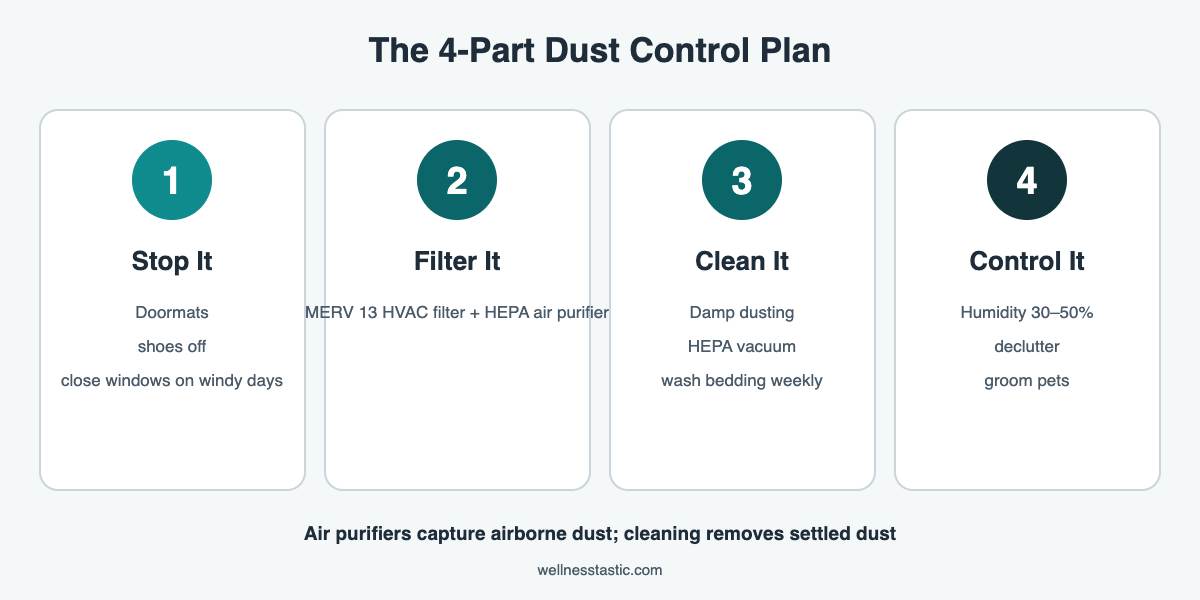
An air purifier works best as part of a complete approach. Combine it with these habits:
- Stop dust at the door: use doormats inside and outside, and take shoes off indoors.
- Upgrade your HVAC filter: use a MERV 13 filter if your system supports it, and change it on schedule. See our MERV guide.
- Dust with damp or microfiber cloths: they trap dust instead of spreading it.
- Vacuum with a HEPA vacuum at least weekly, especially carpets and upholstery.
- Wash bedding weekly in hot water to reduce dust mites and fibers.
- Declutter: fewer surfaces mean less dust to collect.
- Keep humidity between about 30% and 50%: this helps control dust mites.
- Groom pets regularly and wash their bedding.
- Run the purifier during and after cleaning, when dust is stirred into the air.
For more ideas, see our guide on how to improve indoor air quality.
Best Air Purifier for Dust by Situation
Homes near dirt roads, farms or construction
Outdoor dust is the main source here. Keep windows closed on windy days, use good doormats, upgrade your HVAC filter and run a purifier with a strong dust CADR in the main living area. The Blueair Blue Pure 211i Max handles large rooms well.
Renovation dust
Drywall sanding, cutting and demolition create very large amounts of fine dust that can overwhelm consumer purifiers and clog filters quickly. Seal off the work area with plastic sheeting, use tools with dust extraction, ventilate, and run a purifier in adjacent rooms rather than directly in the construction zone. Replace filters after the project. In older homes, test for lead paint before sanding.
Homes with pets
Pets add hair, dander and tracked-in dirt. A washable pre-filter is essential to catch hair before it clogs the main filter. The Levoit Vital 200S, with its pet mode on smart models, is a good fit. See our guide to air purifiers for pets.
Bedrooms
Bedding sheds fibers and hosts dust mites, so bedrooms often feel dusty. Run a quiet purifier overnight, wash bedding weekly in hot water, and vacuum under the bed. See our bedroom guide.
Home offices and craft rooms
Paper, printers, fabrics and craft supplies add fine dust. Place a compact purifier such as the Levoit Core 300 near your desk or work table and run it while you work.
Allergy-prone households
Dust can contain allergens such as pollen, pet dander and dust mite debris. A HEPA purifier helps with airborne allergens, especially in bedrooms. For medical advice, speak with a healthcare professional. See our guide to air purifiers for allergies.
Air Purifier vs HVAC Filter for Dust
If your home has central heating or air conditioning, your HVAC filter is your first line of defense against whole-house dust. Here is how the two compare:
| HVAC filter | Portable air purifier | |
|---|---|---|
| Coverage | Whole house, when the fan runs | One room or area |
| When it works | Only while the system fan is on | Continuously, as long as it runs |
| Best filter | MERV 13 if your system supports it | True HEPA or verified HEPA-grade |
| Cost | Low, filters every 1–3 months | Higher upfront, filters every 6–12 months |
| Best use | Reducing dust throughout the home | Keeping dust low where you spend the most time |
For dusty homes, using both is the most effective approach: a better HVAC filter to reduce dust throughout the house, and a portable purifier for the bedroom or main living area. Some people also set their HVAC fan to run more often, which helps the filter capture more dust, though it uses more electricity.
Where to Place an Air Purifier for Dust
- Place it in the room where you spend the most time, often the bedroom or living room.
- Leave at least a foot or two of space on all intake sides.
- Keep it off thick carpets if possible, or place it on a firm surface, so the intake is not blocked.
- In dusty areas such as home offices with lots of paper or craft rooms, put it near the activity.
- Avoid corners, behind furniture and under shelves.
How to Run an Air Purifier for Dust
- Run it continuously on low or auto, since dust is constantly being released.
- Turn it up while cleaning and for an hour afterward to capture dust you stir up.
- Clean the pre-filter every two to four weeks in dusty homes.
- Replace the main filter on schedule, or sooner if airflow drops.
- Check results with a monitor: an air quality monitor with PM2.5 and PM10 readings shows how much airborne dust is being removed.
Common Mistakes
- Expecting a purifier to remove settled dust: it only captures airborne particles.
- Choosing by smoke CADR only: check the dust CADR for dust problems.
- Skipping pre-filter cleaning: a clogged pre-filter reduces airflow.
- Buying too small: an undersized purifier cannot keep up in dusty rooms.
- Dry dusting with a feather duster: it spreads dust back into the air.
Frequently Asked Questions
What is the best air purifier for dust?
For most rooms up to about 390 square feet, the Levoit Vital 200S is our top pick thanks to its AHAM-verified dust CADR of 254 CFM and washable pre-filter. For larger rooms, the Blueair Blue Pure 211i Max offers an AHAM-verified 410 CFM.
Do air purifiers really help with dust?
Yes, HEPA air purifiers capture airborne dust particles and can reduce how quickly surfaces get dusty. They cannot remove dust that has already settled, so regular cleaning is still needed.
Will an air purifier reduce dusting?
Many people notice less dust buildup when a properly sized purifier runs continuously, especially combined with a better HVAC filter and a HEPA vacuum. You will still need to clean, just less often.
Can an air purifier help with dust mites?
Only to a limited extent. Dust mites live in bedding, mattresses and upholstery, and their allergens settle quickly. Washing bedding in hot water, using allergen-proof covers and keeping humidity below about 50% are more effective. A purifier helps with allergen particles that become airborne.
Should I run an air purifier for dust all day?
Yes. Dust is continuously released by people, pets and fabrics, so running your purifier on low or auto all day keeps airborne dust consistently lower.
How often should I replace the filter in a dusty home?
Dusty homes load filters faster than average. Clean or vacuum the pre-filter every two to four weeks, and expect to replace the main HEPA filter toward the shorter end of the manufacturer’s range, often every six to nine months. Signs that it is time include reduced airflow, more noise at the same speed and dust building up faster than usual.
Is a HEPA vacuum as important as an air purifier for dust?
They work together. A HEPA vacuum removes dust from floors, carpets and upholstery without blowing fine particles back into the air, while an air purifier captures dust that is already airborne. Using both gives much better results than either alone.
The Bottom Line
The best air purifier for dust has a strong dust CADR, true HEPA or verified HEPA-grade filtration and a washable pre-filter. The Levoit Vital 200S is our best overall pick, the Blueair Blue Pure 211i Max is ideal for large rooms, and the Levoit Core 300 is great for small rooms on a budget. For the cleanest home, combine your purifier with a good HVAC filter, a HEPA vacuum and simple dust-control habits.
Sources
- U.S. EPA: Guide to Air Cleaners in the Home
- AHAM Verifide: Air Cleaner Certification Program
- U.S. EPA: What Is a MERV Rating?
Specifications are based on AHAM Verifide data, manufacturer information or independent testing at the time of writing, as labeled. Features and availability can change. See our Affiliate Disclosure.