
If you have shopped for an air purifier, you have probably seen a small label with three numbers on it: smoke, dust and pollen. That is the CADR rating, and it is the single most useful number for comparing air purifiers. Yet many buyers skip it and rely on vague room-size claims instead.
In this guide, we explain what a CADR rating is, how it is tested, what the three numbers mean, how to use CADR to choose the right size purifier, and the limits you should know about. Once you understand CADR, you can compare purifiers on facts rather than marketing. If you want a quick answer for your room, try our air purifier size calculator.
Quick answer: CADR (Clean Air Delivery Rate) measures how many cubic feet of filtered air an air purifier delivers per minute (CFM) for three particle types: smoke, dust and pollen. Higher is better. For most rooms, choose a purifier whose smoke CADR is at least two-thirds of the room’s floor area in square feet.
What Is a CADR Rating?
CADR stands for Clean Air Delivery Rate. It is a standardized measurement, developed by the Association of Home Appliance Manufacturers (AHAM), that tells you how much clean air a portable air purifier delivers on its highest speed setting.
It is expressed in cubic feet per minute (CFM). A purifier with a smoke CADR of 200 delivers the equivalent of 200 cubic feet of smoke-free air every minute. The EPA’s guide to air cleaners recommends using CADR to compare portable air cleaners and choose one that fits your room.
In simple terms, CADR combines two things:
- Airflow: how much air the purifier moves through its filter.
- Filter efficiency: how well the filter removes particles from that air in a single pass.
A purifier with a powerful fan but a poor filter will have a low CADR, and so will a purifier with an excellent filter but weak airflow. CADR rewards purifiers that do both well.
The Three CADR Numbers: Smoke, Dust and Pollen
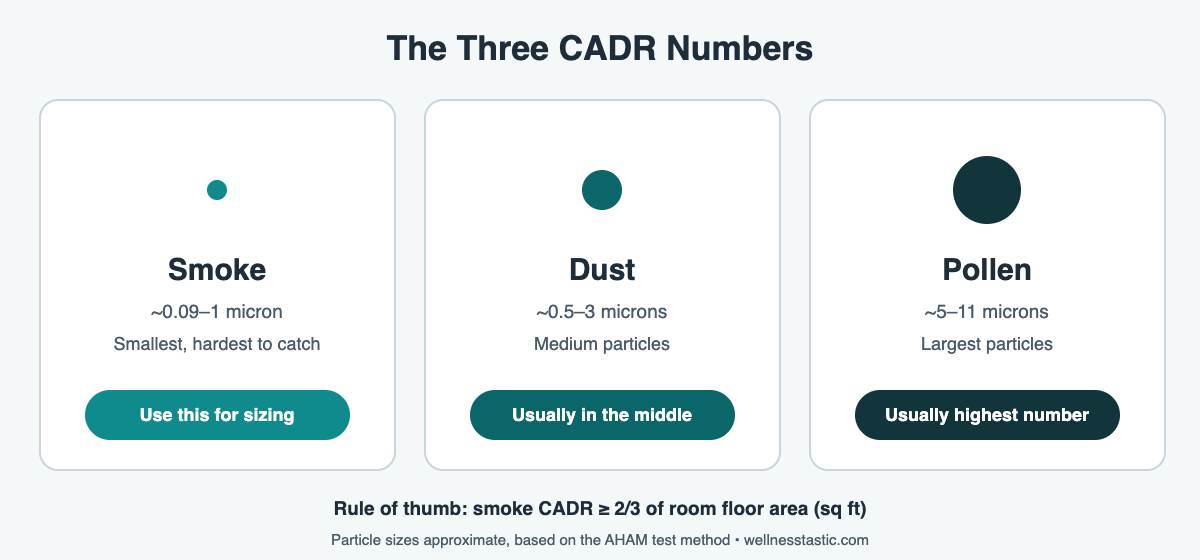
Each CADR rating includes three separate numbers, because particles of different sizes behave differently:
| CADR type | Particle size (approximate) | What it tells you | Typical number |
|---|---|---|---|
| Smoke | Very fine, about 0.09 to 1 micron | How well the purifier removes the smallest particles, such as smoke and fine combustion particles | Usually the lowest of the three |
| Dust | Medium, about 0.5 to 3 microns | How well it removes household dust and similar particles | Usually in the middle |
| Pollen | Larger, about 5 to 11 microns | How well it removes larger particles such as pollen | Usually the highest |
Because smoke particles are the hardest to capture, the smoke CADR is the best single number for comparing purifiers and sizing them for a room. A purifier that performs well on smoke will generally perform well on larger particles too.
How CADR Is Tested
CADR is measured under the ANSI/AHAM AC-1 standard. In simplified terms, the test works like this:
- A sealed test chamber of about 1,008 cubic feet is filled with a known concentration of test particles: tobacco smoke, fine test dust or paper mulberry pollen.
- The particle levels are measured as they naturally decline without a purifier.
- The purifier is switched on at its highest setting, and particle levels are measured again.
- The difference between the two rates of decline is used to calculate the CADR for each particle type.
Purifiers that have been independently tested and certified through the AHAM Verifide program display a CADR label, and you can look up certified models on the AHAM Verifide website.
The limits of the standard test
The AHAM test has practical upper limits, roughly 450 CFM for smoke and pollen and 400 CFM for dust, because of how the chamber test works. That is why you will sometimes see very high numbers from manufacturers that are measured with other methods or are simply estimates. When a number is above these limits, it cannot be an AHAM-certified value, so treat it with more caution and look for independent test results.
How to Read a CADR Label
An AHAM Verifide CADR label typically shows three numbers and a suggested room size. Here is how to read one, using an example purifier:
| Label item | Example value | What it means |
|---|---|---|
| Tobacco smoke CADR | 250 | Delivers 250 CFM of air cleaned of smoke-sized particles |
| Dust CADR | 254 | Delivers 254 CFM of air cleaned of dust-sized particles |
| Pollen CADR | 289 | Delivers 289 CFM of air cleaned of pollen-sized particles |
| Suggested room size | About 390 sq ft | Largest room size for about 4.8 air changes per hour with 8-foot ceilings |
When comparing two purifiers, start with the tobacco smoke CADR. If they are close, look at the other two numbers, then compare noise, filter costs and features.
How to Use CADR to Choose the Right Size Air Purifier
The easiest method is the AHAM two-thirds rule: the smoke CADR should be at least two-thirds of the room’s floor area in square feet, assuming 8-foot ceilings.
| Room size | Minimum smoke CADR |
|---|---|
| 100 sq ft | 65 CFM |
| 200 sq ft | 130 CFM |
| 300 sq ft | 200 CFM |
| 400 sq ft | 265 CFM |
| 500 sq ft | 330 CFM |
| 600 sq ft | 400 CFM |
You can also flip the formula around to estimate the realistic room size for any purifier:
Realistic room size (sq ft) ≈ Smoke CADR × 1.5 (for about 4.8 air changes per hour and 8-foot ceilings)
For example, a purifier with a smoke CADR of 250 is suitable for rooms up to about 375 to 390 square feet. For taller ceilings, allergies, pets or smoke, choose a higher CADR. Our what size air purifier guide explains how to adjust for each situation.
CADR and Air Changes per Hour
CADR is directly linked to air changes per hour (ACH), which describes how many times the purifier can clean the full volume of air in a room each hour:
ACH = CADR × 60 ÷ room volume (sq ft × ceiling height)
| Purifier smoke CADR | Room | Air changes per hour |
|---|---|---|
| 150 CFM | 200 sq ft, 8-ft ceiling | About 5.6 ACH |
| 250 CFM | 300 sq ft, 8-ft ceiling | About 6.3 ACH |
| 250 CFM | 500 sq ft, 8-ft ceiling | About 3.8 ACH |
| 400 CFM | 500 sq ft, 10-ft ceiling | About 4.8 ACH |
As a general guide, about 4 to 5 air changes per hour works well for everyday use, while allergy-prone households and smoke events benefit from more.
Why CADR Matters More Than Advertised Room Size
Many manufacturers advertise how large a room their purifier “covers.” The problem is that these claims are often based on just one or two air changes per hour, which is much slower than most people need.
| Advertised coverage | Smoke CADR | Realistic coverage at 4.8 ACH |
|---|---|---|
| “Up to 1,000 sq ft” | 150 CFM | About 225 sq ft |
| “Up to 1,560 sq ft” | 328 CFM | About 510 sq ft |
| “Up to 2,000 sq ft” | 400 CFM | About 625 sq ft |
Always compare purifiers using the smoke CADR, or check that the advertised room size is stated at 4 to 5 air changes per hour.
Worked Example: Comparing Two Purifiers With CADR
Imagine you are choosing a purifier for a 350 sq ft living room with 9-foot ceilings, and you are deciding between two models. Purifier A advertises “covers up to 1,200 sq ft” and has a smoke CADR of 200. Purifier B advertises “covers up to 600 sq ft” and has a smoke CADR of 300.
- Find your minimum CADR: two-thirds of 350 sq ft is about 233 CFM for 8-foot ceilings. For 9-foot ceilings, multiply by about 1.13, which gives roughly 265 CFM.
- Compare the smoke CADR, not the claims: Purifier A (200 CFM) falls short, despite its bigger advertised coverage. Purifier B (300 CFM) meets the target.
- Check the other factors: compare noise at medium speed, filter prices and whether each model has the carbon and features you need.
- Choose: Purifier B is the better fit, and it can run a little below full speed, which keeps noise down.
This simple process takes a couple of minutes and prevents the most common mistake: trusting an advertised room size that assumes far fewer air changes per hour than you actually need.
CADR in Other Units: m³/h
Outside the United States, CADR is often given in cubic meters per hour (m³/h). To compare with US ratings:
- 1 CFM ≈ 1.7 m³/h
- 1 m³/h ≈ 0.59 CFM
For example, a purifier rated at 400 m³/h delivers about 235 CFM. Be aware that different countries use different test standards, so international numbers are not always directly comparable with AHAM ratings.
CADR vs Airflow: An Important Difference
Some manufacturers list airflow in CFM instead of, or alongside, CADR. These are not the same thing:
- Airflow is how much air the fan moves through the unit.
- CADR is how much of that air is actually cleaned of particles.
If a filter only captures part of the particles on each pass, the CADR will be lower than the airflow. A purifier that lists a large airflow figure but no CADR may be much less effective than it appears. Always look for CADR, ideally AHAM Verifide, rather than raw airflow.
CADR vs Other Air Quality Ratings
CADR is not the only rating you will see. Here is how it compares with other common terms:
| Rating | What it measures | Where it applies |
|---|---|---|
| CADR | Clean air delivered per minute for smoke, dust and pollen | Portable air purifiers |
| HEPA | A filter efficiency standard: at least 99.97% of 0.3-micron particles | Filters inside purifiers and vacuums |
| MERV | Filter efficiency rating from 1 to 16 | HVAC and furnace filters |
| ACH | How many times room air is cleaned per hour | Depends on CADR and room size |
| Airflow (CFM) | Total air moved by the fan, whether cleaned or not | Fans and purifiers |
| Energy Star | Energy efficiency, including CADR per watt | Appliances, including air purifiers |
HEPA and MERV describe filters, while CADR describes the performance of the whole purifier. A purifier can have a true HEPA filter but a low CADR if its fan is weak. Learn more in our guides to HEPA filters and MERV ratings.
What CADR Does Not Tell You
CADR is extremely useful, but it does not tell the whole story. It does not measure:
- Gas and odor removal: CADR covers particles only. For odors and VOCs, look at the amount and type of activated carbon. See our guide to HEPA vs activated carbon.
- Noise: CADR is measured at the highest speed, which is usually the loudest. Check noise levels at the speeds you will actually use.
- Performance at lower speeds: most people run purifiers on low or medium, where the effective CADR is lower.
- Filter life and running costs: a high-CADR purifier with expensive filters may cost more over time.
- Ozone: CADR says nothing about whether a device produces ozone. Look for CARB certification.
- Energy use: compare wattage, or look for Energy Star certification, which considers CADR per watt.
CADR and Energy Efficiency
A useful way to compare efficiency is to divide the smoke CADR by the power used at that speed. A higher CADR per watt means more clean air for less electricity. Energy Star uses this kind of CADR-per-watt measurement for its air cleaner certification, so the Energy Star label is a helpful shortcut when you want an efficient purifier.
Examples: CADR of Popular Air Purifiers
Here is how CADR translates into realistic room sizes for some of the purifiers we recommend:
| Air purifier | Smoke CADR | Source | Realistic room size (4.8 ACH) |
|---|---|---|---|
| Levoit Core 300 | 143 CFM | AHAM verified | About 222 sq ft |
| Levoit Vital 200S | 250 CFM | AHAM verified | About 390 sq ft |
| Coway Airmega 400S | 328 CFM | Manufacturer | About 510 sq ft |
| Blueair Blue Pure 211i Max | 410 CFM | AHAM verified | 635 sq ft |
| Medify MA-112 | 594 CFM | Reported in independent reviews | About 930 sq ft |
Note that the Medify figure is above the AHAM test’s practical limit, so it comes from other testing rather than AHAM certification. For full recommendations, see our best air purifiers guide.
How to Find a Purifier’s CADR
- Check the box: AHAM Verifide purifiers display a CADR label with the three numbers.
- Look up the AHAM directory: the AHAM Verifide website lists certified models and their ratings.
- Read the specifications: manufacturers usually list CADR on product pages and in manuals.
- Check independent reviews: some testers publish their own measured CADR values, which can confirm or challenge manufacturer claims.
If a purifier does not publish a CADR at all, be cautious. It may mean the product has not been tested to a recognized standard.
Common CADR Mistakes
- Using the pollen number: pollen CADR is usually highest and can overstate performance for fine particles.
- Ignoring ceiling height: the two-thirds rule assumes 8-foot ceilings.
- Assuming CADR covers odors: it only measures particles.
- Forgetting CADR is at maximum speed: real-world performance at quieter settings is lower.
- Trusting numbers without a source: look for AHAM Verifide certification or independent testing.
Frequently Asked Questions
What is a good CADR rating?
It depends on your room size. As a rule, a good smoke CADR is at least two-thirds of your room’s floor area. For a 300 sq ft room, that means at least 200 CFM. For large rooms, 300 CFM or more is common.
Is a higher CADR always better?
A higher CADR cleans air faster, which is better for air quality. The trade-offs are size, price, noise at top speed and filter costs. For most people, a purifier slightly above the minimum for their room is the best balance.
Which CADR number should I use?
Use the smoke CADR for sizing and comparisons, because smoke particles are the hardest to remove.
Does CADR measure odor removal?
No. CADR measures particle removal only. For odors and gases, look for purifiers with a substantial activated carbon filter.
What does CFM mean in CADR?
CFM stands for cubic feet per minute. It measures the volume of clean air the purifier delivers each minute.
The Bottom Line
The CADR rating is the most reliable way to compare air purifiers. It tells you how much clean air a purifier delivers for smoke, dust and pollen, and the smoke CADR is the best number to use. Choose a smoke CADR of at least two-thirds of your room’s floor area, adjust upward for tall ceilings, allergies, pets or smoke, and remember that CADR does not cover odors, noise or running costs. With CADR in hand, you can ignore inflated room-size claims and choose a purifier that truly fits your space.
Sources
- U.S. EPA: Guide to Air Cleaners in the Home
- AHAM Verifide: Air Cleaner Certification Program
- ENERGY STAR: Air Purifiers
Test descriptions are simplified for general readers. Product CADR figures are based on AHAM Verifide data, manufacturer information or independent reviews, as labeled. See our How We Research page.