WellnessTastic is reader-supported. When you buy through links on this page, we may earn an affiliate commission at no extra cost to you. As an Amazon Associate, we earn from qualifying purchases. Learn more.
You cannot improve what you cannot measure. An indoor air quality monitor shows you what is really happening in your home: when cooking sends particle levels soaring, when a bedroom runs short on fresh air overnight, or when humidity creeps into mold territory. With real numbers, you can stop guessing and start fixing the right problems.
The challenge is choosing one. Home air quality monitors range from simple budget sensors to premium all-in-one devices, and they measure very different things. In this guide, we compare the best indoor air quality monitors for home use, explain which sensors actually matter, and help you choose the right monitor for your home and budget.
Quick picks: For most homes, the Qingping Air Monitor Pro (Gen 2) offers the best balance of sensors and value. If you also want radon, choose the Airthings View Plus. For the most accurate CO2 readings in a portable package, get the Aranet4 HOME. On a tight budget, the Temtop S1 covers the basics for particles.
Our Top Picks at a Glance
| Monitor | Best for | Measures | Power | Price range |
|---|---|---|---|---|
| Qingping Air Monitor Pro (Gen 2) | Best overall for most homes | CO2, PM2.5, PM10, tVOC, temp, humidity, noise | USB-C (small backup battery) | Mid-range |
| Airthings View Plus | Best all-in-one with radon | Radon, CO2, PM2.5, tVOC, temp, humidity, pressure | 6 AA batteries or USB-C | Premium |
| Aranet4 HOME | Best CO2 monitor | CO2, temp, humidity, pressure | 2 AA batteries | Mid-range |
| Temtop S1 | Best budget particle monitor | PM2.5, temp, humidity | 1 AAA battery | Budget |
| Temtop LKC-1000S+ | Best for formaldehyde | PM2.5, PM10, formaldehyde, tVOC, temp, humidity | Rechargeable / USB | Budget to mid-range |
| AirGradient ONE | Best for data lovers | CO2, PM2.5, tVOC, NOx, temp, humidity | USB-C | Mid-range |
How We Chose These Monitors
We have not yet completed hands-on lab testing of every monitor on this list, and we want to be clear about how we made our picks. We compared manufacturer specifications, sensor types and features, and we relied on independent evaluations, including the South Coast Air Quality Management District’s AQ-SPEC sensor evaluation program and published results from long-running independent testers. We prioritized:
- Sensor quality: true NDIR sensors for CO2 and laser particle counters for PM2.5.
- Useful coverage: the pollutants that matter most in real homes.
- Ease of use: clear displays, simple setup and helpful apps.
- Value: what you get for the price, including ongoing costs such as batteries.
- Honesty about limits: no monitor on this list replaces a certified carbon monoxide alarm.
Read more about our process on our How We Research page.
The Best Indoor Air Quality Monitors for Home Use
1. Qingping Air Monitor Pro (Gen 2): Best Overall for Most Homes
The second-generation Qingping Pro (often sold as the QP Pro) covers the pollutants most homeowners care about in a single, well-designed device. It measures CO2 with an NDIR sensor, fine and coarse particles with a laser particle counter, total VOCs, temperature, humidity and even noise levels, all on a clear touchscreen display. Independent AQ-SPEC evaluations of Qingping sensors have shown performance comparable to much more expensive devices.
| Spec | Details |
|---|---|
| Measures | CO2, PM2.5, PM10, tVOC, temperature, humidity, noise |
| CO2 sensor | NDIR |
| Display | Touchscreen |
| Power | USB-C (internal battery lasts only a few hours) |
| App | Yes, plus smart home integration options |
| Price range | Mid-range |
What we like:
- Broad sensor coverage for the price
- Accurate NDIR CO2 sensor
- Clear, attractive touchscreen display
- Replaceable particle sensor
Things to consider:
- Needs to stay plugged in most of the time
- Companion app has been reported as buggy at times
- No radon or formaldehyde measurement
Best for: most households that want one monitor to track CO2, particles and VOCs in a living room or bedroom.
2. Airthings View Plus: Best All-in-One With Radon
The Airthings View Plus is one of very few consumer monitors that measures radon alongside CO2, PM2.5, VOCs, temperature, humidity and air pressure. Because radon is invisible and a serious long-term risk, that makes it a strong choice for homes with basements or in areas where radon is common. It has an e-ink display, runs on batteries or USB-C, and works with popular smart home platforms.
| Spec | Details |
|---|---|
| Measures | Radon, CO2, PM2.5, tVOC, temperature, humidity, pressure |
| CO2 sensor | NDIR |
| Display | E-ink, customizable |
| Power | 6 AA batteries or USB-C |
| App | Yes, with smart home integrations |
| Price range | Premium |
What we like:
- Continuous radon monitoring plus six other measurements
- Easy-to-read e-ink screen with a wave-to-check light
- Clean, polished app and web dashboard
- Can be used as a hub for other Airthings devices
Things to consider:
- Premium price
- Radon readings need several days of data before they are meaningful
- Longer reading intervals than some competitors
- Data export is limited
Best for: homeowners who want radon monitoring and a complete picture of indoor air in one device.
3. Aranet4 HOME: Best CO2 Monitor
If you want to know when a room needs more fresh air, CO2 is the most useful single measurement, and the Aranet4 HOME is one of the most respected CO2 monitors available. It uses a high-quality NDIR sensor, shows readings on a crisp e-ink screen, and can run for years on a pair of AA batteries. It is small enough to move between rooms or take to the office.
| Spec | Details |
|---|---|
| Measures | CO2, temperature, humidity, pressure |
| CO2 sensor | NDIR |
| Display | E-ink |
| Power | 2 AA batteries (multi-year battery life) |
| App | Yes, via Bluetooth |
| Price range | Mid-range |
What we like:
- Highly accurate NDIR CO2 sensor
- Exceptional battery life
- Portable and easy to read in any light
- Audible alert when CO2 reaches high levels
Things to consider:
- Does not measure particles or VOCs
- Pricey for a single-pollutant monitor
Best for: bedrooms, home offices and anyone focused on ventilation.
4. Temtop S1: Best Budget Particle Monitor
The Temtop S1 is a simple, affordable way to start tracking fine particles. It measures PM2.5 with a laser sensor, along with temperature and humidity, and shows a clear color-coded air quality indicator. It runs on a single AAA battery, stands on a table or sticks to a fridge with its magnetic back, and works straight out of the box.
| Spec | Details |
|---|---|
| Measures | PM2.5, temperature, humidity |
| Sensor | Laser particle sensor |
| Display | LCD |
| Power | 1 AAA battery |
| App | No (the S1+ version adds app connectivity) |
| Price range | Budget |
What we like:
- Very affordable
- Simple to use with no setup
- Portable with magnetic mounting
Things to consider:
- Less accurate than premium monitors
- No CO2 or VOC measurement
- No app or data export on the base model
Best for: anyone on a budget who mainly wants to see how cooking, smoke and cleaning affect particle levels.
5. Temtop LKC-1000S+: Best for Formaldehyde
Formaldehyde is a common indoor pollutant released by pressed wood furniture, cabinets and some building materials, but most monitors do not measure it. The Temtop LKC-1000S+ adds a dedicated electrochemical formaldehyde sensor to PM2.5, PM10, tVOC, temperature and humidity readings, making it useful after renovations or when buying new furniture.
| Spec | Details |
|---|---|
| Measures | PM2.5, PM10, formaldehyde (HCHO), tVOC, temperature, humidity |
| Formaldehyde sensor | Electrochemical |
| Display | Color LCD with history chart |
| Power | Rechargeable, USB |
| App | No (data export via USB) |
| Price range | Budget to mid-range |
What we like:
- One of few affordable monitors that measure formaldehyde
- Color screen with a 12-hour particle history chart
- Stores months of data for export
Things to consider:
- No CO2 measurement
- Particle sensor is not replaceable
Best for: homes with new furniture, recent renovations or new construction.
6. AirGradient ONE: Best for Data Lovers and Tinkerers
The AirGradient ONE is an open-source indoor monitor built with well-known replaceable sensors for CO2 (NDIR), PM2.5, tVOC and NOx, plus temperature and humidity. You can buy it fully assembled or as a build-it-yourself kit. Your data belongs to you, and it integrates with tools like Home Assistant, which makes it popular with tech-savvy users.
| Spec | Details |
|---|---|
| Measures | CO2, PM2.5, tVOC, NOx, temperature, humidity |
| CO2 sensor | NDIR |
| Display | Small OLED screen and color LED bar |
| Power | USB-C |
| App | Yes, plus open data access |
| Price range | Mid-range |
What we like:
- High-quality, replaceable sensors
- Open-source hardware and easy data access
- Available as a DIY kit or fully assembled
Things to consider:
- Less polished for non-technical users
- Sold mainly through the manufacturer rather than Amazon
Best for: smart home fans and anyone who wants full control of their data.
Side-by-Side Comparison
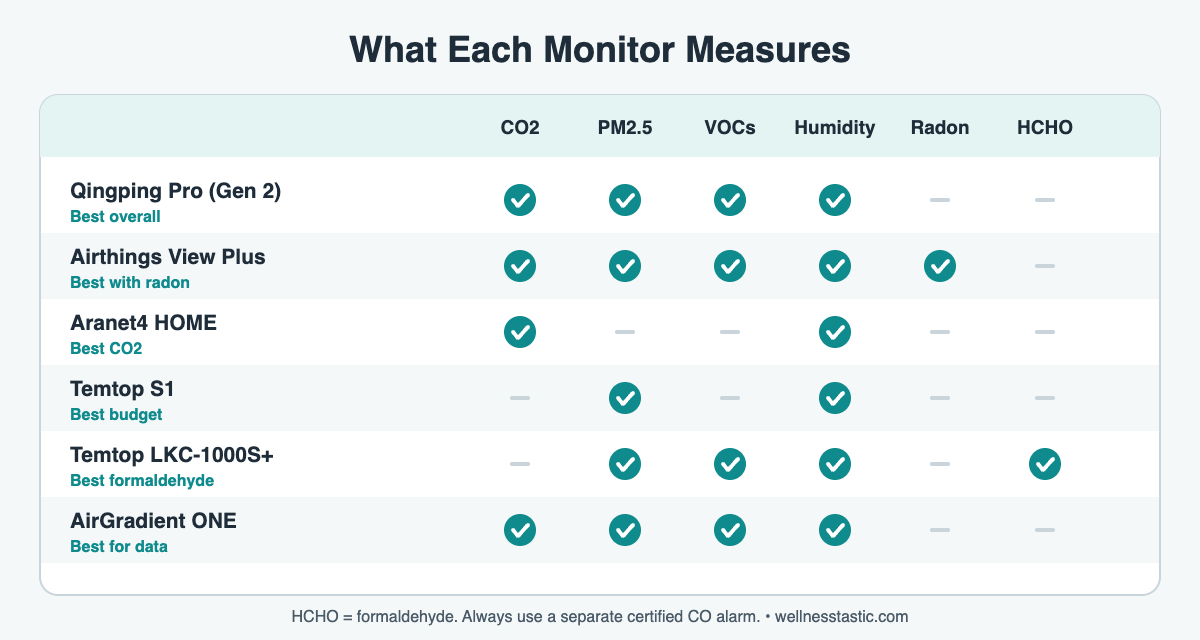
| Monitor | CO2 | PM2.5 | VOCs | Radon | Formaldehyde | App |
|---|---|---|---|---|---|---|
| Qingping Pro (Gen 2) | ✓ NDIR | ✓ | ✓ | — | — | ✓ |
| Airthings View Plus | ✓ NDIR | ✓ | ✓ | ✓ | — | ✓ |
| Aranet4 HOME | ✓ NDIR | — | — | — | — | ✓ |
| Temtop S1 | — | ✓ | — | — | — | S1+ only |
| Temtop LKC-1000S+ | — | ✓ | ✓ | — | ✓ | — |
| AirGradient ONE | ✓ NDIR | ✓ | ✓ | — | — | ✓ |
Types of Indoor Air Quality Monitors
Before comparing models, it helps to know the main types of home air quality monitors and what each is good at.
| Type | What it does | Good for | Example |
|---|---|---|---|
| Single-pollutant monitor | Measures one main pollutant very well | Focused needs, such as ventilation or radon | Aranet4 HOME (CO2) |
| Budget particle monitor | Tracks PM2.5 plus temperature and humidity | Cooking, smoke, dust on a budget | Temtop S1 |
| Multi-sensor monitor | Combines CO2, particles, VOCs and humidity | A complete picture in one device | Qingping Pro (Gen 2) |
| Smart home monitor | Connects to apps and smart home platforms | Automations, alerts and long-term history | Airthings View Plus |
| Specialty monitor | Adds less common sensors such as formaldehyde | Renovations and new furniture | Temtop LKC-1000S+ |
| Open-source monitor | Uses replaceable sensors with open data | Tech-savvy users who want control | AirGradient ONE |
There is also a difference between portable and fixed monitors. Portable, battery-powered monitors are ideal for learning how different rooms behave, while plug-in monitors are better for constant tracking in one room. Many people start with one portable monitor and add a second fixed monitor later for the bedroom or basement.
Finally, remember that a monitor is not a professional inspection. If readings suggest a serious problem, such as high radon or persistent moisture, confirm it with proper testing and, if needed, a qualified professional.
How to Choose an Indoor Air Quality Monitor

1. Decide which pollutants matter most
Start with your main concern rather than the longest spec sheet:
- Stuffy rooms or poor sleep environment? Prioritize a CO2 monitor.
- Cooking, smoke, dust, pets or allergies? Prioritize a PM2.5 monitor.
- New furniture, painting or renovation? Look for VOC or formaldehyde sensors.
- Basement or radon-prone area? Consider a monitor with radon, or at least do a radon test.
- Mold concerns? Humidity is the key measurement; almost every monitor includes it.
If you are not sure, a multi-sensor monitor that covers CO2, PM2.5, VOCs and humidity gives you the broadest picture. Our guide to the signs of poor indoor air quality can help you identify your likely problems.
2. Check the CO2 sensor type
This is one of the most important and least understood specs. True NDIR (non-dispersive infrared) or photoacoustic sensors actually measure CO2. Some cheaper monitors display an “eCO2” or “estimated CO2” value that is calculated from a VOC sensor rather than measured. These estimates can be misleading. If CO2 matters to you, look for NDIR in the specifications.
3. Look for a laser particle sensor
Most good home air quality monitors use laser particle counters for PM2.5. They are not as precise as professional reference instruments, but they are very good at showing changes and spikes, which is what you need at home. Independent programs such as AQ-SPEC publish evaluations of many consumer sensors.
4. Understand the limits of VOC sensors
Consumer VOC sensors measure a combined signal from many gases and usually show it as an index. They cannot tell you which chemical is present or whether it is harmful. They are useful for spotting changes, such as spikes after cleaning or painting, but not for precise measurement.
5. Do not rely on a monitor for carbon monoxide
Some monitors include CO readings, but they are not a substitute for a dedicated, certified carbon monoxide alarm. Every home with fuel-burning appliances or an attached garage should have proper CO alarms on every level.
6. Consider the display, app and smart home features
- Display: a screen lets you see readings at a glance without opening an app. E-ink is easy to read and saves battery.
- App: useful for history charts, alerts and comparing rooms over time.
- Smart home: some monitors can trigger air purifiers, fans or alerts through smart home platforms.
- Data export: important if you want to analyze your data or keep long-term records.
7. Think about power and placement
Battery-powered monitors are easy to move between rooms. Plug-in monitors usually take more frequent readings and are better for a permanent spot. Consider where you want to use it before you buy.
8. Match the monitor to your budget
| Budget level | What you can expect |
|---|---|
| Budget | PM2.5, temperature and humidity; basic display; limited or no app |
| Mid-range | Adds NDIR CO2 and often VOCs; better displays and apps |
| Premium | Adds radon or more sensors, polished apps and smart home integrations |
Best Air Quality Monitor for Your Situation
The right monitor depends on where you will use it and what you are worried about. Here is how our picks match common situations.
For the bedroom
Bedrooms are where CO2 builds up most, because doors and windows are usually closed for hours while people breathe. An accurate CO2 monitor such as the Aranet4 HOME shows whether the room gets enough fresh air overnight. Its e-ink screen does not glow, which also makes it bedroom-friendly. If you want particles and VOCs too, the Qingping Pro is a good all-round choice; just dim the screen at night.
For homes with gas stoves
Cooking on gas releases particles and combustion gases. A monitor with PM2.5 and VOC sensors, such as the Qingping Pro or AirGradient ONE (which also tracks NOx as an index), helps you see how much cooking affects your air and whether your range hood is doing its job. Always pair it with a certified CO alarm.
For basements
Basements are common trouble spots for both humidity and radon. The Airthings View Plus tracks radon alongside humidity and other measurements. If radon is not a concern, even a basic monitor with humidity, like the Temtop S1, helps you decide when a dehumidifier is needed.
For allergy-prone households
Airborne particles such as dust, pollen and pet dander are the main focus, so a reliable PM2.5 sensor matters most. The Qingping Pro offers good particle sensing along with CO2 and VOCs. Use it to see whether your air purifier and cleaning routine are keeping particle levels down. For health questions, speak with a healthcare professional.
For wildfire smoke
During smoke events, you want to know how much smoke is getting inside and whether your filtration is working. Any monitor with a good laser PM2.5 sensor will do, from the budget Temtop S1 to the Qingping Pro. Watch readings as you close windows and run a HEPA air purifier.
For new homes, renovations and new furniture
New materials can release VOCs and formaldehyde for weeks or months. The Temtop LKC-1000S+ is one of the few affordable monitors with a dedicated formaldehyde sensor, which makes it especially useful in this situation.
For home offices
CO2 can climb quickly in a small closed office, especially during long work sessions. A CO2 monitor helps you know when to open a window or take a break. The portable Aranet4 HOME is easy to move between your office and bedroom.
Where to Place Your Air Quality Monitor
- Place it in the room where you spend the most time, such as the bedroom or living room.
- Keep it at roughly breathing height, around 3 to 6 feet off the floor.
- Keep it a few feet away from windows, doors, vents, air purifiers and humidifiers, which can skew readings.
- Avoid placing it right next to the stove unless you specifically want to track cooking spikes.
- Do not place it in direct sunlight or near heat sources.
- For radon, follow the manufacturer’s placement instructions, usually in the lowest lived-in level of the home.
How to Use Your Monitor Readings
A monitor is only valuable if you act on what it shows. Watch for patterns: particle spikes during cooking, CO2 rising overnight in a closed bedroom, or humidity climbing above 60% in the basement. Then take simple steps such as running the range hood, opening a window or using a dehumidifier. Our complete indoor air quality guide explains what the main readings mean, and our step-by-step guide on how to improve indoor air quality shows what to do next.
Not sure whether you need a monitor, an air purifier or both? Read our comparison of an air quality monitor vs an air purifier.
Quick Guide to Reading Your Monitor
Every brand displays data a little differently, and many show their own color scores. Use this simple guide as a starting point for understanding your numbers:
| Measurement | Generally good | Worth attention | What to do |
|---|---|---|---|
| CO2 | Under about 800 ppm | Regularly above about 1,000 ppm | Increase ventilation |
| PM2.5 | Low and steady; the U.S. AQI treats 24-hour averages up to about 9 µg/m³ as “good” | Long periods of elevated readings | Find the source, ventilate, filter |
| Humidity | About 30–50% | Above 60% or below 30% | Dehumidify or humidify carefully |
| tVOC | Low and stable for your device | Frequent spikes | Identify products or activities; ventilate |
| Radon | Below 2 pCi/L | 4 pCi/L or higher (EPA action level) | Confirm with testing; consider mitigation |
These ranges are general guidance for homes, not medical thresholds. Focus on patterns over hours and days, not single readings. Our guide to testing indoor air quality goes deeper into interpreting results.
Common Mistakes When Buying a Home Air Quality Monitor
- Choosing by the number of sensors alone: a monitor with many low-quality sensors can be less useful than one with a few good ones.
- Trusting “eCO2” readings: estimated CO2 from a VOC sensor is not the same as a real NDIR measurement.
- Expecting lab accuracy: consumer monitors are designed to show trends and changes, not to replace professional testing.
- Using a monitor instead of a CO alarm: always install certified carbon monoxide alarms separately.
- Ignoring ongoing costs: consider batteries, replacement sensors and whether key features require a subscription.
- Putting it in the wrong spot: placing a monitor next to a window, vent or air purifier gives misleading readings.
- Buying and never acting on the data: the value comes from using the readings to ventilate, filter and change habits.
Frequently Asked Questions
Are home air quality monitors accurate?
Good consumer monitors are accurate enough to show trends, spikes and whether conditions are getting better or worse. NDIR CO2 sensors are generally reliable. Particle and VOC sensors are less precise than professional equipment, so focus on changes over time rather than exact numbers.
What should an indoor air quality monitor measure?
For most homes, the most useful measurements are PM2.5, CO2, humidity and temperature, with VOCs as a helpful extra. Radon and formaldehyde are worth adding if they are specific concerns for your home.
Can an air quality monitor detect mold?
No consumer monitor directly detects mold. However, humidity readings help you spot conditions where mold is more likely to grow, and a musty smell or visible growth are stronger signs.
Do I need more than one monitor?
One monitor is enough for most people to start. You can move a battery-powered monitor between rooms to learn how each space behaves. Larger homes, or homes with a basement, may benefit from a second monitor.
Is a CO2 monitor worth it?
Yes, especially for bedrooms and home offices. CO2 is one of the easiest ways to tell whether a room is getting enough fresh air, and it helps you decide when to open windows or improve ventilation.
The Bottom Line
The best indoor air quality monitor is the one that measures the problems you actually have. For most homes, the Qingping Air Monitor Pro (Gen 2) offers the best mix of sensors and value. Choose the Airthings View Plus if you also want radon monitoring, the Aranet4 HOME for accurate CO2 tracking, or the Temtop S1 if you want an affordable start with particle monitoring. Whatever you choose, use the data to make small changes that improve the air in your home.
Sources
- South Coast AQMD: Air Quality Sensor Performance Evaluation Center (AQ-SPEC)
- U.S. EPA: Care for Your Air, A Guide to Indoor Air Quality
- U.S. EPA: Radon
Product features and availability can change. Please check the retailer for current details. This article is for general information only. See our Affiliate Disclosure and How We Research.