
WellnessTastic is reader-supported. When you buy through links on this page, we may earn an affiliate commission at no extra cost to you. As an Amazon Associate, we earn from qualifying purchases. Learn more.
If your home has central heating or air conditioning, the filter in your HVAC system is one of the easiest and cheapest ways to improve indoor air quality. But walk down the filter aisle and you will see numbers like MERV 8, MERV 11 and MERV 13, plus other ratings such as MPR and FPR. What do they mean, and which one should you buy?
This guide explains the MERV rating in plain English: what it measures, how the scale works, how MERV compares with HEPA, and how to choose the right filter for your system without hurting airflow. We base our guidance on the U.S. Environmental Protection Agency (EPA) and the ASHRAE testing standard behind MERV.
Quick answer: MERV stands for Minimum Efficiency Reporting Value. It rates how well an air filter captures particles on a scale from 1 to 16; higher numbers capture more and smaller particles. The EPA suggests using a MERV 13 filter, or the highest rating your HVAC system can accommodate, for better indoor air quality. Always check that your system can handle a higher-rated filter first.
What Is a MERV Rating?
MERV stands for Minimum Efficiency Reporting Value. It is a rating system created by ASHRAE (the American Society of Heating, Refrigerating and Air-Conditioning Engineers) under Standard 52.2. It tells you how effectively an air filter captures particles of different sizes as air passes through it.
The scale runs from MERV 1 to MERV 16. A higher MERV rating means the filter captures a higher percentage of particles, including smaller ones. According to the EPA, filters with higher MERV ratings trap more small particles, which can include things like smoke, dust, pollen and some bacteria and viruses, although the benefits depend on the filter fitting well and on how often your system runs.
Why Your HVAC Filter Matters for Indoor Air Quality
Your HVAC filter is the one air-cleaning device that already touches almost all the air in your home. Every time your heating or cooling system runs, air from every room passes through it. That makes the filter a powerful, low-cost tool for reducing airborne particles throughout the house, not just in a single room.
Originally, basic furnace filters were designed mainly to protect the equipment from dust. Today, higher-MERV filters can also help protect the people living in the home by capturing smaller particles such as fine dust, pet dander and smoke. Choosing the right filter is one of the simplest upgrades you can make. For a complete approach, see our guide to indoor air quality.
The MERV Rating Scale Explained
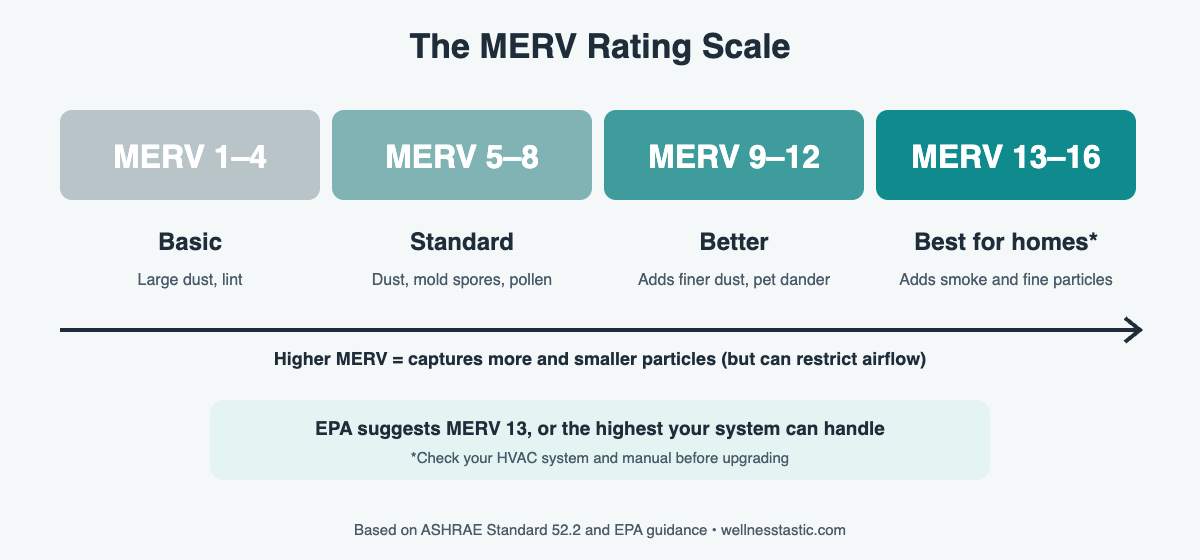
| MERV rating | What it captures | Typical use |
|---|---|---|
| MERV 1–4 | Large particles such as lint, large dust and some pollen | Basic protection for HVAC equipment |
| MERV 5–8 | Adds mold spores, dust mite debris and more pollen | Standard residential filters |
| MERV 9–12 | Adds finer dust, pet dander and some auto emissions | Better residential filtration |
| MERV 13–16 | Adds smoke particles, fine particles and some bacteria | Best residential filtration; also used in hospitals and commercial buildings |
How MERV Ratings Are Tested
Under ASHRAE Standard 52.2, filters are tested against particles in three size ranges, and the MERV rating is based on the minimum efficiency the filter achieves in each range:
| Particle size range | Examples | MERV 8 | MERV 11 | MERV 13 | MERV 16 |
|---|---|---|---|---|---|
| E1: 0.3–1.0 microns | Smoke, fine particles, some bacteria | No minimum | At least 20% | At least 50% | At least 95% |
| E2: 1.0–3.0 microns | Fine dust, pet dander, some mold spores | No minimum | At least 65% | At least 85% | At least 95% |
| E3: 3.0–10 microns | Pollen, dust mite debris, larger dust | At least 70% | At least 85% | At least 90% | At least 95% |
This is why MERV 13 is such an important threshold: it is the first level that must capture at least half of the smallest particle range, which includes many fine particles and smoke particles that matter most for indoor air quality.
MERV 8 vs MERV 11 vs MERV 13
These are the three most common ratings for home filters. Here is how they compare:
| MERV 8 | MERV 11 | MERV 13 | |
|---|---|---|---|
| Fine particles (0.3–1 micron) | Not required | At least 20% | At least 50% |
| Medium particles (1–3 microns) | Not required | At least 65% | At least 85% |
| Large particles (3–10 microns) | At least 70% | At least 85% | At least 90% |
| Good for | Basic dust and pollen | Pets, dust, better everyday filtration | Smoke, allergies, best home filtration |
| Airflow impact | Low | Moderate | Higher; check your system |
For most homes that can handle it, MERV 13 offers the best balance of filtration and practicality. MERV 11 is a solid step up from MERV 8 if your system cannot handle MERV 13.
What MERV Rating Should You Use at Home?
The EPA recommends using a filter rated MERV 13 or higher, or the highest rating your system can accommodate. Here is a practical guide:
| Your situation | Suggested MERV |
|---|---|
| Basic dust control, no allergies or pets | MERV 8 to 11 |
| Pets in the home | MERV 11 to 13 |
| Allergies or asthma in the household | MERV 13 if your system allows |
| Wildfire smoke or nearby traffic pollution | MERV 13 if your system allows |
| Older or low-powered HVAC system | Check with a technician before going above MERV 8 to 11 |
If someone in your home has health concerns, talk with a healthcare professional as well; better filtration can help reduce airborne particles but is not a medical treatment.
Choosing a MERV Rating for Specific Situations
Wildfire season
During wildfire smoke events, a MERV 13 filter can help reduce smoke particles circulating through your home, especially if you run the system fan more often. Check and replace the filter after heavy smoke, and use a portable HEPA purifier in the bedroom. See our smoke guide.
Homes with pets
Pet dander and hair load filters quickly. A MERV 11 to 13 filter captures more dander than a basic filter, but check it monthly and replace it more often. See our pet guide.
Allergy-prone households
Higher MERV ratings capture more pollen and dust. Pair a MERV 13 filter, if your system allows, with a HEPA purifier in the bedroom. See our allergy guide.
Renovations and construction dust
Construction dust can clog filters very quickly. If possible, turn off the HVAC system while sanding or cutting, seal off vents in the work area, and replace the filter as soon as the work is finished.
Vacation homes and rarely used systems
If your system runs only occasionally, a filter may last longer, but check it before each season. Dust and moisture can still build up in unused systems.
Can a High-MERV Filter Hurt Your HVAC System?
Higher-MERV filters use denser media, which can increase resistance to airflow, known as pressure drop. In some systems, especially older or lower-powered ones, a filter that is too restrictive can:
- Reduce airflow through the system and to your rooms
- Make the fan work harder and use more energy
- Reduce heating or cooling performance
- In some cases, contribute to equipment problems if airflow drops too far
Many modern systems handle MERV 13 without trouble, especially with deeper filters. The safest approach is to check your HVAC manual or ask a licensed HVAC technician before upgrading. Signs of restricted airflow include weaker airflow from vents, rooms that do not heat or cool as well, and a system that runs longer than usual.
1-inch vs 4-inch filters
Filter thickness matters. A deeper filter, such as a 4- or 5-inch media filter, has much more surface area than a standard 1-inch filter. That means it can offer high MERV filtration with less airflow resistance and usually lasts longer. If your system has a media filter cabinet, a deeper MERV 13 filter is often the best choice. Never force a filter into a slot it was not designed for.
MERV vs HEPA
HEPA filters are not rated on the MERV scale. A true HEPA filter captures at least 99.97% of particles 0.3 microns in size, which exceeds the highest MERV rating. However, HEPA filters are usually too restrictive for standard home HVAC systems, which is why they are used mainly in portable air purifiers, vacuums and specialized systems.
| MERV 13 filter | HEPA filter | |
|---|---|---|
| Where it is used | Home HVAC systems | Portable air purifiers, vacuums, specialized systems |
| Fine particle efficiency | At least 50% of 0.3–1 micron particles | At least 99.97% at 0.3 microns |
| Airflow resistance | Moderate | High |
| Coverage | Whole house, when the fan runs | One room or area |
For many homes, the best approach is to combine both: a MERV 13 HVAC filter for whole-house filtration and a portable HEPA air purifier in the bedroom or main living area.
MERV vs MPR vs FPR
Some retailers and brands use their own rating systems:
- MPR (Microparticle Performance Rating) is used by 3M Filtrete filters.
- FPR (Filter Performance Rating) is used by some filters sold at The Home Depot.
These scales are not the same as MERV and are not directly interchangeable. When comparing filters from different brands, look for the MERV rating on the packaging or specifications, since it is based on the industry-standard ASHRAE test.
A Note on Electrostatic Filters
Some filters use electrostatically charged fibers to attract particles, which can give them high efficiency when new. That charge can fade over time as the filter is exposed to particles, which may reduce efficiency during use. ASHRAE provides an optional test, sometimes shown as a MERV-A rating, that accounts for this effect. If you see a MERV-A rating, it reflects performance after this conditioning, which can be a more realistic indicator of real-world performance.
How Much Do HVAC Filters Cost?
| Filter type | Relative cost | Notes |
|---|---|---|
| Basic fiberglass (MERV 1–4) | Lowest | Protects equipment; minimal air quality benefit |
| Pleated MERV 8 | Low | Common standard filter |
| Pleated MERV 11 | Moderate | Good step up for pets and dust |
| Pleated MERV 13 | Moderate to higher | Best air quality for most homes |
| 4- to 5-inch media filter | Higher per filter, but lasts longer | Often better value over a year |
Buying filters in multi-packs usually lowers the cost per filter, and a deeper media filter can be more economical over a full year because it lasts much longer.
How Often to Change Your HVAC Filter
| Filter type | Typical replacement |
|---|---|
| 1-inch filter | Every 1–3 months |
| 2-inch filter | Every 2–4 months |
| 4- to 5-inch media filter | Every 6–12 months |
| Homes with pets, smokers or high dust | More often than the typical range |
| During or after wildfire smoke | Check and replace sooner |
Check your filter monthly. Replace it when it looks visibly dirty or grey, or on the manufacturer’s schedule, whichever comes first. A clogged filter restricts airflow and filters less effectively.
How to Choose and Install the Right Filter
- Check the size: look at the dimensions printed on your current filter, such as 16×25×1.
- Check your system: read your HVAC manual or ask a technician what MERV rating it can handle.
- Choose the MERV rating: MERV 13 if your system allows, otherwise the highest it can handle.
- Check the airflow arrow: install the filter with the arrow pointing toward the furnace or air handler.
- Make sure it fits snugly: gaps let unfiltered air bypass the filter.
- Set a reminder to check it monthly.
Getting the Most From Your HVAC Filter
- Run the fan more often: the filter only cleans air when the system fan is running. Some people set the fan to “on” or use a circulation setting, though this uses more electricity.
- Seal leaks: leaky ducts can pull in unfiltered air from attics or crawl spaces.
- Keep up with maintenance: have your system serviced regularly.
- Add a portable purifier in the bedroom for continuous cleaning where you sleep.
- Reduce sources: source control and ventilation still come first.
Common MERV Mistakes
- Buying the highest MERV without checking your system: it can restrict airflow.
- Comparing MPR or FPR with MERV directly: they are different scales.
- Ignoring fit: a gap around the filter lets air bypass it.
- Forgetting to replace it: an overdue filter works poorly.
- Expecting a filter to fix everything: HVAC filters do not remove gases, CO2 or moisture.
Frequently Asked Questions
What does MERV stand for?
MERV stands for Minimum Efficiency Reporting Value. It is a 1 to 16 scale that rates how well an air filter captures particles, based on ASHRAE Standard 52.2.
What is the best MERV rating for home use?
The EPA suggests MERV 13 or the highest rating your HVAC system can accommodate. For systems that cannot handle MERV 13, MERV 11 is a good alternative.
Is MERV 13 too high for a home system?
Many modern systems handle MERV 13 without problems, especially with deeper filters. Older or lower-powered systems may struggle. Check your manual or ask a technician.
Is a MERV 13 filter the same as HEPA?
No. HEPA filters are more efficient than MERV 13 for the smallest particles but are usually too restrictive for home HVAC systems. MERV 13 is a practical high-efficiency option for central systems.
Do MERV filters remove odors?
Standard MERV filters capture particles, not gases or odors. Some filters include a carbon layer for odor control. For stronger odors, a portable purifier with activated carbon helps. See our guide to HEPA vs activated carbon.
Can I wash and reuse a MERV filter?
Most pleated MERV filters are disposable and should not be washed, as water can damage the media and encourage mold. Some permanent washable filters exist, but they typically have lower MERV ratings. Follow the manufacturer’s instructions.
The Bottom Line
The MERV rating tells you how well an HVAC filter captures particles, on a scale from 1 to 16. For most homes, a MERV 13 filter, or the highest your system can handle, offers the best whole-house filtration, capturing at least half of the finest particles tested. Check your system before upgrading, choose the right size, replace filters on schedule and pair your HVAC filter with a portable HEPA purifier in key rooms for the cleanest possible indoor air.
Sources
- U.S. EPA: What Is a MERV Rating?
- U.S. EPA: Guide to Air Cleaners in the Home
- ASHRAE: Standard 52.2 publisher
This article is for general information only. Always follow your HVAC manufacturer’s guidance or consult a licensed technician before changing filter types. See our Affiliate Disclosure.