WellnessTastic is reader-supported. When you buy through links on this page, we may earn an affiliate commission at no extra cost to you. As an Amazon Associate, we earn from qualifying purchases. Learn more.
A good air purifier is one of the most effective ways to reduce airborne particles such as dust, pollen, pet dander and smoke in the rooms where you spend the most time. But choosing one is harder than it should be. Marketing claims about room size are often inflated, “HEPA-type” filters are not the same as true HEPA, and filter costs can quietly double what you spend over a few years.
This guide to the best air purifiers cuts through the noise. We compare the best air purifiers for home using verified performance data, explain the features that actually matter, and give you a simple method to choose the right size for your room. If you are new to the topic, start with our guide on how an air purifier works.
Quick picks: The Levoit Vital 200S is our best overall pick for most bedrooms and medium rooms. The Coway Airmega AP-1512HH (Mighty) is a proven, long-running favorite. For large rooms, choose the Coway Airmega 400S. For a premium, quiet option, the Rabbit Air A3 stands out. On a budget, the Levoit Core 300 is hard to beat for small rooms.
Our Top Picks at a Glance
| Air purifier | Best for | Smoke CADR | Room size (4.8 ACH) | Price range |
|---|---|---|---|---|
| Levoit Vital 200S | Best overall | 250 CFM | About 390 sq ft | Mid-range |
| Coway Airmega AP-1512HH (Mighty) | Proven all-rounder | 233 CFM | About 360 sq ft | Mid-range |
| Coway Airmega 400S | Large rooms | 328 CFM | About 510 sq ft | Premium |
| Rabbit Air A3 | Premium and quiet | 370 CFM | About 578 sq ft | Premium |
| Levoit Core 300 | Budget and small rooms | 141 CFM | About 219 sq ft | Budget |
| Medify MA-112 | Very large spaces | 594 CFM (reported) | About 930 sq ft | Premium |
Room sizes above are calculated at 4.8 air changes per hour (ACH) with 8-foot ceilings, which is the level commonly recommended for good particle removal. Many brands advertise much larger room sizes based on only one or two air changes per hour. We explain why this matters below.
How We Chose the Best Air Purifiers
We want to be transparent: we have not yet completed our own hands-on lab testing of every model here. Instead, we built this list using data that can be independently checked:
- Verified CADR ratings: Clean Air Delivery Rate figures from the AHAM Verifide program or official manufacturer specifications.
- Independent test results: published results from established independent air purifier testers and reviewers.
- Filtration type: we prioritized true HEPA filtration and avoided models that rely on ozone-producing technology.
- Real room coverage: we recalculated room sizes at 4.8 ACH rather than using marketing figures.
- Cost of ownership: filter lifespan, replacement cost and energy use.
- Noise: especially at the lower fan speeds you will actually use every day.
Read more on our How We Research page.
The Best Air Purifiers for Home
1. Levoit Vital 200S: Best Overall
The Levoit Vital 200S offers an excellent balance of performance, features and price. Its AHAM-verified CADR ratings of 250 CFM for smoke, 254 CFM for dust and 289 CFM for pollen put it well above most purifiers at this price, and independent testing has closely matched those figures. It uses a three-stage filter with a washable pre-filter, a HEPA-grade particle layer and activated carbon, and the smart version adds app control, an air quality sensor and a dedicated pet mode.
| Spec | Details |
|---|---|
| CADR (smoke / dust / pollen) | 250 / 254 / 289 CFM (AHAM verified) |
| Room size at 4.8 ACH | About 390 sq ft |
| Filtration | Washable pre-filter, HEPA-grade filter, activated carbon |
| Smart features | App control, air quality sensor, pet mode (smart models) |
| Ozone | No ionizer |
| Price range | Mid-range |
What we like:
- Strong verified CADR for the price
- Quiet in sleep mode, making it bedroom-friendly
- Washable pre-filter helps extend filter life
- Useful app and auto mode on smart versions
Things to consider:
- Particle and carbon layers are bonded, so you replace them together
- Carbon layer is fine for everyday odors but not heavy smoke or VOC problems
Best for: bedrooms, home offices, nurseries and living rooms up to about 390 square feet.
2. Coway Airmega AP-1512HH (Mighty): Best Proven All-Rounder
The Coway Mighty has been one of the most recommended air purifiers for years, and for good reason. It combines a true HEPA filter with a pre-filter and a deodorization filter, has a CADR of 233 CFM, and includes an air quality indicator and auto mode. It is a dependable choice if you want a well-established model with a long track record.
| Spec | Details |
|---|---|
| CADR (smoke) | 233 CFM |
| Room size at 4.8 ACH | About 360 sq ft |
| Filtration | Pre-filter, deodorization filter, true HEPA |
| Features | Air quality indicator, auto mode, eco mode |
| Ozone | Ionizer can be turned off |
| Price range | Mid-range |
What we like:
- Long track record of reliable performance
- True HEPA filtration
- Auto mode adjusts fan speed to air quality
- Compact footprint
Things to consider:
- Includes an ionizer (you can switch it off)
- No app on the standard model
- Carbon filter is fairly thin
Best for: bedrooms and medium living rooms, and anyone who values a proven model.
3. Coway Airmega 400S: Best for Large Rooms
For large living rooms and open areas, you need more airflow. The Coway Airmega 400S has manufacturer-rated CADR figures of 328 CFM for smoke and dust and 400 CFM for pollen. It pulls air through two filter sets, each combining activated carbon and HEPA, and adds app control, scheduling and automatic sleep and eco modes. Coway advertises coverage of 1,560 sq ft, but that is based on two air changes per hour; at 4.8 ACH, it is better suited to rooms of around 510 square feet.
| Spec | Details |
|---|---|
| CADR (smoke / dust / pollen) | 328 / 328 / 400 CFM (manufacturer) |
| Room size at 4.8 ACH | About 510 sq ft |
| Filtration | Washable pre-filters plus two Max2 filters (carbon + HEPA) |
| Noise | 22–52 dB (manufacturer) |
| Smart features | App, scheduling, auto, eco and sleep modes |
| Price range | Premium |
What we like:
- High airflow for larger spaces
- Dual filters with a combined carbon and HEPA design
- Quiet at low speeds
- Smart app with scheduling
Things to consider:
- Large and heavy
- Premium price and filter costs
- Advertised coverage is based on only two air changes per hour
Best for: large living rooms, family rooms and open-plan spaces around 400 to 550 square feet.
4. Rabbit Air A3: Best Premium and Quiet Pick
The Rabbit Air A3 is a premium air purifier with a CADR of 370 CFM, a five-layer filtration system including a pre-filter, activated carbon and HEPA filter, and an option to customize one filter for specific needs such as pets or odors. It is Energy Star certified, can be wall-mounted, and is known for quiet operation at lower speeds.
| Spec | Details |
|---|---|
| CADR | 370 CFM |
| Room size at 4.8 ACH | About 578 sq ft |
| Filtration | Multi-stage, including pre-filter, activated carbon and HEPA |
| Noise | About 30–55 dB |
| Certifications | Energy Star |
| Price range | Premium |
What we like:
- High CADR with quiet operation
- Customizable filter options
- Attractive design that can be wall-mounted
- App and voice control
Things to consider:
- Expensive to buy
- Replacement filter kits are not cheap
Best for: larger bedrooms and living rooms where design and low noise matter.
5. Levoit Core 300: Best Budget Pick for Small Rooms
The Levoit Core 300 is one of the most popular small air purifiers for good reason: it is affordable, compact and effective in small rooms. It has a rated CADR of 141 CFM, which suits rooms up to about 219 square feet at 4.8 ACH. It is Energy Star and CARB certified, and its sleep mode is quiet enough for bedrooms.
| Spec | Details |
|---|---|
| CADR (smoke) | 141 CFM (manufacturer) |
| Room size at 4.8 ACH | About 219 sq ft |
| Filtration | Pre-filter, HEPA filter, activated carbon |
| Noise | As low as about 24 dB in sleep mode |
| Certifications | Energy Star, CARB, ETL |
| Price range | Budget |
What we like:
- Very affordable to buy and run
- Compact and lightweight
- Quiet sleep mode
- Inexpensive replacement filters
Things to consider:
- Only suitable for small rooms
- No air quality sensor or auto mode on the base model
Best for: small bedrooms, dorm rooms, nurseries and home offices.
6. Medify MA-112: Best for Very Large Spaces
If you need to clean the air in a very large room or open-concept floor, the Medify MA-112 offers one of the highest CADR ratings of any single consumer air purifier, with a smoke CADR of 594 CFM reported in independent reviews. It uses an H13-grade HEPA filter and is designed for spaces where maximum airflow matters most.
| Spec | Details |
|---|---|
| CADR | 594 CFM (reported) |
| Room size at 4.8 ACH | About 930 sq ft |
| Filtration | Pre-filter, H13-grade HEPA, carbon |
| Price range | Premium |
What we like:
- Very high airflow for big spaces
- H13-grade HEPA filtration
- Can replace two smaller units in some homes
Things to consider:
- Large, heavy unit
- Loud at top speed
- Higher filter replacement costs
Best for: open floor plans, large great rooms and spaces over 600 square feet.
Air Purifier Comparison Table
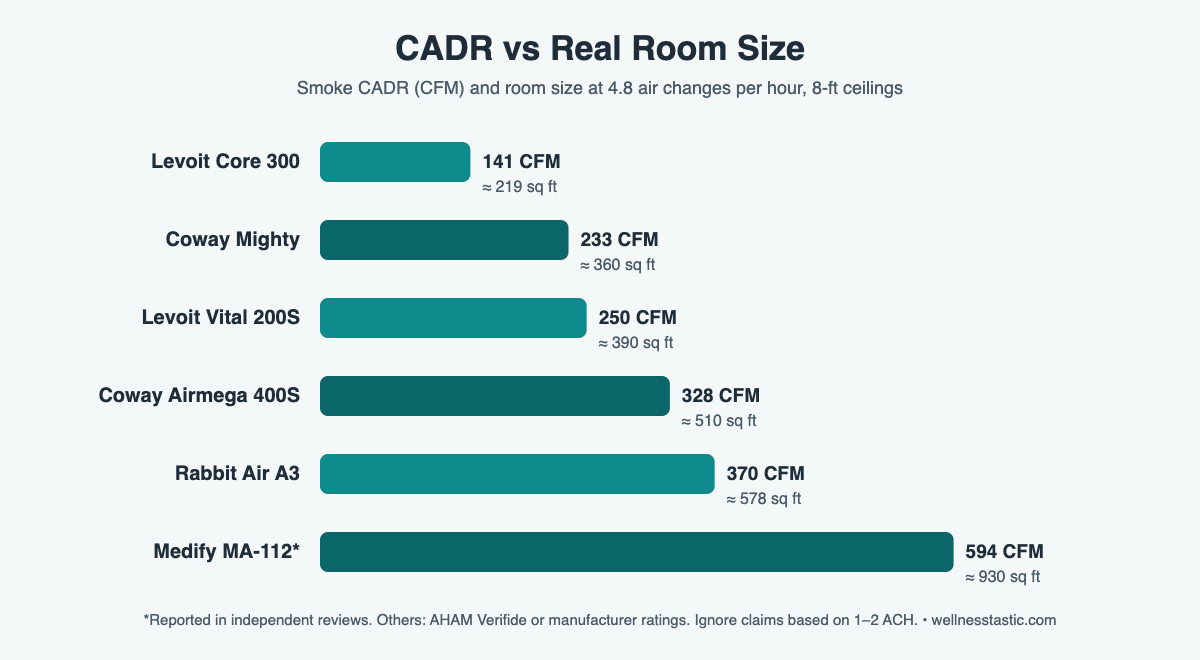
| Model | CADR | Room size (4.8 ACH) | Carbon filter | Smart app | Best for |
|---|---|---|---|---|---|
| Levoit Vital 200S | 250 CFM | ~390 sq ft | ✓ | ✓ (smart models) | Most homes |
| Coway Mighty | 233 CFM | ~360 sq ft | ✓ | — | Proven all-rounder |
| Coway Airmega 400S | 328 CFM | ~510 sq ft | ✓ | ✓ | Large rooms |
| Rabbit Air A3 | 370 CFM | ~578 sq ft | ✓ | ✓ | Premium, quiet |
| Levoit Core 300 | 141 CFM | ~219 sq ft | ✓ | — | Small rooms, budget |
| Medify MA-112 | 594 CFM | ~930 sq ft | ✓ | — | Very large spaces |
Types of Air Purifiers Explained
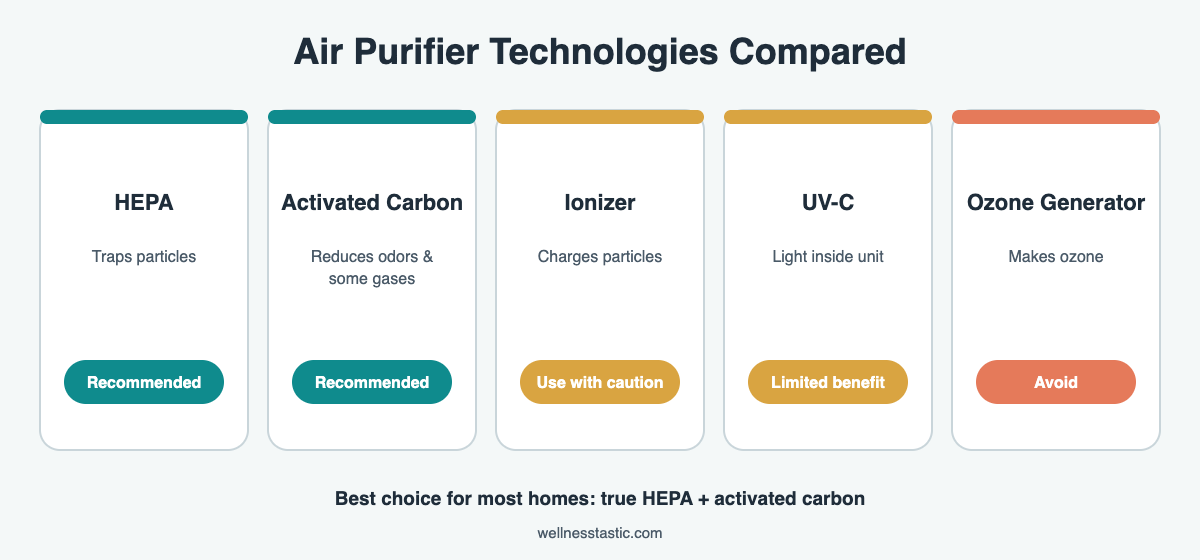
Not all air purifiers work the same way. Understanding the main technologies helps you avoid products that sound impressive but deliver little.
| Technology | How it works | Pros | Cons |
|---|---|---|---|
| HEPA (mechanical filter) | Traps particles in a dense fiber filter | Proven, effective for particles, no byproducts | Filters must be replaced; does not remove gases |
| Activated carbon | Adsorbs some gases and odors onto carbon | Helps with odors and some VOCs | Needs enough carbon to be effective; saturates over time |
| Ionizers and electrostatic | Charge particles so they stick to surfaces or plates | Can reduce some particles, low filter costs | May produce ozone; particles may settle on surfaces |
| UV-C light | Uses ultraviolet light inside the unit | Marketed for germs | Limited effect at typical airflow; not a substitute for HEPA |
| PECO and other photocatalytic | Uses light and a catalyst to break down pollutants | Proprietary designs with some research | Often low CADR for the price |
| Ozone generators | Intentionally produce ozone | None for occupied homes | Ozone is a lung irritant; the EPA advises against them |
For most homes, a purifier combining a true HEPA filter with activated carbon is the best choice. It captures particles effectively, helps with everyday odors and does not produce harmful byproducts.
What about DIY box fan filters?
A do-it-yourself air cleaner, often called a Corsi-Rosenthal box, uses a box fan and several MERV 13 furnace filters taped into a cube. Research and field use have shown these can deliver high airflow at low cost, especially during wildfire smoke events. They are louder and bulkier than commercial purifiers and do not include carbon, but they are a useful budget option for emergencies.
How to Choose the Best Air Purifier for Your Home
1. Choose true HEPA filtration
A true HEPA filter is the gold standard for capturing airborne particles. Under the U.S. standard, HEPA filters are designed to capture at least 99.97% of particles 0.3 microns in size, which is the hardest size to capture. Be cautious of terms like “HEPA-type” or “HEPA-like,” which are not the same. Learn more in our HEPA air purifier guide.
2. Match the CADR to your room size
CADR (Clean Air Delivery Rate) measures how much filtered air a purifier delivers, in cubic feet per minute. It is tested separately for smoke, dust and pollen. The smoke CADR is usually the most useful number because smoke particles are the smallest and hardest to remove.
A simple rule from AHAM is that the smoke CADR should be at least two-thirds of your room’s floor area in square feet. For example, a 300 sq ft room needs a smoke CADR of at least 200 CFM. For faster cleaning, or for smoke and allergies, go higher. Our CADR guide and air purifier size guide explain this in detail.
| Room size | Minimum smoke CADR |
|---|---|
| 100 sq ft | 65 CFM |
| 200 sq ft | 130 CFM |
| 300 sq ft | 195 CFM |
| 400 sq ft | 260 CFM |
| 500 sq ft | 325 CFM |
| 600 sq ft | 390 CFM |
3. Ignore inflated room size claims
Many brands list huge room sizes, such as “up to 1,800 sq ft.” These usually assume only one or two air changes per hour, which is far too slow for good particle removal. Check the CADR and calculate coverage yourself, or look for coverage stated at 4 to 5 air changes per hour.
4. Consider noise
You will run your purifier for many hours a day, so noise matters, especially in bedrooms. Look at decibel ratings for low and medium speeds, not just sleep mode. A larger purifier running at medium speed is often quieter than a small one running at full speed.
5. Check filter costs and lifespan
Replacement filters are the biggest ongoing cost. Before buying, check how much filters cost and how often they need replacing (often every 6 to 12 months). Some models use bonded filters where particle and carbon layers must be replaced together. A washable pre-filter can help extend the life of the main filter.
6. Look at energy use
Because purifiers often run 24 hours a day, efficiency matters. Energy Star certified models use less electricity, which lowers running costs over time.
7. Decide if you need activated carbon
HEPA filters capture particles but not gases or odors. If cooking smells, pet odors or light smoke odors are a concern, choose a purifier with activated carbon. For heavier odor or VOC problems, look for models with a substantial carbon filter rather than a thin carbon-coated layer.
8. Avoid ozone
Some devices intentionally produce ozone, which is a lung irritant, and the EPA advises against ozone generators. Ionizers and some other technologies may also produce small amounts of ozone. Look for models certified to meet California Air Resources Board (CARB) ozone limits, and switch off ionizers if you are unsure.
9. Consider smart features
Air quality sensors, auto mode, apps and scheduling are nice extras. Auto mode can save energy and filter life by running the fan faster only when needed. Just remember that built-in sensors usually measure particles near the purifier, not the whole room.
How Much Does an Air Purifier Really Cost?
The purchase price is only part of the cost. Over a few years, filters and electricity can add up to more than the unit itself.
| Cost | What to expect | How to save |
|---|---|---|
| Purchase price | Budget models for small rooms; mid-range for bedrooms and medium rooms; premium for large rooms and smart features | Buy the right size rather than the biggest |
| Replacement filters | Usually every 6–12 months; bonded or dual filters cost more | Check filter prices before buying; clean pre-filters regularly |
| Electricity | Depends on wattage and hours of use; highest at top speed | Choose Energy Star models; use auto or low mode |
| Carbon filters | May need more frequent replacement in homes with strong odors | Remove odor sources where possible |
To estimate electricity use, multiply the purifier’s wattage at your usual speed by the hours it runs, then by your local electricity rate. For example, a purifier using 20 watts for 24 hours uses about 0.48 kWh a day. Running at low or auto most of the time keeps costs down.
Best Air Purifier by Room and Need
The right purifier depends on where and why you use it. Our detailed guides cover each situation:
| Need | What to look for | Our guide |
|---|---|---|
| Bedroom | Quiet low speeds, dim display, right size | Best air purifiers for bedrooms |
| Large rooms | High CADR, dual filters | Best air purifiers for large rooms |
| Small rooms and apartments | Compact size, quiet, affordable filters | Best air purifiers for small rooms |
| Open floor plans | Very high CADR or multiple units | Best air purifiers for open floor plans |
| Smoke | High smoke CADR plus substantial carbon | Best air purifiers for smoke |
| Dust | True HEPA, strong dust CADR | Best air purifiers for dust |
| Pets | Pre-filter for hair, carbon for odors | Best air purifiers for pets |
| Allergies | True HEPA, run continuously in bedroom | Best air purifiers for allergies |
Where to Place Your Air Purifier
- Put it in the room where you spend the most time, usually the bedroom or living room.
- Leave at least a foot or two of space around it so air can flow freely in and out.
- Avoid corners and spots behind furniture, which restrict airflow.
- Keep doors and windows closed while it runs for the best results (unless you are ventilating).
- In bedrooms, place it where the clean air flows toward your bed without blowing directly on you.
- For large or open spaces, consider two smaller purifiers in different areas rather than one in the corner.
How to Get the Most From Your Air Purifier
- Run it continuously: particles are constantly added to indoor air, so purifiers work best when running all the time, often on low or auto. See how long to run an air purifier.
- Use higher speeds when needed: turn it up during cooking, cleaning, smoke events or high pollen days.
- Clean the pre-filter regularly: vacuum or rinse washable pre-filters every few weeks.
- Replace filters on time: a clogged filter reduces performance.
- Combine with source control and ventilation: an air purifier works best as part of a complete approach. See our guide on how to improve indoor air quality.
Air Purifier Maintenance Guide
A well-maintained air purifier performs better, runs quieter and lasts longer. Follow this simple schedule, and always check your model’s manual:
| How often | Task |
|---|---|
| Every 2–4 weeks | Vacuum or rinse the washable pre-filter (let it dry fully before reinstalling) |
| Monthly | Wipe the outside, intake and outlet grilles; check that nothing blocks airflow |
| Every 3–6 months | Check the carbon filter if odors return quickly; replace sooner in homes with strong odors |
| Every 6–12 months | Replace the HEPA or combined filter, or when the filter indicator tells you to |
| After heavy use | Check filters after wildfire smoke, renovations or dusty projects, which can shorten filter life |
Signs that your filter needs replacing include slower cleaning, more noise at the same speed, reduced airflow or odors that return quickly. Only use genuine or verified compatible filters; cheap knock-offs may not fit tightly or meet the same standard.
Do You Need an Air Purifier If You Have a Good HVAC Filter?
A high-quality HVAC filter cleans air throughout the home whenever your system’s fan runs, and the EPA suggests using MERV 13 or the highest rating your system can handle. But there are limits: the fan often runs only part of the time, and air in individual rooms may not pass through the filter often.
A portable air purifier complements your HVAC filter by cleaning air continuously in the rooms where you spend the most time, especially bedrooms. For many homes, the best approach is both: a good HVAC filter for whole-home filtration and a portable purifier in key rooms. Read more in our guide to MERV ratings.
What an Air Purifier Can and Cannot Do
According to the EPA, portable air cleaners can help reduce airborne particles, but no air cleaner removes all pollutants. HEPA purifiers are effective at capturing airborne dust, pollen, pet dander and smoke particles. Models with activated carbon can reduce some odors and gases.
However, an air purifier cannot lower CO2, control humidity, remove radon, fix mold problems or protect you from carbon monoxide. For those, you need ventilation, moisture control, testing and CO alarms. Our do air purifiers work guide explains the evidence in more detail.
Common Air Purifier Buying Mistakes
- Trusting advertised room sizes: figures based on one or two air changes per hour make purifiers look more powerful than they are.
- Buying too small: an undersized purifier running at full speed is louder and less effective than a properly sized one on a lower setting.
- Choosing “HEPA-type” filters: they do not meet the true HEPA standard.
- Ignoring filter costs: a cheap purifier with expensive filters can cost more over time.
- Buying for gimmicks: UV lights, ionizers and fragrance features add little compared with good filtration and airflow.
- Expecting one purifier to clean the whole house: portable purifiers are designed for a single room or area.
- Placing it in a corner or behind furniture: restricted airflow reduces performance.
- Using it instead of ventilation: purifiers do not lower CO2 or remove moisture.
If you are not sure whether you need a purifier or an air quality monitor first, read our comparison of an air quality monitor vs an air purifier.
Frequently Asked Questions
What is the best air purifier for home use?
For most homes, the Levoit Vital 200S offers the best balance of verified performance, features and price for rooms up to about 390 square feet. For larger rooms, the Coway Airmega 400S is a strong choice, and for small rooms on a budget, the Levoit Core 300 is excellent.
What size air purifier do I need?
Use the two-thirds rule: the smoke CADR should be at least two-thirds of your room’s floor area in square feet. For a 300 sq ft room, look for a smoke CADR of at least 200 CFM. See our air purifier size guide.
Is it OK to run an air purifier 24/7?
Yes. Most air purifiers are designed to run continuously, and doing so keeps particle levels consistently lower. Using auto or low mode keeps noise and energy use down.
How often should I replace air purifier filters?
Most HEPA filters need replacing every 6 to 12 months, depending on the model and how dirty your air is. Pre-filters should be cleaned every few weeks. Follow the manufacturer’s recommendations.
Do air purifiers help with dust?
Yes, HEPA air purifiers capture airborne dust particles. However, dust that has settled on surfaces needs to be removed by cleaning, so combine a purifier with regular vacuuming and damp dusting.
Do air purifiers help with cooking smells and pet odors?
Air purifiers with activated carbon can reduce some everyday odors, such as cooking smells and pet odors. The more carbon a filter contains, the better it handles odors. However, the best solution is still to remove the source and ventilate, for example by using a range hood that vents outdoors and cleaning pet bedding regularly.
Is a bigger air purifier always better?
Not always. A purifier that is too large for a small room wastes energy and space, while one that is too small will struggle. The goal is a CADR that matches your room so the purifier can run quietly on low or medium speed most of the time. If in doubt, choose a model slightly larger than the minimum for your room, and see our large room guide for bigger spaces.
The Bottom Line
The best air purifier is one with true HEPA filtration, a verified CADR that matches your room size, acceptable noise and affordable filters. For most people, the Levoit Vital 200S is the best all-round choice. Choose the Coway Mighty for a proven model, the Coway Airmega 400S or Medify MA-112 for large spaces, the Rabbit Air A3 for premium quiet performance, and the Levoit Core 300 for small rooms on a budget. Pair your purifier with source control and ventilation for the cleanest possible air.
Sources
- U.S. EPA: Guide to Air Cleaners in the Home
- AHAM Verifide: Air Cleaner Certification Program
- California Air Resources Board: Air Cleaners and Ozone
Specifications are based on AHAM Verifide data or manufacturer information at the time of writing. Features and availability can change; please check the retailer for current details. See our Affiliate Disclosure.