WellnessTastic is reader-supported. When you buy through links on this page, we may earn an affiliate commission at no extra cost to you. As an Amazon Associate, we earn from qualifying purchases. Learn more.
Living with dogs and cats is wonderful, but it also means living with pet hair on the sofa, dander in the air and the occasional litter box or wet-dog smell. Choosing the best air purifier for pets can make a real difference to how clean your home feels, as long as you pick one with the right filters and enough power for your space.
In this guide, we explain what pets actually add to indoor air, which air purifier features matter most for pet owners, and which models offer the best combination of particle filtration, odor control and easy maintenance. We also cover pet safety, placement and the cleaning habits that make the biggest difference. For a broader overview, see our guide to the best air purifiers for home.
Quick picks: The Levoit Vital 200S is our best overall pick for pet owners, with an AHAM-verified smoke CADR of 250 CFM, a washable pre-filter and a dedicated pet mode on smart models. For large homes with several pets, the Coway Airmega 400S offers dual carbon and HEPA filters. The Blueair Blue Pure 211i Max is great for big living rooms, the Rabbit Air A3 offers a customizable pet filter, and the Levoit Core 300 is a budget choice for small rooms.
What Pets Add to Your Indoor Air
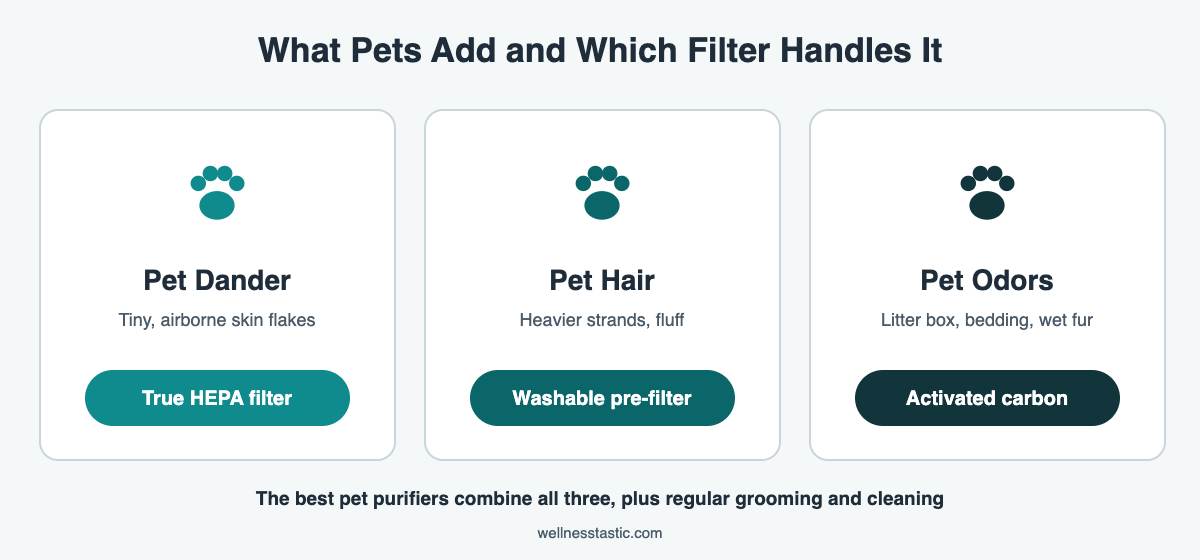
Pets affect indoor air in three main ways, and each needs a different solution:
| What pets add | What it is | What helps most |
|---|---|---|
| Pet dander | Tiny flakes of skin that can stay airborne and stick to surfaces | HEPA filtration, regular cleaning |
| Pet hair | Larger strands that mostly fall to the floor and furniture | Pre-filters, grooming, vacuuming |
| Odors | Smells from litter boxes, pet bedding, wet fur and accidents | Activated carbon, cleaning the source, ventilation |
| Tracked-in dirt and pollen | Soil, dust and pollen carried in on paws and coats | Doormats, wiping paws, HEPA filtration |
Pet dander is the part most people are concerned about. The particles are small and lightweight, so they can float in the air and settle on furniture, carpets and walls. Pet hair itself is not usually the main allergen, but it carries dander and dust, and it can clog purifier filters quickly.
What to Look for in the Best Air Purifier for Pets
1. True HEPA or verified HEPA-grade filtration
A true HEPA filter captures at least 99.97% of particles at 0.3 microns, and captures larger particles such as dander even more easily. This is the most important feature for airborne pet allergens. Avoid vague “HEPA-type” claims. Our HEPA guide explains why.
2. A washable or easy-to-clean pre-filter
In pet homes, a pre-filter is essential. It catches hair and fluff before they reach the main filter, which protects your airflow and extends the life of the more expensive HEPA filter. Washable or vacuumable pre-filters save money over time.
3. Activated carbon for pet odors
HEPA does not remove smells. For litter box, pet bedding and wet-dog odors, look for a purifier with activated carbon. More carbon generally means better and longer-lasting odor control. See our guide to HEPA vs activated carbon.
4. Enough CADR for your room
Choose a purifier whose smoke CADR is at least two-thirds of your room’s floor area, and go higher if you have several pets or someone in the home is sensitive to pet allergens. Our air purifier size guide makes this easy.
5. Pet-friendly design
Look for a stable base, a child or control lock so curious paws cannot change settings, and a design that is hard to tip over. Quiet operation matters too, because some pets are sensitive to fan noise.
6. No ozone
Avoid ozone generators entirely, and be cautious with ionizers. Ozone is a lung irritant for people and animals, and birds are especially sensitive to airborne irritants. Look for models that meet California (CARB) ozone limits, and keep any ionizer switched off.
How We Chose the Best Air Purifiers for Pets
We have not yet completed our own hands-on testing of every model on this list. We chose these purifiers using AHAM Verifide CADR ratings where available, clearly labeled manufacturer specifications, pre-filter and carbon filter design, and results from established independent testers. Read more on our How We Research page.
The Best Air Purifiers for Pets
1. Levoit Vital 200S: Best Overall Air Purifier for Pets
The Levoit Vital 200S combines strong verified performance with features designed for pet owners. It has AHAM-verified CADR ratings of 250 CFM for smoke, 254 for dust and 289 for pollen, covering rooms of about 390 square feet at 4.8 air changes per hour. Its washable pre-filter catches pet hair before it reaches the main filter, the carbon layer helps with everyday pet odors, and smart models include a dedicated pet mode that adjusts fan behavior for homes with animals.
| Spec | Details |
|---|---|
| CADR (smoke / dust / pollen) | 250 / 254 / 289 CFM (AHAM verified) |
| Room size at 4.8 ACH | About 390 sq ft |
| Pre-filter | Washable |
| Carbon | Activated carbon layer |
| Pet features | Pet mode on smart models |
| Ozone | No ionizer |
Why it works for pet owners:
- Washable pre-filter handles pet hair
- Strong verified CADR for the price
- Pet mode on smart versions
- Quiet at low speeds
Things to consider:
- Carbon layer is designed for everyday odors, not heavy litter box smells
- Particle and carbon layers are replaced together
Best for: most homes with one or two pets, in bedrooms and living rooms up to about 390 square feet.
2. Coway Airmega 400S: Best for Large Homes With Multiple Pets
The Coway Airmega 400S draws air through two filter sets, each combining activated carbon and HEPA, with washable pre-filters on both sides. That large filter area handles heavy hair and dander loads well, and the dual carbon helps with pet odors. Coway rates it at 328 CFM for smoke and dust, covering about 510 square feet at 4.8 air changes per hour. It also offers app control and scheduling.
| Spec | Details |
|---|---|
| CADR (smoke / dust) | 328 / 328 CFM (manufacturer) |
| Room size at 4.8 ACH | About 510 sq ft |
| Filtration | Two carbon + HEPA filter sets |
| Pre-filters | Washable, on both sides |
| Noise | 22–52 dB (manufacturer) |
Why it works for pet owners:
- Dual filters handle heavy pet loads
- Washable pre-filters on both sides
- Carbon in both filter sets for odors
Things to consider:
- Premium price and two filters to replace
- Large footprint
Best for: multi-pet households and large open living areas.
3. Blueair Blue Pure 211i Max: Best for Large Living Rooms
With an AHAM-verified CADR of 410 CFM and honest sizing for 635 square feet at 4.8 air changes per hour, the Blueair Blue Pure 211i Max can clear pet dander quickly in large rooms. Its fabric pre-filter wraps around the outside of the unit, so you can simply vacuum off pet hair or wash the fabric. It uses Blueair’s HEPASilent technology and has a light carbon layer for mild odors.
| Spec | Details |
|---|---|
| CADR | 410 CFM (AHAM verified) |
| Room size at 4.8 ACH | 635 sq ft |
| Pre-filter | Washable fabric wrap |
| Noise | 23–53 dB (manufacturer) |
| Power | About 46 W |
Why it works for pet owners:
- Very high verified CADR for large rooms
- Pre-filter is easy to vacuum or wash
- Energy-efficient
Things to consider:
- Light carbon layer is not ideal for strong litter box odors
- Uses electrostatic HEPASilent technology
Best for: large living rooms and family rooms where pets spend the day.
4. Rabbit Air A3: Best Premium Pick With a Customizable Pet Filter
The Rabbit Air A3 offers a CADR of 370 CFM, covering about 578 square feet at 4.8 air changes per hour, with multi-stage filtration including a washable pre-filter, activated carbon and HEPA. One stage can be customized, and Rabbit Air offers a pet allergy option, which makes it a good match for pet owners who want a targeted filter. It is quiet, Energy Star certified and can be wall-mounted, which keeps it away from curious pets.
| Spec | Details |
|---|---|
| CADR | 370 CFM |
| Room size at 4.8 ACH | About 578 sq ft |
| Filtration | Pre-filter, customizable filter, activated carbon, HEPA |
| Noise | About 30–55 dB |
| Mounting | Floor or wall |
Why it works for pet owners:
- Customizable pet-focused filter option
- Wall-mountable, out of reach of pets
- Quiet operation
Things to consider:
- Expensive to buy
- Filter kits are costly
Best for: pet owners who want premium performance and a wall-mounted option.
5. Levoit Core 300: Best Budget Pick for Small Rooms
The Levoit Core 300 is a compact, affordable option for a bedroom, office or small room where your pet sleeps. It has AHAM-verified CADR ratings of 143 CFM for smoke and 153 for dust, suiting rooms up to about 222 square feet. Levoit also sells specialized replacement filters for this model, including a pet-focused version.
| Spec | Details |
|---|---|
| CADR (smoke / dust) | 143 / 153 CFM (AHAM verified) |
| Room size at 4.8 ACH | About 222 sq ft |
| Filtration | Pre-filter, HEPA, activated carbon |
| Weight | About 7.9 lb |
Why it works for pet owners:
- Affordable with verified performance
- Compact for small rooms
- Specialized filter options
Things to consider:
- Pre-filter is not separately washable
- Too small for large living areas
Best for: small bedrooms and rooms where a single pet sleeps.
Best Air Purifier for Pets: Comparison Table
| Model | CADR | Room size (4.8 ACH) | Washable pre-filter | Carbon | Best for |
|---|---|---|---|---|---|
| Levoit Vital 200S | 250 (AHAM) | ~390 sq ft | ✓ | ✓ | Best overall |
| Coway Airmega 400S | 328 (mfr) | ~510 sq ft | ✓ (x2) | ✓ (x2) | Multi-pet homes |
| Blueair 211i Max | 410 (AHAM) | 635 sq ft | ✓ | Light | Large living rooms |
| Rabbit Air A3 | 370 | ~578 sq ft | ✓ | ✓ | Premium, wall-mount |
| Levoit Core 300 | 143 (AHAM) | ~222 sq ft | — | ✓ | Small rooms, budget |
Best Air Purifier for Pets by Situation
Cat owners
Cat dander is known for being lightweight and sticky, so it can stay airborne and cling to furniture and walls. A HEPA purifier running continuously in the rooms where your cat spends the most time helps. For litter box odors, choose a purifier with a meaningful amount of carbon, and focus on cleaning the box daily and ventilating the area.
Dog owners
Dogs tend to shed more hair and bring in more outdoor dirt and pollen. A strong pre-filter is essential, and carbon helps with “dog smell” after walks and baths. Wiping paws at the door and bathing your dog on a regular schedule also make a big difference.
Multiple pets
With several pets, choose a larger purifier than the room size alone suggests, or use two purifiers in different areas. The Coway Airmega 400S’s dual filters are well suited to heavy loads.
Birds and small animals
Birds have very sensitive respiratory systems. Use only mechanical HEPA filtration, never ozone generators, and keep ionizers switched off. Place the purifier near, but not directly blowing on, cages and enclosures. For small animals such as rabbits and guinea pigs, a purifier helps with bedding dust and hay particles.
Pet owners with allergies
A HEPA purifier can reduce airborne pet allergens, especially in the bedroom, but it works best as part of a wider plan: keeping pets out of the bedroom, washing bedding often, using a HEPA vacuum and cleaning surfaces regularly. If you have pet allergies or asthma, speak with a healthcare professional for advice. Our guide to air purifiers for allergies covers this in more detail.
Where to Place an Air Purifier in a Pet Home
- Put it in the room where your pets spend the most time, such as the living room or the room with their bed.
- Keep it a few feet away from pet beds, litter boxes and food bowls so it does not blow hair and litter dust around.
- Place it on a stable surface where it cannot be knocked over, and secure the power cord so pets cannot chew it.
- Leave space around the intake so hair does not block airflow.
- If pets sleep in your bedroom, use a quiet purifier there overnight. See our bedroom guide.
How to Reduce Pet Dander, Hair and Odors
An air purifier is one part of a pet-friendly clean air routine. Combine it with these habits:
- Groom regularly: brush pets outdoors when possible to remove loose hair and dander.
- Wash pet bedding weekly in hot water.
- Vacuum with a HEPA vacuum at least twice a week in pet areas.
- Clean the litter box daily and ventilate the area.
- Wipe paws when pets come in from outside.
- Keep pets off beds if anyone in the home has allergies.
- Use washable covers on sofas and pet favorite spots.
- Upgrade your HVAC filter to MERV 13 if your system supports it. See our MERV guide.
Where Pet Odors Really Come From
An air purifier with carbon can reduce odors in the air, but most pet smells come from sources that keep releasing odor until they are cleaned. Tackle these first:
- Litter boxes: scoop daily, change litter regularly and wash the box. A covered box in a ventilated spot helps.
- Pet bedding and blankets: these absorb oils and odors quickly; wash them weekly.
- Carpets and upholstery: accidents and oils soak in; use an enzyme cleaner designed for pet messes.
- Wet fur: dry dogs thoroughly after walks in the rain and after baths.
- Food and water bowls: wash them daily to prevent sour smells.
- Toys: soft toys trap saliva and dirt; wash them regularly.
Once the sources are under control, a purifier with a good amount of activated carbon handles the remaining background odor much more effectively.
Shedding Season: How to Adjust Your Air Purifier
Many dogs and cats shed more heavily in spring and fall as their coats change. During these periods:
- Clean the pre-filter more often, as frequently as every week.
- Run the purifier on a higher setting in rooms where pets spend the most time.
- Increase grooming to several times a week, ideally outdoors.
- Vacuum more often with a HEPA vacuum, especially sofas and pet beds.
- Check your HVAC filter monthly, since it will load up faster.
Spring shedding also coincides with pollen season, when pets carry pollen indoors on their coats. Wiping your pet down with a damp cloth after outdoor time can reduce the amount of pollen and dirt brought inside.
Tip: track the results
An indoor air quality monitor with PM2.5 and PM10 readings shows how much airborne dander and dust your pets are adding and how quickly your purifier clears it, which helps you choose the right fan speed.
Maintaining an Air Purifier in a Pet Home
| Task | How often in a pet home |
|---|---|
| Clean or vacuum the pre-filter | Every 1–2 weeks |
| Wipe the intake and outlet grilles | Monthly |
| Replace the main HEPA filter | Often every 6–9 months, sooner with several pets |
| Replace the carbon filter | When odors return quickly |
Pet hair builds up faster than typical household dust, so pre-filter cleaning matters more than usual. A clogged pre-filter reduces airflow and makes the purifier work harder and louder.
Common Mistakes Pet Owners Make
- Skipping the pre-filter: hair clogs the main filter quickly and reduces performance.
- Relying on HEPA for odors: smells need carbon and source cleaning.
- Buying too small: pets add a constant stream of particles, so size up.
- Using ozone or scented air fresheners: these can irritate both people and pets.
- Placing the purifier next to the litter box: it can blow litter dust around the room.
- Forgetting to clean: a purifier cannot remove hair and dander that has settled on surfaces.
Frequently Asked Questions
What is the best air purifier for pets?
For most homes, the Levoit Vital 200S is our top pick thanks to its AHAM-verified CADR, washable pre-filter, carbon layer and pet mode on smart models. For multiple pets in larger spaces, the Coway Airmega 400S is a strong choice.
Do air purifiers really help with pet dander?
HEPA air purifiers capture airborne pet dander effectively. Because dander also settles on surfaces, the best results come from combining a purifier with regular vacuuming, washing bedding and grooming.
Will an air purifier remove pet hair?
Air purifiers catch some floating hair and fluff in their pre-filters, but most pet hair is heavy enough to fall to the floor and furniture. Grooming and vacuuming are the main ways to control pet hair.
Are air purifiers safe for pets?
HEPA air purifiers without ozone are generally safe for pets. Avoid ozone generators, keep ionizers off, especially around birds, secure cords and place the purifier where it cannot be tipped over.
Can an air purifier get rid of litter box smell?
A purifier with activated carbon can reduce some litter box odor in the air, but cleaning the box daily and ventilating the area are more effective. Carbon filters also need replacing when odors return.
The Bottom Line
The best air purifier for pets combines true HEPA or verified HEPA-grade filtration for dander, a washable pre-filter for hair and activated carbon for odors. The Levoit Vital 200S is our best overall pick, the Coway Airmega 400S suits multi-pet homes, the Blueair Blue Pure 211i Max is ideal for large living rooms, the Rabbit Air A3 offers a customizable pet filter, and the Levoit Core 300 is a great budget option for small rooms. Pair your purifier with regular grooming and cleaning for the freshest home.
Sources
- U.S. EPA: Guide to Air Cleaners in the Home
- AHAM Verifide: Air Cleaner Certification Program
- California Air Resources Board: Air Cleaners and Ozone
Specifications are based on AHAM Verifide data, manufacturer information or independent testing at the time of writing, as labeled. This article is for general information and is not medical or veterinary advice. See our Affiliate Disclosure and Disclaimer.