Poor indoor air quality rarely announces itself. Many indoor pollutants are invisible and odorless, so problems can build up for months before anyone notices. Still, your home often gives you clues. Stale air, lingering smells, condensation on windows or dust that seems to return overnight can all be signs of poor indoor air quality.
This guide covers the most common warning signs, what each one may point to, and practical steps for investigating the cause. It is designed to help you spot home air quality problems early and decide what to do next. For a full overview of the topic, see our complete guide to indoor air quality.
Important: Many of the signs below are clues, not proof. Physical symptoms such as headaches or irritated eyes can have many different causes that have nothing to do with indoor air. This article does not diagnose or treat any health condition. If you have health concerns, please speak with a qualified healthcare professional.
Emergency Signs: Act Immediately
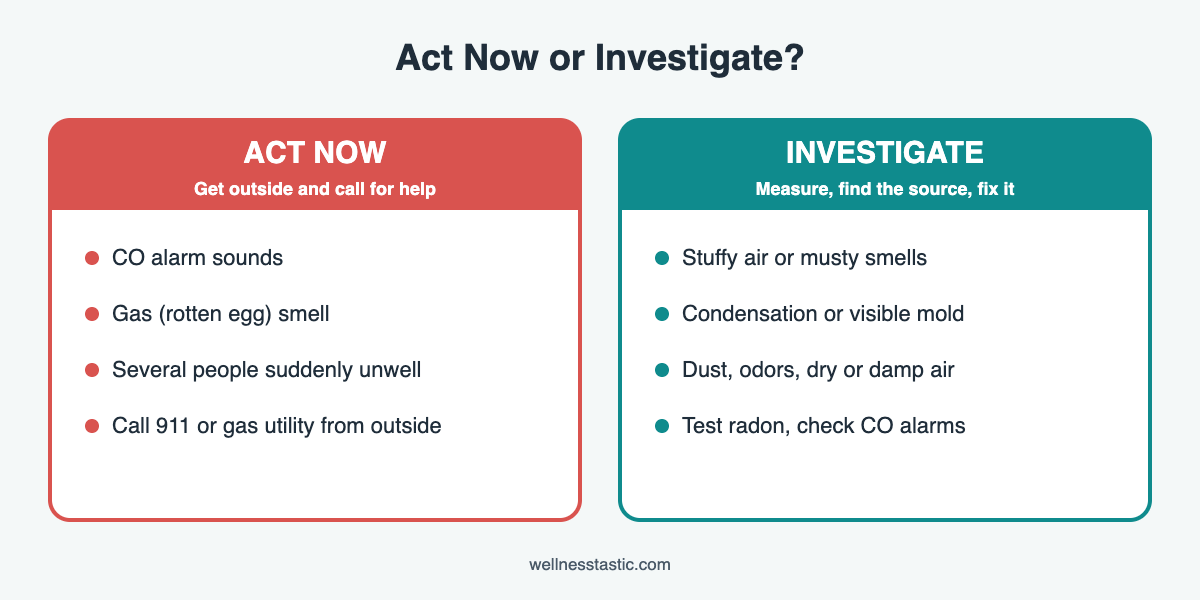
Before looking at everyday clues, it is important to know the signs that need immediate action rather than investigation:
- Your carbon monoxide (CO) alarm goes off: get everyone, including pets, outside into fresh air right away and call 911 or your local fire department. Do not go back inside until emergency responders say it is safe.
- You smell gas (a rotten egg smell): leave the home immediately, avoid using light switches or anything that could create a spark, and call your gas utility or 911 from outside.
- Several people or pets in the home suddenly feel unwell at the same time, especially with symptoms such as headache, dizziness, nausea or confusion that improve outside: treat it as a possible CO problem, get outside and call for help.
Carbon monoxide cannot be seen or smelled, which is why working CO alarms on every level of your home are essential.
Common Signs of Poor Indoor Air Quality
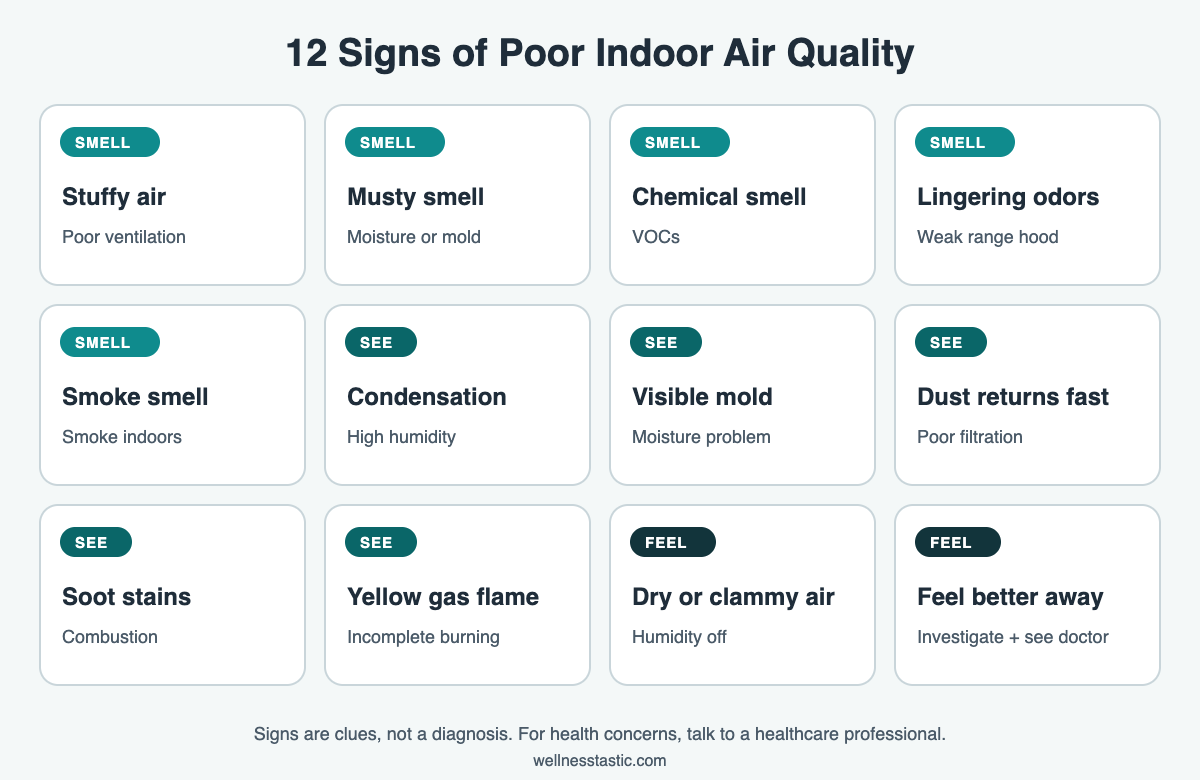
The signs below are grouped by what you might notice: smells, sights, comfort, and changes in how you feel at home. For each one, we explain what it may mean, what to check and what to do.
Signs You Can Smell
1. Stale, stuffy or “heavy” air
A room that feels stuffy, especially first thing in the morning or after several people have been in it, is one of the most common signs of bad indoor air. It usually points to poor ventilation, which allows carbon dioxide (CO2), moisture and other pollutants to build up.
What to check: whether windows and doors stay closed for long periods, whether bedroom doors are shut overnight, and whether your home has any mechanical ventilation. A CO2 monitor will show whether levels rise significantly overnight.
What to do: open windows for 10 to 15 minutes when outdoor air is good, leave bedroom doors slightly open, run exhaust fans, and ask an HVAC professional about ventilation options if the problem persists.
2. Musty or earthy odors
A musty smell is one of the clearest signs of excess moisture and possible mold or mildew growth, even when you cannot see any mold.
What to check: basements, closets on exterior walls, under sinks, around windows, behind furniture against cold walls, bathroom ceilings and anywhere that has had water damage. Measure humidity; readings above 60% make mold growth more likely.
What to do: find and fix the moisture source, dry wet materials within 24 to 48 hours, use a dehumidifier if humidity stays high, and clean up small areas of mold. Larger or hidden mold problems may need a professional.
3. Chemical, paint or “new” smells
Strong chemical smells often come from volatile organic compounds (VOCs) released by paints, varnishes, new furniture, carpets, cleaning products and air fresheners.
What to check: whether you have recently painted, renovated, bought new furniture or flooring, or started using a new cleaning or fragrance product. A monitor with a VOC sensor can show spikes.
What to do: ventilate well, let new items air out, store chemicals outside living areas, switch to low-VOC and fragrance-free products, and consider an air purifier with a substantial activated carbon filter for ongoing odors.
4. Cooking smells that linger for hours
If cooking odors hang around long after a meal, your kitchen ventilation probably is not removing pollutants effectively. Cooking also releases fine particles that you cannot smell.
What to check: whether your range hood vents outdoors or only recirculates, whether it is used every time you cook, and whether its grease filter is clean.
What to do: turn on the range hood before cooking and leave it running afterward, use back burners, clean or replace hood filters, and open a window if your hood only recirculates.
5. Smoke or burning smells
Smoke smells can come from indoor smoking, fireplaces, wood stoves, candles, or outdoor wildfire smoke drifting inside. Smoke contains fine particles that can affect indoor air quality.
What to check: for indoor smoking or vaping, fireplace and chimney drafts, and local outdoor air quality on AirNow.gov.
What to do: keep smoking outside, have chimneys inspected, close windows during smoke events and run a HEPA air purifier sized for the room.
Signs You Can See
6. Condensation on windows and walls
Frequent condensation on the inside of windows, especially in colder months, is a strong sign of high indoor humidity.
What to check: humidity levels with a hygrometer, bathroom and kitchen fan use, indoor clothes drying, and whether a humidifier is set too high.
What to do: use exhaust fans, dry clothes outdoors or in a vented dryer, reduce humidifier use, and wipe condensation so window frames do not develop mold. Aim for roughly 30–50% humidity.
7. Visible mold or mildew
Black, green, gray or white patches on walls, ceilings, grout, caulk or window frames are a clear sign of a moisture problem.
What to check: the size of the area, nearby leaks, poor ventilation and humidity levels. Also look for peeling paint or water stains, which can signal hidden moisture.
What to do: fix the moisture problem first, then clean small areas using appropriate precautions. The EPA suggests that larger areas, often described as more than about 10 square feet, may need professional help.
8. Dust that builds up quickly
If surfaces become dusty again soon after cleaning, there may be a lot of airborne particles circulating in your home.
What to check: the condition and rating of your HVAC filter, whether it fits properly, cleaning methods, pets, and whether windows are open near busy roads.
What to do: replace or upgrade your HVAC filter, dust with damp cloths, vacuum with a HEPA vacuum, and consider a HEPA air purifier in frequently used rooms.
9. Dark stains around vents or on walls and ceilings
Dark streaks around air vents, above candles or near fireplaces can come from soot and particles. Stains on ceilings may also point to leaks.
What to check: candle and incense use, fireplace drafts, furnace condition, and roof or plumbing leaks above stained areas.
What to do: reduce candle and incense use, have fuel-burning appliances inspected, and repair any leaks.
10. Yellow or flickering flames on gas appliances
Gas stove and appliance flames should generally burn blue. Yellow, orange or lazy flames can be a sign of incomplete combustion.
What to check: burner flames on your stove and, if visible, on water heaters and furnaces. Look for soot around appliances.
What to do: have the appliance inspected and adjusted by a qualified technician, and make sure CO alarms are installed and working.
Signs You Can Feel
11. Air that feels too dry or too damp
Very dry air in winter can make a home feel uncomfortable, while damp, clammy air in summer often means humidity is too high.
What to check: humidity levels in several rooms with a hygrometer or air quality monitor.
What to do: keep humidity roughly between 30% and 50%. Use a dehumidifier or air conditioning when it is too high, and a clean humidifier only when it is too low.
12. Symptoms that seem to improve when you leave home
Some people notice things like irritated eyes, nose or throat, headaches or tiredness that seem worse at home and better when they are away. The EPA notes that this pattern can sometimes suggest an indoor air issue, but these symptoms are common and can have many other causes, from allergies and colds to stress and sleep.
What to check: whether the symptoms follow a pattern, such as appearing after cooking, in a particular room, after renovations, or when the heating is on. Check CO alarms, humidity and ventilation.
What to do: review the other signs in this guide, improve ventilation and reduce sources, and talk to a healthcare professional about your symptoms. Do not assume the cause is indoor air without proper advice.
Signs From Your Monitor and Alarms
An indoor air quality monitor removes a lot of the guesswork. These readings are worth paying attention to:
| Reading | What it may suggest | First step |
|---|---|---|
| PM2.5 stays high for long periods | Ongoing particle source or poor filtration | Check cooking, smoking and candles; upgrade filtration |
| CO2 regularly above about 1,000 ppm | The room is not getting enough fresh air | Increase ventilation |
| VOC readings spike often | Products, furniture or activities releasing chemicals | Identify the source; ventilate; switch products |
| Humidity above 60% | Higher risk of mold and dust mites | Find moisture sources; dehumidify |
| Humidity below 30% | Very dry air | Use a clean humidifier carefully |
| CO alarm sounds | Possible carbon monoxide | Leave immediately and call 911 |
Consumer monitors are helpful for spotting patterns but are not laboratory instruments. Focus on trends and changes rather than single readings. Learn more in our guide on how to test indoor air quality, or compare options in our list of the best indoor air quality monitors.
Signs of Poor Indoor Air Quality by Season
Indoor air quality problems often follow the seasons. Knowing what to watch for at different times of year helps you catch issues early.
| Season | Common signs | Likely reason |
|---|---|---|
| Winter | Stuffy rooms, window condensation, very dry air, lingering cooking smells | Homes are sealed up, ventilation drops and heating runs constantly |
| Spring | More dust and pollen indoors, sneezing when windows are open | Pollen enters through windows, clothing, shoes and pets |
| Summer | Clammy air, musty basements, condensation around AC vents and ducts | High outdoor humidity and cool indoor surfaces |
| Fall | Musty smells when heating starts, dust from vents | Dust and debris in ducts and furnaces after months of little use |
| Wildfire season | Smoke smell indoors, haze, high PM2.5 readings | Outdoor smoke leaking into the home |
Seasonal patterns are useful clues. For example, if musty smells appear every summer in the basement, humidity control is likely the answer. If the home feels stuffy only in winter, ventilation is probably the main issue.
Signs You Cannot Detect Without Testing
Some of the most serious indoor air quality problems give no signs at all:
- Radon: an invisible, odorless radioactive gas from the ground. The only way to know your level is to test. The EPA recommends fixing homes with levels at or above 4 pCi/L.
- Carbon monoxide: requires CO alarms. Do not rely on smell or symptoms.
- Lead dust: in homes built before 1978, lead paint can create dust during renovation. Testing is needed.
Even if your home shows none of the signs in this guide, testing for radon and installing CO alarms are basic steps every household should take.
Quick Reference: Sign and Possible Cause
| Sign | Possible cause |
|---|---|
| Stuffy air | Poor ventilation, high CO2 |
| Musty smell | Moisture, mold or mildew |
| Chemical smell | VOCs from products, furniture or renovation |
| Lingering cooking odors | Weak or unused range hood |
| Window condensation | High humidity |
| Visible mold | Moisture problem |
| Fast-returning dust | Poor filtration, many particle sources |
| Soot stains | Candles, fireplaces, combustion problems |
| Yellow gas flames | Incomplete combustion |
| Dry or clammy air | Humidity too low or too high |
How to Investigate Home Air Quality Problems Step by Step
If you have noticed several signs, work through them methodically rather than buying a gadget and hoping for the best:
- Check safety first: make sure CO alarms are installed and working, and have fuel-burning appliances inspected.
- Measure: use a hygrometer or air quality monitor for a week to see patterns in humidity, particles, CO2 and VOCs.
- Walk through your home: look and smell for moisture, mold, leaks and chemical sources, room by room.
- Keep a simple log: note when smells, stuffiness or symptoms appear and what was happening at the time.
- Remove likely sources: stop using suspected products, keep smoking outside and fix leaks.
- Improve ventilation and filtration: use exhaust fans, open windows when appropriate and upgrade filters.
- Test for radon if you have not already.
- Re-check: compare readings and signs after a week or two.
Our printable indoor air quality checklist makes the walkthrough easy, and our guide on how to improve indoor air quality lists fixes for each problem.
When to Call a Professional
- CO alarms go off or you suspect a combustion problem.
- You smell gas.
- Radon test results are 4 pCi/L or higher.
- You find large or recurring mold, or mold after flooding.
- Signs persist even after you have improved ventilation, removed sources and controlled humidity.
- You are planning renovations in an older home that may contain lead paint or asbestos.
Depending on the problem, the right professional may be a licensed HVAC technician, a certified radon professional, a mold assessment specialist or your gas utility. For health concerns, speak with a doctor or other qualified healthcare provider.
Frequently Asked Questions
How can I tell if the air in my house is bad?
Look for clues such as stuffy air, musty or chemical smells, condensation, visible mold and dust that returns quickly. For a more reliable answer, use an indoor air quality monitor, CO alarms and a radon test.
Can poor indoor air quality make you feel unwell?
According to the EPA, some indoor pollutants can be associated with effects such as irritation of the eyes, nose and throat, headaches and fatigue, and some pollutants have more serious long-term effects. However, these symptoms have many possible causes. If you feel unwell, talk to a healthcare professional rather than assuming indoor air is the cause.
Does an air purifier fix poor air quality in a house?
An air purifier can help reduce airborne particles, but it cannot fix moisture problems, gas leaks, radon or poor ventilation. Identify and fix the cause first, then use filtration as support. See do air purifiers work.
What is the most common indoor air quality problem?
In many homes, the most common issues are poor ventilation, excess humidity and moisture, and pollutants from cooking and household products. The right answer for your home depends on what you find when you investigate.
The Bottom Line
Recognizing the signs of poor indoor air quality early helps you fix problems before they grow. Your home usually gives you clues when indoor air quality needs attention: stale air, musty smells, condensation, mold and dust are the most common. Treat emergency signs such as CO alarms and gas smells seriously and act right away. For everything else, measure, investigate step by step, fix the source and improve ventilation. If you have health concerns, speak with a healthcare professional.
Sources
- U.S. EPA: Care for Your Air, A Guide to Indoor Air Quality
- U.S. EPA: A Brief Guide to Mold, Moisture and Your Home
- U.S. EPA: Guide to Air Cleaners in the Home
- AirNow.gov: Air Quality Index
This article is for general information only and does not diagnose or treat any health condition. See our Disclaimer and How We Research.