When people hear “air pollution,” they usually picture smog, traffic or factory smoke. But some of the pollution you breathe every day comes from inside your own home. Indoor air pollution is the presence of particles, gases and biological contaminants in the air inside buildings, and it comes from everyday things like cooking, cleaning, heating, furniture and even the ground beneath your house.
In this guide, you will learn what indoor air pollution is, the main causes, the most common indoor air pollutants one by one, and practical solutions for each. For the bigger picture, see our complete guide to indoor air quality.
In short: Indoor air pollution mainly comes from combustion (cooking, heating, smoking), building materials and furnishings, household products, moisture and biological sources, and outdoor pollution that gets inside. Poor ventilation allows these pollutants to build up.
What Is Indoor Air Pollution?
Indoor air pollution refers to contaminants in the air inside homes, schools, offices and other buildings. These pollutants can be:
- Particles: tiny solid or liquid droplets such as smoke, dust and soot.
- Gases: such as carbon monoxide, nitrogen dioxide, radon and volatile organic compounds (VOCs).
- Biological contaminants: such as mold, dust mites, pet dander, pollen, bacteria and viruses.
The EPA notes that indoor levels of some pollutants can be higher than outdoor levels, and because most people spend the majority of their time indoors, indoor air can account for a large share of total exposure. Globally, the term household air pollution is also used for smoke from cooking and heating with solid fuels such as wood, coal or dung, which the World Health Organization identifies as a major health risk in many low- and middle-income countries.
Main Causes of Indoor Air Pollution
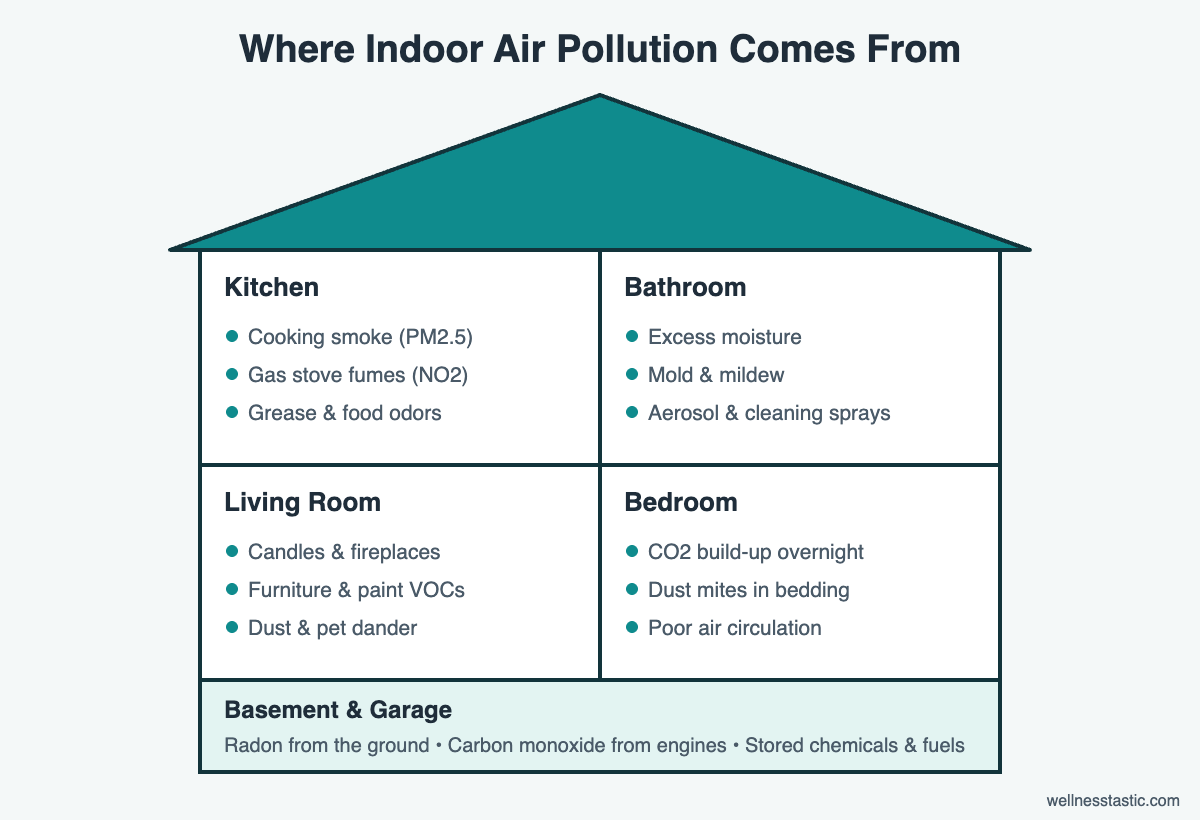
Most indoor pollution sources fall into six groups:
| Cause | Examples |
|---|---|
| Combustion | Gas stoves, fireplaces, candles, wood stoves, unvented heaters, tobacco smoke |
| Building materials and furnishings | Pressed wood furniture, new carpets, paints, varnishes, insulation in older homes |
| Household products | Cleaning products, air fresheners, aerosol sprays, personal care products, pesticides, hobby supplies |
| Moisture and biological sources | Leaks, high humidity, pets, dust mites, mold, pollen |
| Outdoor pollution | Traffic pollution, wildfire smoke, pollen, radon from the ground |
| Poor ventilation | Tightly sealed homes, lack of exhaust fans, closed windows for long periods |
Ventilation deserves special attention. It is not a source itself, but when too little outdoor air comes in, pollutants from every other source build up to higher levels.
The Most Common Indoor Air Pollutants

1. Particulate matter (PM2.5 and PM10)
Particulate matter is a mix of tiny particles suspended in the air. PM2.5 refers to fine particles 2.5 micrometers or smaller, small enough to be inhaled deep into the lungs.
Common sources: cooking (especially frying and searing), candles, incense, fireplaces, wood stoves, tobacco smoke, and outdoor smoke or traffic pollution that drifts inside.
How to reduce it: use a range hood vented outdoors, limit candles and incense, keep smoking outside, use a high-rated HVAC filter and run a HEPA air purifier.
2. Volatile organic compounds (VOCs)
VOCs are gases released from many solids and liquids at room temperature. There are thousands of different VOCs, and levels are often higher indoors than outdoors.
Common sources: paints, varnishes and paint strippers, cleaning and disinfecting products, air fresheners, cosmetics, new furniture, carpets, glues and hobby products.
How to reduce it: choose low-VOC products, use fewer fragranced products, ventilate during and after painting or cleaning, store chemicals outside the living area, and let new furniture air out. Air purifiers with a substantial activated carbon filter may help with some gases and odors.
3. Formaldehyde
Formaldehyde is a common VOC with a strong smell at higher levels. It is often discussed separately because it is widely used in building materials.
Common sources: pressed wood products such as particleboard, plywood and medium-density fiberboard (MDF), some glues, fabrics and household products, and combustion.
How to reduce it: choose furniture and cabinets labeled as low-emitting or compliant with formaldehyde emission standards, keep humidity and temperature moderate (emissions rise with heat and humidity), and ventilate, especially in new homes or after renovations.
4. Carbon monoxide (CO)
Carbon monoxide is an odorless, colorless gas produced by incomplete combustion. It can be deadly at high levels, and hundreds of people in the U.S. die each year from accidental CO poisoning.
Common sources: faulty or poorly vented furnaces, water heaters, gas stoves, fireplaces, generators, and vehicles running in attached garages.
How to reduce it: install CO alarms on every level of your home and near sleeping areas, have fuel-burning appliances inspected annually, never use generators, grills or camp stoves indoors, and never leave a car running in a garage.
5. Nitrogen dioxide (NO2)
Nitrogen dioxide is a gas produced when fuel is burned at high temperatures. It can irritate the airways.
Common sources: gas stoves and ovens, unvented gas heaters, wood stoves and kerosene heaters.
How to reduce it: use a range hood vented outdoors every time you cook on gas, keep appliances properly adjusted, and avoid unvented heaters.
6. Radon
Radon is a naturally occurring radioactive gas that seeps up from the ground into buildings. The EPA identifies radon as the leading cause of lung cancer among non-smokers in the United States.
Common sources: soil and rock beneath the home, entering through cracks in foundations, floors and gaps around pipes.
How to reduce it: test your home with a radon kit or professional test. If levels are at or above 4 picocuries per liter (pCi/L), the EPA recommends mitigation by a qualified contractor.
7. Mold and moisture
Mold grows wherever there is moisture. Mold spores and fragments can become airborne and may trigger reactions in sensitive people.
Common sources: roof and plumbing leaks, flooding, condensation on cold surfaces, poorly ventilated bathrooms and kitchens, damp basements and humidity above 60%.
How to reduce it: fix water problems, dry wet materials within 24 to 48 hours, keep humidity between about 30% and 50%, and clean up small areas of mold. The EPA emphasizes that moisture control is the key to mold control.
8. Dust mites, pet dander and pollen
These are common biological allergens. Dust mites are microscopic creatures that live in bedding, upholstery and carpets. Pet dander consists of tiny skin flakes, and pollen comes indoors from outside.
Common sources: bedding, mattresses, carpets, upholstered furniture, pets, and open windows or clothing during pollen season.
How to reduce it: wash bedding weekly in hot water, vacuum with a HEPA vacuum, keep humidity below 50% to discourage dust mites, groom pets regularly, and use a HEPA air purifier in bedrooms.
9. Secondhand and thirdhand smoke
Tobacco smoke contains thousands of chemicals and fine particles. Thirdhand smoke refers to residues that settle on surfaces and linger long after smoking stops.
Common sources: smoking cigarettes, cigars or pipes indoors, and vaping.
How to reduce it: the only fully effective solution is to keep all smoking outside the home and car. Air purifiers and ventilation cannot remove all of the harmful components of tobacco smoke.
10. Carbon dioxide (CO2)
CO2 is exhaled by people and pets. At typical indoor levels it is mainly an indicator of ventilation rather than a direct hazard, but high levels can make a room feel stuffy.
Common sources: people in closed rooms, especially bedrooms overnight and crowded living spaces.
How to reduce it: increase fresh air through open windows, bedroom doors, or mechanical ventilation. A CO2 monitor helps you see when a room needs more air.
11. Lead dust and asbestos in older homes
Homes built before 1978 may contain lead-based paint, and older homes may contain asbestos in insulation, flooring or ceiling materials. They are usually a concern when disturbed.
Common sources: sanding, scraping or renovating painted surfaces in older homes, and disturbing old insulation, pipe wrap or ceiling tiles.
How to reduce it: do not sand or scrape suspected lead paint or disturb suspected asbestos yourself. Have materials tested and use certified professionals for renovation or removal.
12. Pesticides and ozone
Pesticides used indoors or tracked in from outside can linger in dust and air. Ozone is a lung irritant that mostly comes from outdoors, but some devices marketed as air purifiers produce it on purpose.
Common sources: indoor pest sprays and foggers, lawn chemicals tracked indoors, and ozone generators.
How to reduce it: use integrated pest management and the least toxic options first, take shoes off at the door, and avoid ozone generators. Look for air cleaners that meet California (CARB) ozone emission limits.
Indoor vs Outdoor Air Pollution
Indoor and outdoor air pollution are connected, but they behave differently. Understanding the difference helps you decide when to open windows and when to rely on filtration.
| Indoor air pollution | Outdoor air pollution | |
|---|---|---|
| Main sources | Cooking, heating, smoking, products, materials, moisture | Traffic, industry, wildfires, pollen, ozone |
| Typical pollutants | PM2.5, VOCs, formaldehyde, CO, NO2, mold, allergens, radon | PM2.5, ozone, NO2, pollen |
| How it builds up | Trapped by limited ventilation | Spread by weather and wind |
| Who controls it | Mostly you | Mostly regulations and weather |
| Best response | Remove sources, ventilate, filter | Close windows on bad days, filter indoor air |
When outdoor air is clean, opening windows is one of the easiest ways to dilute indoor pollution. When outdoor air is poor, such as during wildfire smoke or high pollen days, keeping windows closed and running filtration is usually the better choice.
Hidden Sources of Indoor Air Pollution You Might Not Expect
Beyond the obvious culprits, several everyday items and habits can add pollutants to your air:
- Self-cleaning oven cycles: the high heat can burn off food residue and release smoke and particles. Ventilate well and use the range hood.
- Ultrasonic humidifiers filled with tap water: they can release minerals from the water into the air as fine “white dust.” Using distilled or demineralized water helps.
- Laser printers and 3D printers: some studies have found they can emit ultrafine particles and VOCs during use. Place them in a well-ventilated area away from where you sleep.
- Freshly dry-cleaned clothes: some dry-cleaning solvents can off-gas. Airing clothes out before bringing them into closets reduces this.
- Attached garages: car exhaust, fuels, paints and lawn equipment stored in an attached garage can seep into the home through shared walls and doors. Keep the connecting door closed and never idle engines inside.
- Gas fireplaces and decorative burners: even vented units should be inspected, and unvented ones can release combustion gases into living spaces.
- Scented laundry products and dryer sheets: they add fragrance compounds to clothes, linens and indoor air.
- Renovation dust: sanding, cutting drywall and demolition create large amounts of fine dust. Seal off work areas and use proper ventilation and protection.
You do not need to eliminate all of these. The goal is to be aware of them, reduce the ones you can, and ventilate when you use them.
How Indoor Air Pollution Can Affect You
Effects depend on the pollutant, how much is in the air, how long you are exposed and individual sensitivity. According to the EPA, some effects may show up soon after exposure, such as irritation of the eyes, nose and throat, headaches, dizziness and fatigue. Other effects may appear years later or only after long or repeated exposure.
Children, older adults and people with asthma, allergies or heart and lung conditions may be more sensitive. Because symptoms can have many causes, talk to a healthcare professional if you are concerned about your health. This guide is for general information and is not medical advice.
Solutions: How to Reduce Indoor Air Pollution
The EPA recommends three main strategies, in this order of priority:
- Source control: remove or reduce the sources of pollution. This is usually the most effective approach.
- Ventilation: bring in more outdoor air and exhaust polluted air, especially from kitchens and bathrooms.
- Air cleaning: use HVAC filters and portable air purifiers to capture pollutants that remain.
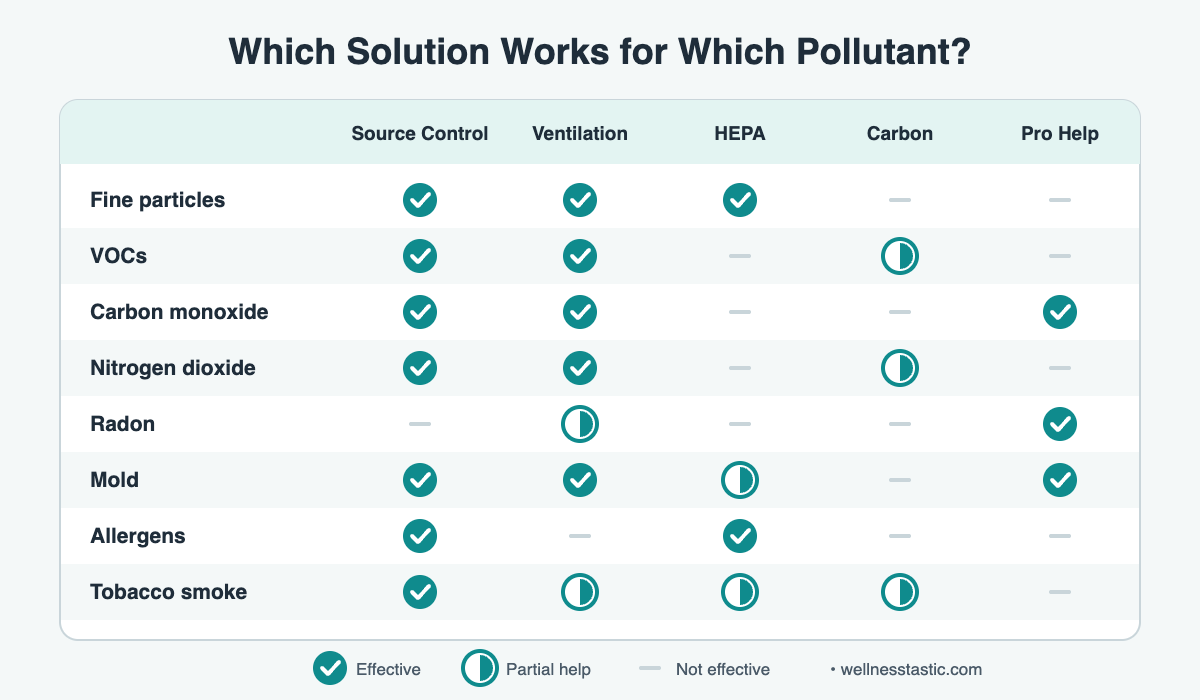
Different pollutants respond to different solutions:
| Pollutant | Source control | Ventilation | HEPA filter | Activated carbon | Professional help |
|---|---|---|---|---|---|
| Fine particles (PM2.5) | ✓ | ✓ | ✓ | — | — |
| VOCs and formaldehyde | ✓ | ✓ | — | Partial | — |
| Carbon monoxide | ✓ | ✓ | — | — | ✓ (appliance inspection) |
| Nitrogen dioxide | ✓ | ✓ | — | Partial | — |
| Radon | — | Partial | — | — | ✓ (mitigation) |
| Mold | ✓ (moisture) | ✓ | Partial | — | ✓ (large areas) |
| Dust mites, dander, pollen | ✓ | — | ✓ | — | — |
| Tobacco smoke | ✓ (only real fix) | Partial | Partial | Partial | — |
For a step-by-step list of actions, read our guide on how to improve indoor air quality at home. To see which pollutants are highest in your home, an indoor air quality monitor can track particles, CO2, VOCs and humidity, and our best air purifiers guide can help if filtration is your next step.
Frequently Asked Questions
What is the biggest source of indoor air pollution?
It varies by home. In many homes, cooking, smoking and fuel-burning appliances are major sources of particles and gases. In homes with moisture problems, mold can be significant. Radon is one of the most serious risks and can only be found by testing.
Is indoor air pollution worse than outdoor pollution?
Indoor levels of some pollutants can be higher than outdoor levels, particularly VOCs and cooking-related particles. Outdoor pollution also enters homes, so both matter.
Can an air purifier remove all indoor air pollution?
No. HEPA purifiers are designed to capture airborne particles, and activated carbon can reduce some gases and odors, but no air cleaner removes all pollutants. Carbon monoxide and radon require other solutions. Source control and ventilation come first.
How can I tell if my home has indoor air pollution?
Clues include stale or stuffy air, lingering odors, condensation, visible mold and dust that builds up quickly. The most reliable approach is to use an air quality monitor, CO alarms and a radon test. See our guide on the signs of poor indoor air quality.
The Bottom Line
Indoor air pollution comes from many everyday sources, but most of them are within your control. Identify the main sources in your home, reduce them, ventilate regularly, keep humidity in check and use filtration where it helps. Test for radon and install CO alarms to protect against the invisible risks.
Sources
- U.S. EPA: Care for Your Air, A Guide to Indoor Air Quality
- U.S. EPA: Guide to Air Cleaners in the Home
- U.S. EPA: A Brief Guide to Mold, Moisture and Your Home
This article is for general information only and is not medical advice. See our Disclaimer and How We Research.