WellnessTastic is reader-supported. We may earn a commission from links on this page at no extra cost to you. As an Amazon Associate, we earn from qualifying purchases. Learn more.
Air quality monitor vs air purifier: which one do you actually need? If you are trying to improve the air in your home, you have probably come across two very different devices: air quality monitors and air purifiers. They are often sold side by side and sometimes even combined, so it is easy to assume they do the same job. They do not.
In simple terms, an air quality monitor measures what is in your air, while an air purifier cleans certain pollutants out of it. In this guide, we explain the difference between an air quality monitor vs an air purifier, what each one can and cannot do, and how to decide whether you need one, the other, or both.
Quick answer: An air quality monitor is a measuring tool that shows levels of things like PM2.5, CO2, VOCs and humidity. An air purifier is a cleaning device that removes airborne particles and, with carbon filters, some odors and gases. A monitor tells you whether you have a problem; a purifier helps fix one type of problem. Many homes benefit from both.
What Is an Air Quality Monitor?
An indoor air quality monitor is a device with sensors that measure conditions in your home. Depending on the model, it can track:
- PM2.5 and PM10: fine and coarse airborne particles from cooking, smoke, dust and pollen.
- CO2: carbon dioxide, a practical indicator of how much fresh air a room is getting.
- VOCs: a general signal for chemical gases released by products and materials.
- Humidity and temperature: important for comfort and for spotting mold risk.
- Radon or formaldehyde: on some specialized models.
A monitor does not change your air in any way. Its value is information: it shows you when and where problems happen, how serious they are, and whether the changes you make are working. Learn more in our guide to the best indoor air quality monitors.
What Is an Air Purifier?
An air purifier, also called a portable air cleaner, is a device that pulls room air through one or more filters and releases cleaner air back into the room. Most good air purifiers use:
- A true HEPA filter: designed to capture airborne particles such as dust, pollen, pet dander and smoke particles.
- An activated carbon filter (on some models): helps reduce some odors and gases.
An air purifier is a cleaning tool. It can reduce certain airborne pollutants in the room where it is used, but it cannot tell you what is in your air in any detail. As the EPA notes, no air cleaner removes all pollutants, and portable air cleaners work best alongside source control and ventilation. Read more in our guide on how an air purifier works.
Air Quality Monitor vs Air Purifier: Key Differences
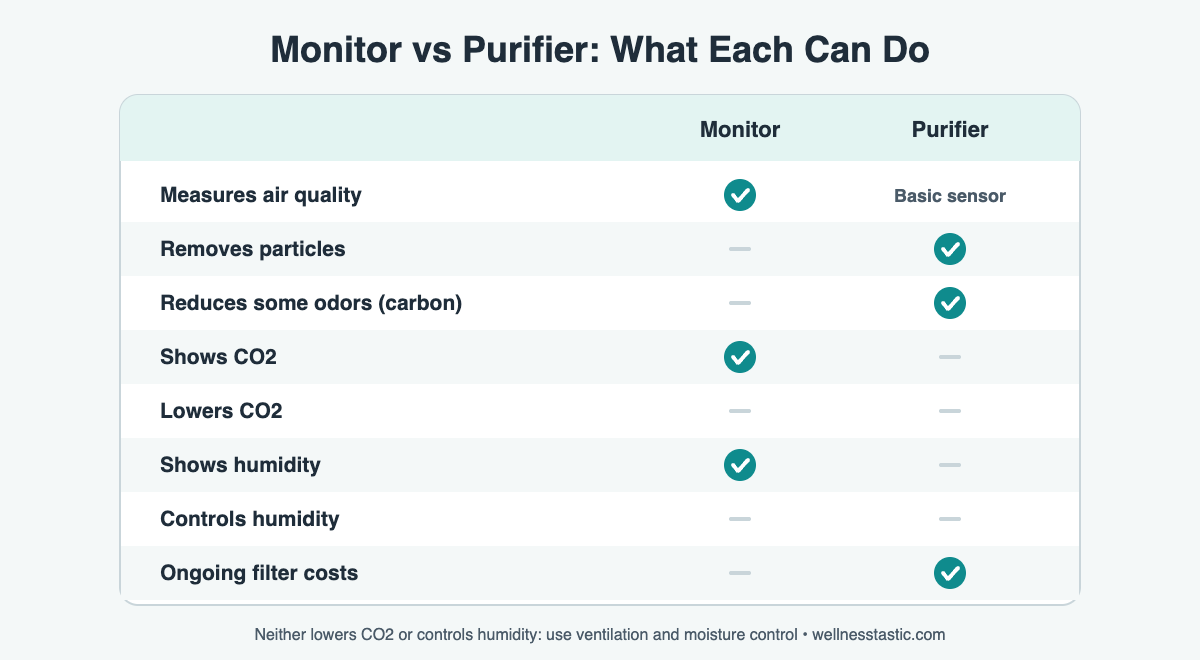
| Air quality monitor | Air purifier | |
|---|---|---|
| Main job | Measures and reports air conditions | Removes certain pollutants from the air |
| Changes your air? | No | Yes, in the room where it runs |
| What it handles | Detects PM2.5, CO2, VOCs, humidity and more (depends on model) | Captures particles; carbon models reduce some odors and gases |
| Helps with CO2? | Yes, measures it | No, purifiers do not remove CO2 |
| Helps with humidity? | Yes, measures it | No |
| Power use | Very low | Moderate, depending on fan speed |
| Ongoing costs | Batteries or occasional sensor replacement | Replacement filters and electricity |
| Best for | Finding and understanding problems | Reducing airborne particles in key rooms |
A simple way to think about it: a monitor is like a thermometer, and an air purifier is like an air conditioner. A thermometer tells you how warm the room is; the air conditioner changes it. You can run an air conditioner without a thermometer, but you will not know how well it is working or whether you even need it.
Cost Comparison: Upfront and Ongoing
The two devices also differ in what they cost to own. Monitors are usually a one-time purchase, while air purifiers have ongoing costs.
| Cost | Air quality monitor | Air purifier |
|---|---|---|
| Upfront price | Budget to premium, depending on sensors | Budget to premium, depending on room size and features |
| Filters | None | Replacement HEPA and carbon filters, often every 6 to 12 months |
| Electricity | Very low | Depends on size, fan speed and hours of use |
| Batteries or sensors | Batteries on some models; occasional sensor replacement | Not applicable |
| Lifespan | Several years | Several years with regular filter changes |
When comparing air purifiers, always check the price and replacement schedule of filters. A cheaper purifier with expensive filters can cost more over a few years than a pricier model with affordable filters. A monitor can actually help reduce purifier running costs by showing you when high fan speeds are needed and when a lower setting is enough.
Do Air Purifiers Have Built-In Monitors?
Many modern air purifiers include a built-in sensor and an “auto” mode that adjusts fan speed based on air quality. These sensors are useful, but they have limits:
- They usually measure only particles, not CO2, VOCs or humidity.
- They are often less precise than the sensors in dedicated monitors.
- They measure air right next to the purifier, which may be cleaner than the rest of the room.
- Some show only a colored light rather than actual numbers.
A built-in sensor is great for convenience. A separate monitor placed elsewhere in the room gives you a more accurate picture of what you are actually breathing.
When You Need an Air Quality Monitor First
Start with a monitor if you are not sure what your problem is. A monitor is the smarter first purchase when:
- Rooms feel stuffy, and you suspect poor ventilation. (An air purifier cannot fix high CO2.)
- You are worried about humidity, condensation or mold risk.
- You notice chemical smells after painting, renovating or buying new furniture.
- You want to know whether cooking or a gas stove is affecting your air.
- You want proof before spending money on bigger solutions.
Our guide to the signs of poor indoor air quality can also help you narrow down the problem before you buy anything.
When You Need an Air Purifier First
If you already know that airborne particles are the problem, an air purifier is the more direct solution. Consider a purifier first when:
- Wildfire smoke is affecting your area.
- You have pets and want to reduce airborne dander.
- Pollen season brings allergens indoors.
- You live near a busy road and dust or soot builds up quickly.
- You want cleaner air in a bedroom where you spend many hours.
Choose a purifier with a true HEPA filter and a CADR that matches your room size. Our best air purifiers buying guide and air purifier size guide will help you choose the right model.
When You Need Both
For many homes, the best approach is to use both devices together. You will get the most value from owning both when:
- You deal with wildfire smoke: the monitor shows how much smoke gets inside and when it is safe to open windows; the purifier reduces smoke particles.
- Someone in your home has allergies: the monitor confirms that particle levels are staying low; the purifier helps keep them there.
- You cook often, especially on gas: the monitor reveals cooking spikes; the purifier and range hood help clear them.
- You want to use your purifier efficiently: the monitor tells you when to run it on high and when a lower, quieter setting is enough, which can save energy and filter life.
How to Use a Monitor and an Air Purifier Together
- Measure a baseline: run the monitor for a few days before turning on the purifier to see normal levels and spikes.
- Place them apart: put the monitor at breathing height a few feet away from the purifier so it measures the room, not the purifier’s outlet.
- Test the purifier: after cooking or on a smoky day, turn the purifier on and watch how quickly PM2.5 drops.
- Adjust settings: use higher fan speeds when readings rise and lower speeds when the air is clean.
- Check other readings: if CO2 or humidity is high, remember the purifier will not help; improve ventilation or control moisture instead.
- Replace filters on time: if particle levels drop more slowly than before, the purifier filter may need replacing.
What Neither Device Can Do
Neither an air quality monitor nor an air purifier is a complete solution. Keep these limits in mind:
- Carbon monoxide: requires dedicated, certified CO alarms. Purifiers do not remove CO, and most monitors are not CO safety devices.
- Radon: requires testing and, if needed, professional mitigation. Air purifiers are not a radon solution.
- Moisture and mold: need moisture control. A purifier may capture some airborne spores, but it will not stop mold growing.
- CO2 and stuffiness: need ventilation, not filtration.
- Ongoing sources: indoor smoking, unvented heaters and leaks need to be removed or fixed at the source.
That is why the EPA recommends source control and ventilation first, with air cleaning as an additional step. Our guide on how to improve indoor air quality covers the full approach.
What About Combination Devices and Smart Homes?
Some products blur the line between monitors and purifiers:
- Air purifiers with displays: many purifiers show a PM2.5 number or a color-coded light from their built-in sensor. This is helpful for auto mode, but it only reflects particles near the purifier.
- Monitors that control purifiers: some smart monitors can trigger compatible purifiers, fans or smart plugs when readings rise, creating a simple automatic system.
- All-in-one “air quality stations”: some devices combine sensors with small fans or filters. These are usually far less effective at cleaning air than a properly sized HEPA purifier.
For most homes, a good standalone monitor plus a properly sized HEPA purifier gives better results than a single device that tries to do both. If you like automation, look for monitors and purifiers that work with the same smart home platform.
Real-Life Examples: Which Would Help?
An apartment near a busy road
Dust builds up quickly and the air sometimes smells of traffic. Here, particles are the likely problem, so a HEPA air purifier in the bedroom and living area is the priority. A monitor is a useful second step to confirm that indoor PM2.5 stays low and to decide when to keep windows closed.
A family with a dog and a cat
Pet dander and hair are the main concern. An air purifier sized for the main living space, combined with regular vacuuming and grooming, will do most of the work. A monitor helps show whether particle levels stay low, especially during shedding season. See our guide to air purifiers for pet owners.
A stuffy home office
The room feels heavy by mid-afternoon and it is hard to concentrate. This sounds like a ventilation problem, which an air purifier cannot fix. A CO2 monitor is the right first purchase; it will likely show CO2 climbing during the day, and the solution is opening a window, leaving the door open or improving ventilation.
A newly renovated home
There is a chemical smell after new flooring and paint. A monitor with VOC sensing, or one with a formaldehyde sensor, helps you track whether levels are falling. Ventilation is the main solution, and a purifier with a substantial activated carbon filter may help with odors.
A basement that smells musty
A musty smell points to moisture. A hygrometer or monitor with humidity will likely show levels above 60%. A dehumidifier and fixing any water leaks are the solution; an air purifier would not address the cause.
If You Can Only Buy One
| Your situation | Buy first | Why |
|---|---|---|
| Not sure what the problem is | Monitor | Find the real problem before spending more |
| Stuffy rooms or poor sleep environment | Monitor (with CO2) | A purifier cannot fix high CO2 |
| Humidity or mold concerns | Monitor or hygrometer | Purifiers do not control moisture |
| Wildfire smoke | Air purifier | Directly reduces smoke particles |
| Pets or pollen | Air purifier | Directly reduces airborne allergens |
| Allergies and you want proof it works | Both, if budget allows | Purifier cleans; monitor confirms |
Common Myths About Monitors and Purifiers
- “A green light on my purifier means my air is clean.” The light usually reflects particles right next to the purifier. It says nothing about CO2, VOCs or humidity, and the rest of the room may be different.
- “One air purifier cleans the whole house.” Portable air purifiers are designed for a single room or area. Larger homes usually need a purifier in each key room or better whole-home filtration through the HVAC system.
- “A monitor will detect mold.” No consumer monitor detects mold directly. Humidity readings can show conditions that encourage mold growth.
- “Consumer monitors are useless because they are not lab-grade.” They are not laboratory instruments, but good monitors are very effective at showing trends and changes, which is what matters for everyday decisions.
- “The more expensive the device, the better.” For monitors, sensor quality matters more than price or the number of features. For purifiers, a HEPA filter and the right CADR for your room matter more than extra features.
Understanding these limits helps you choose the right device and set realistic expectations for what each one can do.
Frequently Asked Questions
Is an air quality monitor the same as an air purifier?
No. A monitor measures air conditions but does not change them. An air purifier removes certain pollutants but typically cannot tell you in detail what is in your air.
Do I need an air quality monitor if my purifier has a sensor?
Not necessarily, but a separate monitor gives a more complete and accurate picture. Built-in sensors usually measure only particles and sit right next to the purifier.
Can an air purifier lower CO2?
No. Air purifiers do not remove carbon dioxide. To lower CO2, you need more fresh air through open windows, doors or mechanical ventilation.
Can an air purifier fix humidity problems?
No. Air purifiers do not add or remove moisture. Use a dehumidifier, exhaust fans or a humidifier as appropriate, and fix any leaks.
Which should I buy first, a monitor or an air purifier?
If you are unsure what the problem is, start with a monitor. If you already know airborne particles are the issue, for example from smoke, pets or pollen, start with an air purifier.
The Bottom Line
Air quality monitors and air purifiers do different jobs. A monitor tells you what is in your air and whether your efforts are working. An air purifier removes airborne particles and, with carbon filters, some odors and gases. Start with a monitor if you are unsure what the problem is, start with a purifier if particles are clearly the issue, and use both together for the best results.
Sources
- U.S. EPA: Guide to Air Cleaners in the Home
- U.S. EPA: Care for Your Air, A Guide to Indoor Air Quality
This article is for general information only. See our Affiliate Disclosure and How We Research.