WellnessTastic is reader-supported. When you buy through links on this page, we may earn an affiliate commission at no extra cost to you. As an Amazon Associate, we earn from qualifying purchases. Learn more.
“HEPA” is printed on almost every air purifier box, but few people know what it actually means, or why some “HEPA” filters are far better than others. A HEPA air purifier uses a dense mechanical filter to capture tiny airborne particles such as dust, pollen, pet dander and smoke. When the filter meets the true HEPA standard and the purifier is sized correctly, it is one of the most effective and proven ways to reduce airborne particles at home.
In this guide, we explain what a HEPA filter is, how it captures particles, the difference between true HEPA and “HEPA-type” filters, what HEPA can and cannot remove, and what to look for when choosing a HEPA air purifier. For product picks, see our guide to the best air purifiers for home.
Quick answer: A true HEPA filter is designed to capture at least 99.97% of particles 0.3 microns in size under standard test conditions. Particles of this size are among the hardest to capture, so HEPA filters are also very effective against larger particles such as dust and pollen. HEPA filters do not remove gases or odors; that requires activated carbon.
What Is a HEPA Filter?
HEPA stands for High Efficiency Particulate Air. A HEPA filter is a pleated mechanical filter made from a dense mat of very fine, randomly arranged fibers, usually fiberglass or synthetic materials.
In the United States, a true HEPA filter must capture at least 99.97% of particles 0.3 microns in diameter. The EPA explains that HEPA filters used in portable air cleaners are a type of pleated mechanical filter and notes this 99.97% efficiency figure for 0.3-micron particles under the stated test conditions.
To put 0.3 microns in perspective, a human hair is roughly 50 to 70 microns wide. HEPA filters capture particles far smaller than anything you can see.
A Short History of HEPA Filters
HEPA filters were originally developed in the 1940s to capture hazardous airborne particles in nuclear research facilities. Over the following decades, the technology spread to hospitals, laboratories, cleanrooms and aircraft cabins, where very clean air is essential. Today, the same basic principle is used in home air purifiers, vacuums and some HVAC systems, making high-efficiency particle filtration affordable for everyday homes.
How a HEPA Air Purifier Works
A HEPA air purifier has a simple design: a fan pulls room air through the filter, and clean air comes out the other side. Most purifiers use several stages:
- Pre-filter: catches hair, lint and large dust, protecting the main filter.
- Activated carbon filter (in many models): reduces some odors and gases.
- HEPA filter: captures fine particles such as dust, pollen, pet dander, mold spores and smoke particles.
- Fan: pushes the cleaned air back into the room.
Learn more about the full process in our guide on how an air purifier works.
How HEPA Filters Capture Particles
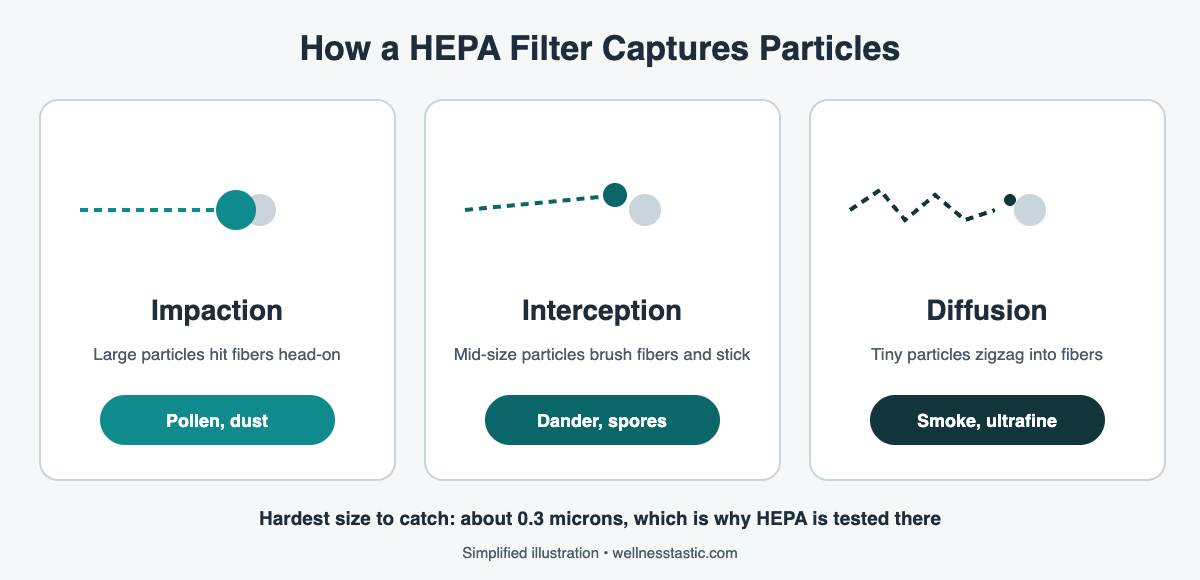
A HEPA filter is not simply a fine sieve. It captures particles using three physical mechanisms that work together:
| Mechanism | How it works | Best at capturing |
|---|---|---|
| Impaction | Larger, heavier particles cannot follow the airflow around fibers and crash into them | Larger particles, such as pollen and dust |
| Interception | Mid-sized particles following the airflow come close enough to a fiber to stick to it | Medium particles |
| Diffusion | Very small particles move erratically (Brownian motion) and bump into fibers | Very small particles, below about 0.1 micron |
Here is the interesting part: the hardest particles to capture are around 0.3 microns, because they are too small for impaction but too large for strong diffusion. This is called the most penetrating particle size. That is why the HEPA standard is tested at 0.3 microns. If a filter captures 99.97% of these, it captures even smaller and larger particles at the same or higher efficiency.
Common Particle Sizes Compared
To understand what HEPA filtration means in practice, it helps to compare the sizes of common airborne particles:
| Particle | Approximate size | Captured by true HEPA? |
|---|---|---|
| Pollen | About 10–100 microns | Yes, easily |
| Dust mite debris | About 10–40 microns | Yes, when airborne |
| Mold spores | About 2–20 microns | Yes |
| Pet dander | About 0.5–10 microns | Yes |
| Bacteria | About 0.3–10 microns | Yes, when airborne |
| Smoke particles | About 0.01–1 micron | Yes, with high efficiency |
| Human hair (for comparison) | About 50–70 microns wide | Not relevant; far larger |
These sizes are approximate and vary widely. The key point is that a true HEPA filter captures the vast majority of airborne particles found in homes, as long as the air actually passes through the filter. That is why airflow and room coverage matter just as much as the filter itself.
True HEPA vs HEPA-Type Filters
This is one of the most important things to understand when buying a HEPA air purifier. Terms such as “HEPA-type,” “HEPA-like,” “HEPA-style” or “99% HEPA” are marketing terms, not standards.
| Term | What it means | Should you trust it? |
|---|---|---|
| True HEPA | Meets the 99.97% at 0.3 micron standard | Yes |
| H13 / H14 (EN 1822) | European HEPA classes with defined efficiencies | Yes |
| HEPA-type / HEPA-like / HEPA-style | Resembles HEPA but does not meet the standard | Be cautious |
| “99% effective” | Often measured at larger particle sizes | Check the details |
| Permanent or washable HEPA | Usually not true HEPA; washing can damage fibers | Be cautious |
A “HEPA-type” filter may capture only a fraction of the fine particles that a true HEPA filter captures. If a product does not clearly say “True HEPA” or list an H13 or H14 rating, check the specifications carefully or look for independent test results.
HEPA Filter Grades: H11, H12, H13 and H14
In Europe, HEPA filters are classified under the EN 1822 standard, which you will often see on air purifiers sold worldwide. The efficiency is measured at the most penetrating particle size.
| Class | Minimum efficiency (at most penetrating particle size) | Notes |
|---|---|---|
| E10–E12 | 85% to 99.5% | Efficient particulate air (EPA) filters, not full HEPA |
| H13 | 99.95% | Common in higher-quality consumer purifiers |
| H14 | 99.995% | Very high efficiency; common in specialized uses |
| U15–U17 | 99.9995% and above | Ultra-low penetration air (ULPA) filters for cleanrooms |
For home use, a true HEPA or H13 filter is more than sufficient. Higher grades can restrict airflow, so a well-designed H13 purifier with a strong fan often outperforms a weaker purifier with an H14 filter.
How Long Does a HEPA Air Purifier Take to Clean a Room?
It depends on the purifier’s CADR and the size of the room, which together determine the number of air changes per hour (ACH). In a well-mixed room, each full air change removes a large share of the airborne particles that remain, so particle levels fall quickly at first and then more slowly.
| Air changes per hour | Approximate time for one full air change | What to expect |
|---|---|---|
| 2 ACH | About 30 minutes | Slow cleaning; better for light use |
| 4.8 ACH (AHAM guideline) | About 12–13 minutes | Noticeable improvement within an hour |
| 6 ACH | About 10 minutes | Faster cleaning for allergies and pets |
| 8 ACH | About 7–8 minutes | Rapid cleaning, useful during smoke events |
Real homes are slower than these ideal numbers, because new particles keep entering from cooking, people, pets and outdoor air, and air does not mix perfectly. That is why purifiers work best when they run continuously rather than for short bursts. An air quality monitor that measures PM2.5 is the easiest way to see how quickly your own purifier clears the air.
What a HEPA Air Purifier Can Remove
- Dust and household particles
- Pollen from trees, grasses and weeds
- Pet dander and fine hair
- Mold spores
- Smoke particles from wildfires, cooking and candles
- Fine particulate matter (PM2.5)
- Some bacteria and virus-carrying particles
On viruses: HEPA filters can capture particles in the size range of many respiratory droplets and aerosols, and the EPA notes that portable air cleaners can help reduce airborne contaminants in a space. However, an air purifier alone is not enough to protect against infection and should be used alongside ventilation and other public health measures.
What a HEPA Filter Cannot Remove
- Odors from cooking, pets or smoke
- Volatile organic compounds (VOCs) from paints, cleaners and furniture
- Formaldehyde and other chemical gases
- Carbon monoxide or carbon dioxide
- Radon
- Settled dust on surfaces or mold growth on walls
For odors and some gases, look for a purifier that combines HEPA with activated carbon. Our guide to HEPA vs activated carbon explains how they work together. For CO2, radon and carbon monoxide, you need ventilation, testing and alarms rather than filtration.
Why the Filter Is Only Half the Story
- CADR: the Clean Air Delivery Rate combines airflow and filter efficiency. A HEPA filter with a weak fan cleans very little air. See our CADR guide.
- Sealing: if the filter does not seal tightly in its housing, air leaks around it.
- Room size: the purifier must be sized for your space. Use our size calculator.
- Filter condition: a clogged filter restricts airflow and reduces cleaning.
In short, choose a purifier with a true HEPA or H13 filter and a verified CADR that matches your room.
HEPA vs Other Air Purifier Technologies
| Technology | Removes particles? | Removes gases/odors? | Byproducts | Our view |
|---|---|---|---|---|
| True HEPA | Yes, very effectively | No | None | Best proven option for particles |
| Activated carbon | No | Some, depending on amount | None | Best paired with HEPA |
| Ionizer / electrostatic | Some | No | Possible ozone | Use with caution |
| UV-C light | No (targets microbes) | No | Some lamps can produce ozone | Limited benefit in home purifiers |
| Photocatalytic (PCO) | Limited | Claimed | Possible byproducts | Mixed evidence |
| Ozone generator | No | Masks odors | Ozone | Avoid |
For most homes, a combination of true HEPA and activated carbon offers the best balance of proven particle removal and odor control without harmful byproducts. Learn more in our guide on whether air purifiers work.
How to Tell If a Filter Is Really HEPA
- Look for exact wording: “True HEPA” or a class such as “H13” or “H14” is more meaningful than “HEPA-type.”
- Check the efficiency claim: it should state 99.97% at 0.3 microns (or 99.95% / 99.995% at the most penetrating particle size for H13/H14).
- Look for a verified CADR: AHAM Verifide certification shows how the whole purifier performs, not just the filter.
- Check independent reviews: some testers measure real-world particle removal.
- Be wary of very cheap replacement filters: knock-off filters may not meet the same standard or seal properly.
What to Look for in a HEPA Air Purifier
- True HEPA or H13 filtration, clearly stated.
- A verified CADR, ideally AHAM Verifide, that fits your room size.
- A pre-filter, ideally washable, to protect the HEPA filter.
- Activated carbon if odors matter to you.
- Quiet low settings for bedrooms and living spaces.
- Affordable replacement filters and a clear replacement schedule.
- No ozone: avoid ozone generators and switch off ionizers if you are concerned. Look for CARB certification.
- Energy efficiency, such as Energy Star certification.
Recommended HEPA Air Purifiers
Here are HEPA air purifiers we recommend based on verified or clearly labeled data. We have not yet completed our own hands-on testing of every model; see our How We Research page.
| Air purifier | Filter | Smoke CADR | Best for |
|---|---|---|---|
| Levoit Vital 200S | HEPA-grade with carbon | 250 CFM (AHAM) | Best overall for most rooms |
| Coway Airmega AP-1512HH (Mighty) | True HEPA with deodorization filter | 233 CFM | Proven all-rounder |
| IQAir HealthPro Plus | HyperHEPA (H12/13 class) | 260 CFM | Premium, sealed design |
| Medify MA-112 | Dual H13-grade HEPA | 594 CFM (reported) | Very large spaces |
| Levoit Core 300 | HEPA with carbon | 143 CFM (AHAM) | Small rooms, budget |
For more options by room and need, see our guides to bedrooms, allergies and large rooms.
Choosing a HEPA Air Purifier for Your Situation
For allergies
Choose a true HEPA purifier with a strong pollen and dust CADR, and run it continuously in the bedroom. See our allergy guide.
For pets
Look for a washable pre-filter to catch hair before it clogs the HEPA filter, plus activated carbon for odors. See our pet guide.
For smoke
Prioritize a high smoke CADR for fine particles and a substantial carbon filter for smoke odors, since HEPA alone does not remove smells. See our smoke guide.
For bedrooms and nurseries
Choose a quiet HEPA purifier with a dimmable display, sized so it can run on a low setting overnight. See our bedroom guide.
For dust
Check the dust CADR and choose a model with an easy-to-clean pre-filter. Combine it with a HEPA vacuum. See our dust guide.
Where to Place a HEPA Air Purifier
- In the room where you spend the most time, usually the bedroom or living room.
- With at least one to two feet of clear space around the intake and outlet.
- Away from corners, curtains and furniture that block airflow.
- Near sources of particles, such as pet beds or entryways, but not directly next to a stove or humidifier.
- With doors and windows closed while it runs, unless you are ventilating the room.
HEPA in Other Products: Vacuums, HVAC and Cars
HEPA vacuums
A HEPA vacuum captures fine dust instead of blowing it back into the room. Look for a “sealed system” or “whole-machine HEPA” vacuum; a HEPA filter in a leaky vacuum lets dust escape around it.
HVAC systems
Most home heating and cooling systems cannot use true HEPA filters because the dense media restricts airflow too much for a typical furnace fan. Instead, the EPA suggests MERV 13 filters, or the highest rating your system can handle. See our MERV guide.
Car cabin filters
Many cars now offer high-efficiency cabin air filters, sometimes marketed as HEPA. Check the specifications, as not all meet the true HEPA standard.
The Running Costs of a HEPA Air Purifier
| Cost | Typical frequency | Tip |
|---|---|---|
| HEPA filter replacement | Every 6–12 months | Check filter prices before buying the purifier |
| Carbon filter replacement | Every 3–12 months, depending on odors | Replace when smells return quickly |
| Electricity | Continuous use | Run on auto or low; choose Energy Star models |
| Pre-filter cleaning | Every 2–4 weeks | Free, and extends the life of the HEPA filter |
A purifier with a slightly higher price but affordable, long-lasting filters often costs less over three to five years than a cheaper model with expensive filters.
How to Maintain a HEPA Filter
- Clean the pre-filter every two to four weeks.
- Replace the HEPA filter as recommended, typically every 6 to 12 months, or sooner in dusty or smoky conditions.
- Do not wash a true HEPA filter unless the manufacturer specifically says it is washable; water can damage the fibers.
- Do not vacuum the HEPA filter surface aggressively, which can tear the media.
- Use genuine or verified replacement filters that seal properly.
- Handle used filters carefully, ideally outdoors, and bag them before throwing them away.
Signs Your HEPA Filter Needs Replacing
- The filter indicator light comes on.
- Airflow from the purifier feels weaker than usual.
- The purifier is louder at the same fan speed.
- The filter looks dark grey or heavily loaded.
- Dust or odors return more quickly than before.
- An air quality monitor shows particle levels dropping more slowly.
Common Myths About HEPA Air Purifiers
- “Medical-grade HEPA” is a special standard: it is a marketing term, not a regulated category. Look for true HEPA or H13/H14 ratings instead.
- “Higher grade is always better”: a strong fan and good seal matter as much as the filter grade.
- “HEPA removes odors”: it does not; you need carbon.
- “Washable HEPA filters last forever”: many washable filters are not true HEPA, and washing can reduce performance.
- “A HEPA purifier cleans the whole house”: portable purifiers are designed for a single room or area.
Frequently Asked Questions
What does HEPA stand for?
HEPA stands for High Efficiency Particulate Air. True HEPA filters capture at least 99.97% of particles 0.3 microns in size under standard test conditions.
Is a HEPA air purifier worth it?
For reducing airborne particles such as dust, pollen, pet dander and smoke, a properly sized HEPA air purifier is one of the most effective home solutions. It works best alongside source control and ventilation.
What is the difference between true HEPA and H13?
True HEPA is the US standard of 99.97% at 0.3 microns. H13 is a European class requiring at least 99.95% efficiency at the most penetrating particle size. Both are excellent for home use.
How often should I replace a HEPA filter?
Most manufacturers recommend every 6 to 12 months, depending on use and air quality. Replace sooner if airflow drops or the filter looks heavily loaded.
Do HEPA air purifiers produce ozone?
Mechanical HEPA filtration does not produce ozone. Some purifiers include ionizers or other technologies that can; choose models that meet CARB ozone limits and switch off ionizers if you prefer.
Can a HEPA filter capture viruses?
HEPA filters can capture particles in the size range of many virus-carrying droplets and aerosols. However, an air purifier is not a substitute for ventilation, vaccination or other public health measures. Follow guidance from health authorities.
The Bottom Line
A HEPA air purifier is one of the most proven ways to reduce airborne particles at home. Look for true HEPA or H13 filtration, a verified CADR that fits your room, a pre-filter and activated carbon if odors matter. Avoid vague “HEPA-type” claims and ozone-producing devices, maintain your filters on schedule, and use your purifier alongside source control and ventilation for the cleanest air.
Sources
- U.S. EPA: What Is a MERV Rating? (HEPA filter note)
- U.S. EPA: Guide to Air Cleaners in the Home
- AHAM Verifide: Air Cleaner Certification Program
- California Air Resources Board: Air Cleaners and Ozone
This article is for general information only. Product specifications are based on AHAM Verifide data, manufacturer information or independent reviews, as labeled. See our Affiliate Disclosure and Disclaimer.