An air purifier looks simple from the outside: you plug it in, switch it on and hope the air gets cleaner. But how does an air purifier work, and what actually happens inside? Understanding how an air purifier works helps you choose the right model, place it correctly, run it efficiently and know what it can and cannot do for your home.
In this guide, we explain the basic parts of an air purifier, the path air takes through it, how different filter technologies capture particles and odors, how sensors and smart features work, and why size and placement matter so much. If you already know the basics and want recommendations, see our guide to the best air purifiers for home.
Quick answer: An air purifier uses a fan to pull room air through one or more filters. A pre-filter catches large particles, an activated carbon filter reduces some odors and gases, and a HEPA filter captures fine particles such as dust, pollen, pet dander and smoke. The cleaned air is blown back into the room, and the process repeats continuously, lowering particle levels over time.
The Basic Parts of an Air Purifier
Almost every portable air purifier is built from the same core components:
| Part | What it does |
|---|---|
| Air intake | Openings where room air is drawn in, usually on the sides, back or bottom |
| Pre-filter | Catches hair, lint and larger dust to protect the main filter |
| Activated carbon filter | Adsorbs some odors and gases (in many, but not all, models) |
| HEPA or HEPA-grade filter | Captures fine airborne particles |
| Fan and motor | Pull air through the filters and push clean air out |
| Air outlet | Where cleaned air returns to the room, often at the top |
| Sensors (optional) | Measure particle levels, sometimes gases, to control the fan |
| Controls and app (optional) | Let you set speed, timers, sleep mode and schedules |
A Simple Way to Picture It
Think of an air purifier like a pool filter. The pool pump keeps pulling water through a filter and sending clean water back into the pool. The filter does not clean the whole pool at once; instead, the water circulates through it again and again until most of the debris is captured. An air purifier does the same thing with the air in your room. The stronger the pump (the fan) and the better the filter, the faster the room gets clean, and the more often the air cycles through, the cleaner it stays.
How Air Moves Through an Air Purifier
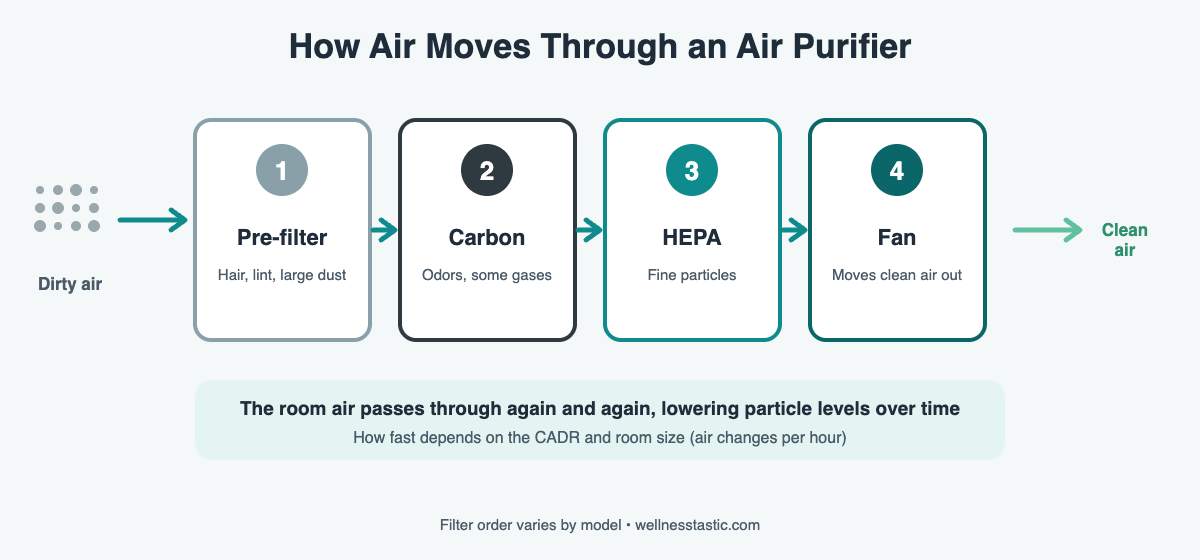
Here is what happens, step by step, when you switch on a typical air purifier:
- The fan pulls in room air through the intake openings.
- The pre-filter catches large particles such as hair, fluff and visible dust.
- The carbon filter adsorbs odors and some gases, if the purifier has one.
- The HEPA filter captures fine particles, including dust, pollen, pet dander, mold spores and smoke particles.
- The fan pushes cleaned air back into the room through the outlet.
- The cycle repeats continuously. Cleaned air mixes with the rest of the room, and the purifier keeps drawing air through again and again.
The order of the filters varies between models, and some combine carbon and HEPA into a single filter. What matters most is that all the air passes through a well-sealed, high-quality filter.
How the Filters Work
Pre-filter
The pre-filter is usually a fine mesh or fabric layer. It captures larger particles that would otherwise clog the more expensive HEPA filter. Many pre-filters are washable or vacuumable, and cleaning them regularly helps the purifier keep its airflow.
Activated carbon filter
Activated carbon is treated to create a huge internal surface area. Gas and odor molecules stick to this surface through a process called adsorption. Carbon helps with cooking smells, pet odors and some VOCs, but it saturates over time and does not capture particles. The amount of carbon matters: thin carbon layers handle light odors, while heavy carbon beds last much longer. See our guide to HEPA vs activated carbon.
HEPA filter
A true HEPA filter is designed to capture at least 99.97% of particles 0.3 microns in size under standard test conditions. It works through three mechanisms: impaction (large particles hit fibers), interception (medium particles brush against fibers) and diffusion (tiny particles zigzag into fibers). Learn more in our HEPA air purifier guide.
What Happens Inside the Filter Over Time
As an air purifier runs, its filters gradually fill up:
- The HEPA filter loads with particles. Surprisingly, a slightly used HEPA filter can capture particles even more efficiently, but as it clogs, it restricts airflow, so less air gets cleaned.
- The carbon filter saturates. Once its surface is covered with gas molecules, it stops removing odors.
- The pre-filter collects hair and dust. If it is not cleaned, it can block airflow before the air even reaches the main filter.
That is why regular maintenance matters. A purifier with clogged filters may still run and make noise, but it will move and clean far less air than when the filters were new.
How HEPA Air Purifiers Differ From Other Technologies
Not all air purifiers rely on filters. Here is how the main technologies work:
| Technology | How it works | Main strengths | Main concerns |
|---|---|---|---|
| Mechanical filtration (HEPA) | Traps particles in dense fibers | Proven, no byproducts | Filters need replacing |
| Activated carbon | Adsorbs gases onto a porous surface | Reduces some odors and VOCs | Saturates; amount matters |
| Ionizers | Charge particles so they stick to surfaces or collector plates | Low filter costs | May produce ozone; particles may settle on surfaces |
| Electrostatic precipitators | Charge particles and collect them on metal plates | Washable collector | Can produce ozone; plates need cleaning |
| UV-C light | Uses ultraviolet light inside the unit | Marketed for germs | Limited effect at typical airflow speeds |
| Photocatalytic oxidation (PCO) | Uses light and a catalyst to break down some gases | Targets certain VOCs | Mixed evidence; possible byproducts |
| Ozone generators | Release ozone to react with odors | Mask some smells | Ozone is a lung irritant; not recommended |
The EPA advises against using ozone generators in occupied spaces. For most homes, a purifier that combines true HEPA filtration with activated carbon is the most reliable and safest option.
How Much Air an Air Purifier Can Clean
An air purifier’s cleaning power is measured by its Clean Air Delivery Rate (CADR), which combines airflow and filter efficiency. CADR is tested separately for smoke, dust and pollen and is expressed in cubic feet per minute. See our CADR guide.
CADR determines how many times per hour the purifier can clean the air in a room, known as air changes per hour (ACH). A good target for everyday use is about 4.8 ACH, which is the basis of the AHAM guideline that the smoke CADR should be at least two-thirds of the room’s floor area. Our air purifier size calculator does the math for you.
How Air Purifier Sensors and Auto Mode Work
Many modern purifiers include an air quality sensor and an auto mode:
- Particle sensors usually use a small laser or infrared light to count particles in a sample of air.
- Gas or VOC sensors in some models detect changes in certain gases, often shown as a color indicator.
- Auto mode raises the fan speed when the sensor detects more pollution, such as during cooking or cleaning, and lowers it when the air is clean.
Sensors are convenient, but they measure air right next to the purifier, which may be cleaner than the rest of the room. A separate indoor air quality monitor placed elsewhere gives a more accurate picture.
What an Air Purifier Can and Cannot Do
| Can help with | Cannot solve |
|---|---|
| Airborne dust and fine particles | Dust that has already settled on surfaces |
| Pollen and pet dander | Dust mites living in bedding |
| Smoke particles | Carbon monoxide |
| Some odors and gases (with carbon) | Carbon dioxide and stuffiness |
| Airborne mold spores | Mold growth and moisture problems |
| Some virus-carrying particles | Radon |
According to the EPA, air cleaning can help reduce indoor airborne particles, but no air cleaner removes all pollutants. It works best alongside source control and ventilation. See our guide on how to improve indoor air quality.
Why Placement Matters
Because an air purifier cleans the air around it, where you put it affects how well it works:
- Place it in the room where you spend the most time, such as the bedroom or living room.
- Leave at least one to two feet of space around the intake and outlet.
- Avoid corners, behind furniture and near curtains, which restrict airflow.
- Keep doors and windows closed while it runs, unless you are ventilating.
- In large or open spaces, consider two purifiers for more even coverage.
How Long It Takes an Air Purifier to Work
A properly sized purifier running at about 4.8 air changes per hour cleans the full volume of room air roughly every 12 to 13 minutes. Particle levels usually drop noticeably within the first hour. In real homes, new particles keep entering, so purifiers work best when they run continuously. Learn more in our guide on how long to run an air purifier.
Energy Use and Noise
- Energy: most purifiers use relatively little electricity on low settings. Energy Star certified models are the most efficient.
- Noise: noise comes mainly from the fan. Higher speeds are louder; a properly sized purifier can run on low or medium most of the time.
- Filter condition: a clogged filter makes the fan work harder, which can increase noise and reduce cleaning.
How to Keep an Air Purifier Working Well
- Clean the pre-filter every two to four weeks.
- Replace the HEPA filter as recommended, usually every 6 to 12 months.
- Replace carbon filters when odors return.
- Wipe the intake and outlet to keep airflow clear.
- Use genuine or verified replacement filters that seal properly.
Types of Portable Air Purifiers by Design
| Design | How it works | Best for |
|---|---|---|
| Round or 360-degree | Draws air in from all sides through a cylindrical filter | Placing in the middle of a room |
| Tower | Tall, slim design that pulls air in from the front or sides | Saving floor space in bedrooms and living rooms |
| Box or console | Rectangular unit, often with large flat filters | Large rooms and high airflow |
| Wall-mounted | Thin unit that hangs on the wall | Saving floor space; keeping away from pets and children |
| Desktop | Small unit for personal spaces | Desks and very small rooms |
| DIY box fan filter | A box fan with MERV 13 filters attached | Budget or emergency use during smoke events |
All of these designs follow the same basic principle: move air through a filter. What differs is how much air they move, how much filter area they have and how well they fit your space. Our guides to small rooms and large rooms cover the best options for each.
Common Myths About How Air Purifiers Work
- “Air purifiers add oxygen or fresh air.” They do not. They clean existing air; ventilation brings in fresh air.
- “One purifier cleans the whole house.” Portable purifiers are designed for one room or area.
- “If it has a HEPA filter, it must be powerful.” A great filter with a weak fan cleans very little air; check the CADR.
- “Ionizers and ozone make air cleaner.” Ozone is a lung irritant, and some ionizers produce it.
- “You only need to run it when the air feels bad.” Particles are constantly entering, so continuous operation works best.
Portable Air Purifiers vs Whole-Home Filtration
Portable air purifiers clean a single room or area. Whole-home filtration works through your heating and cooling system, using filters rated on the MERV scale. The EPA suggests MERV 13 filters, or the highest rating your system can handle. For many homes, the most effective approach is a combination: a good HVAC filter for the whole house and a portable HEPA purifier in the bedroom or main living area. See our MERV guide.
Using This Knowledge to Choose a Purifier
Now that you know how an air purifier works, choosing one becomes much simpler. Focus on the parts that actually determine performance:
- Filter quality: true HEPA or H13 for particles, and enough activated carbon if odors matter.
- Fan power and CADR: a smoke CADR of at least two-thirds of your room’s floor area.
- Airflow design: a shape that suits where you will place it, with space around the intake.
- Sensors and controls: auto mode and a sleep mode if you want convenience and quiet nights.
- Maintenance costs: affordable filters and a washable pre-filter.
- No ozone: avoid ozone generators and check for CARB certification.
For tested recommendations based on these factors, see our best air purifiers guide.
Frequently Asked Questions
How does an air purifier work to clean the air?
A fan pulls room air through filters that capture particles and, in many models, adsorb some odors and gases. Clean air is blown back into the room, and the process repeats continuously.
Do air purifiers remove dust?
Yes, HEPA air purifiers capture airborne dust. They cannot remove dust that has already settled on surfaces, so regular cleaning is still needed.
Do air purifiers bring in fresh air?
No. Air purifiers clean the air already in the room; they do not bring in outdoor air or reduce carbon dioxide. Ventilation is needed for fresh air.
Do air purifiers use a lot of electricity?
Most use relatively little power on low or auto settings. Energy use increases at higher fan speeds. Energy Star certified models are the most efficient.
Is it safe to run an air purifier all day?
Yes. Air purifiers are designed for continuous use. Avoid ozone generators and switch off ionizers if you are concerned about ozone.
Why does my air purifier smell after a while?
A musty or stale smell often means the carbon filter is saturated or the filters need replacing. Replace the carbon or combination filter, clean the pre-filter and check that the purifier is not placed in a damp area.
The Bottom Line
So, how does an air purifier work? It pulls room air through filters and returns cleaner air, again and again. The pre-filter protects the system, activated carbon reduces some odors and gases, and a HEPA filter captures fine particles. How well it works depends on the filter quality, the CADR, room size and placement. For the best results, choose a true HEPA purifier sized for your room, keep the filters maintained and combine it with source control and ventilation.
Sources
- U.S. EPA: Guide to Air Cleaners in the Home
- U.S. EPA: What Is a MERV Rating?
- AHAM Verifide: Air Cleaner Certification Program
- California Air Resources Board: Air Cleaners and Ozone
This article is for general information only. See our How We Research page.