WellnessTastic is reader-supported. When you buy through links on this page, we may earn an affiliate commission at no extra cost to you. As an Amazon Associate, we earn from qualifying purchases. Learn more.
You have bought an air purifier, plugged it in and switched it on. Now what? Should it run for an hour, only when the air feels bad, or all day and night? How long should you run an air purifier to actually get cleaner air, and what does that mean for your electricity bill, noise and filter life?
This guide answers those questions. We explain how long an air purifier takes to clean a room, whether you should run it 24/7, how to use it overnight, when it is reasonable to switch it off, and how much it really costs to keep it running. For choosing the right model, see our guide to the best air purifiers for home.
Quick answer: For most homes, the best approach is to run your air purifier continuously, on auto or a low setting, and turn it up when air quality gets worse, such as during cooking, cleaning, wildfire smoke or high pollen days. Particles are constantly being released indoors, so an air purifier that runs only occasionally lets levels creep back up. A properly sized purifier usually makes a noticeable difference within the first hour.
Why Running Time Matters
An air purifier does not clean a room once and then stop being needed. It works by continuously pulling air through its filters. Meanwhile, new particles keep entering the air from many sources:
- People and pets shedding skin cells, hair and dander
- Cooking, toasting and frying
- Dust stirred up by walking, sitting and making the bed
- Outdoor air coming in through doors, windows and gaps
- Candles, fireplaces and smoke from outside
If you switch the purifier off, particle levels gradually rise back toward where they were before. That is why the U.S. Environmental Protection Agency describes air cleaners as most effective when they are run consistently and sized for the room, as part of a wider plan that also includes source control and ventilation.
How Long Does It Take an Air Purifier to Clean a Room?
How quickly an air purifier cleans a room depends on its Clean Air Delivery Rate (CADR) and the size of the room. Together, these determine the number of air changes per hour (ACH): how many times the purifier can filter the full volume of air in the room each hour.
| Air changes per hour | Time for one full air change | What to expect |
|---|---|---|
| 2 ACH | About 30 minutes | Slow cleaning; typical of undersized purifiers |
| 4.8 ACH (AHAM guideline) | About 12–13 minutes | Noticeable improvement within the first hour |
| 6 ACH | About 10 minutes | Faster cleaning, good for allergies and pets |
| 8 ACH | About 7–8 minutes | Rapid cleaning during smoke events |
In a well-mixed room, each air change removes a large share of the particles that remain, so levels fall quickly at first and then more slowly. Most people see a meaningful drop within 30 to 60 minutes when the purifier is sized correctly. If it takes much longer, your purifier may be too small for the room. Our air purifier size calculator helps you check.
Should You Run an Air Purifier All Day?
Yes, for most people, running an air purifier all day is the best way to keep indoor particle levels consistently low. Modern air purifiers are designed for continuous operation, and running them on a low or auto setting keeps noise and energy use down.
Here is why continuous operation works better than switching it on and off:
- Steady air quality: particles are removed as soon as they are released, instead of building up.
- Quieter operation: a purifier running continuously on low can keep up with normal activity, so it rarely needs to run on loud high settings.
- Less wasted effort: restarting a purifier in a room full of particles means it has to work harder to catch up.
- Automatic response: on auto mode, the purifier ramps up when it detects more pollution and slows down when the air is clean.
Should You Run an Air Purifier Overnight?
Running an air purifier overnight is one of the most effective ways to use it, because you spend many continuous hours in the bedroom, usually with the door closed. Here is how to do it well:
- Pre-clean the room: run the purifier on high for about an hour before bedtime.
- Switch to sleep mode or low when you go to bed, which reduces noise and usually dims the display.
- Keep the bedroom door closed so the purifier is cleaning your room, not the whole house.
- Place it a few feet from the bed, with clear space around it, and not blowing directly on your face.
- Choose a quiet model that can clean your room effectively on a low setting.
See our guide to the best air purifiers for bedrooms for quiet options.
A Simple Daily Air Purifier Schedule
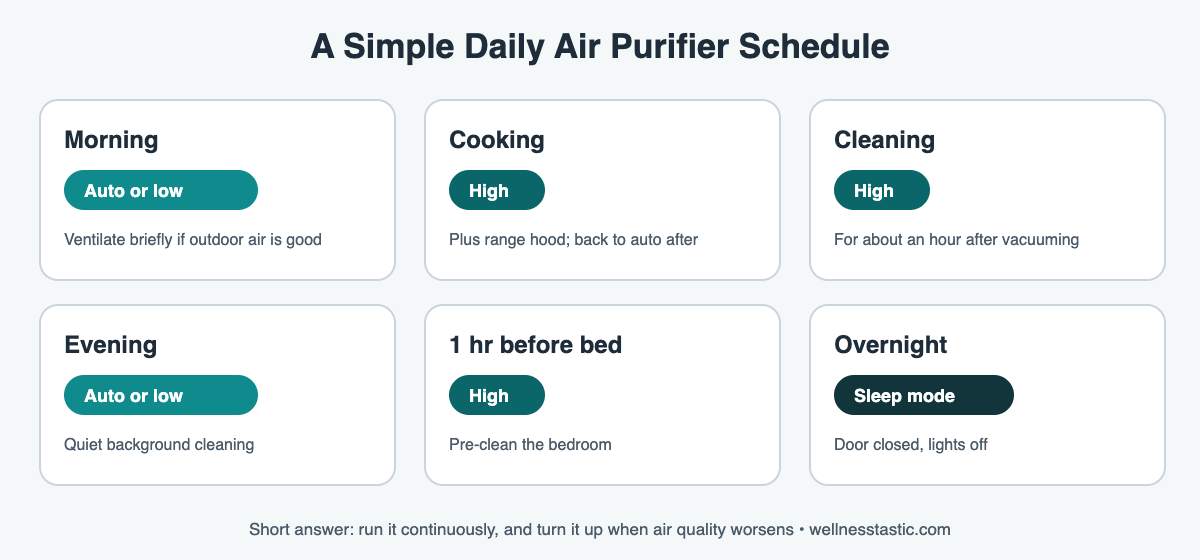
| Time or activity | Setting | Tip |
|---|---|---|
| Morning | Auto or low | Open windows briefly if outdoor air is good, then close them |
| While cooking | High | Use your range hood too; return to auto afterward |
| During and after cleaning | High | Vacuuming and dusting stir up particles; run high for about an hour |
| When pets come in | Auto or medium | Auto mode will respond to extra dander |
| Evening | Auto or low | Quiet background cleaning |
| One hour before bed | High in the bedroom | Pre-clean the room |
| Overnight | Sleep mode | Keep the door closed |
How Long to Run an Air Purifier in Different Situations
Allergies
Run your purifier continuously, especially in the bedroom, and turn it up during high pollen days or after cleaning. Keep windows closed during peak pollen times. See our allergy guide. If you have allergy or asthma symptoms, follow your doctor’s advice.
Wildfire smoke
During smoke events, keep windows and doors closed and run your purifier on its highest comfortable setting, 24 hours a day, in the room where you spend the most time. Check outdoor conditions on AirNow.gov and keep running it until outdoor air quality improves. See our smoke guide.
Pets
Pets shed dander continuously, so run the purifier all day on auto or low in the rooms your pets use most. Clean the pre-filter more often during shedding season. See our pet guide.
Cooking
Turn the purifier up when you start cooking and keep it on high for about 30 to 60 minutes afterward, alongside a range hood vented outdoors.
Dust and cleaning
Run the purifier on high during and for about an hour after vacuuming, dusting or changing bedding, when particles are stirred into the air. See our dust guide.
New furniture, paint or renovations
VOCs from new materials are gases, so ventilation matters most. A purifier with activated carbon can help, and it is worth running continuously for several weeks while materials off-gas.
How Long to Run an Air Purifier in Each Season
Your air purifier running time can follow the seasons. Here is a simple guide:
| Season | Recommended running time | Why |
|---|---|---|
| Spring | Continuously, higher on high-pollen days | Tree and grass pollen enter through windows, clothes and pets |
| Summer | Continuously; high during wildfire smoke | Smoke events and outdoor pollution can peak |
| Fall | Continuously, higher on high-pollen days | Weed pollen and mold from damp leaves |
| Winter | Continuously | Homes are sealed, so indoor particles build up |
In winter especially, when windows stay closed and heating runs, indoor particles from cooking, candles and dust have fewer ways to escape. Continuous operation makes the biggest difference during these months. Remember that an air purifier does not add fresh air, so keep using exhaust fans and ventilate briefly when you can. See our guide on how to improve indoor air quality.
When Is It Okay to Turn Off an Air Purifier?
While continuous use is ideal, there are times when switching off, or turning down, makes sense:
- When you are ventilating: if you have windows wide open on a clean-air day, the purifier is mostly cleaning outdoor air. Turn it off or down, then back on when you close the windows.
- When you are away for several days: you can switch it off to save energy and filter life, then run it on high for an hour or two when you return. Many people simply leave it on auto.
- When changing or cleaning filters: always switch off and unplug before maintenance.
- If it produces ozone: switch off any ionizer feature, and avoid ozone generators entirely.
- If it is making unusual noises or smells: turn it off and check the filters and fan.
How Much Electricity Does an Air Purifier Use?
Many people worry that running an air purifier all day will be expensive. In most cases, the cost is modest, especially on low or auto settings. To estimate your cost, use this formula:
Monthly cost = Watts ÷ 1,000 × hours per day × 30 × your electricity rate per kWh
| Power at your usual setting | Hours per day | Energy per month | Cost per month at an example rate of $0.17 per kWh |
|---|---|---|---|
| 10 W (low setting) | 24 | About 7.2 kWh | About $1.20 |
| 30 W (medium setting) | 24 | About 21.6 kWh | About $3.70 |
| 50 W (high setting) | 24 | About 36 kWh | About $6.10 |
| 50 W (high setting) | 8 | About 12 kWh | About $2.00 |
Your actual cost depends on your purifier’s wattage and your local electricity rate. Energy Star certified purifiers are the most efficient, and running on auto or low most of the time keeps costs low. Check your purifier’s manual for power use at each speed.
Does Running an Air Purifier All Day Wear Out the Filter?
Running your purifier more means it captures more particles, so filters do fill up faster. That is a sign it is doing its job. Most manufacturers base their filter replacement schedules, typically every 6 to 12 months, on regular daily use. You can extend filter life by:
- Cleaning the pre-filter every two to four weeks
- Running on auto or low when the air is clean
- Reducing indoor pollution sources, such as candles and smoking
- Keeping doors and windows closed while the purifier runs
Replace the filter when the indicator comes on, airflow drops or odors return. Learn more in our HEPA guide.
Is It Safe to Leave an Air Purifier Running?
Air purifiers are designed for long, continuous operation, and most people run them all day and night. For safe use:
- Follow the manufacturer’s instructions and use the correct power outlet.
- Keep the purifier on a stable, flat surface with clear space around it.
- Keep cords away from walkways, pets and children.
- Do not cover the intake or outlet.
- Avoid ozone generators, and keep ionizers switched off if you are concerned about ozone.
- Choose products with recognized safety certifications, such as UL or ETL listing.
Recommended Air Purifiers for All-Day Use
The best purifiers for continuous use are energy-efficient, quiet on low settings and have auto modes. These models are good options, based on verified or clearly labeled data:
| Air purifier | Why it suits all-day use | Smoke CADR |
|---|---|---|
| Levoit Vital 200S | Auto mode on smart models, quiet sleep mode | 250 CFM (AHAM) |
| Levoit Core 300 | Energy Star certified, very quiet sleep mode | 143 CFM (AHAM) |
| Blueair Blue Pure 211i Max | Low power use for its size, auto mode | 410 CFM (AHAM) |
| Coway Airmega AP-1512HH (Mighty) | Auto and eco modes | 233 CFM |
Common Mistakes
- Running it only occasionally: particle levels creep back up as soon as it is off.
- Using only the highest setting: it is loud and uses more energy; auto or low is usually enough.
- Leaving doors and windows open: the purifier ends up cleaning the whole house or outdoors.
- Choosing an undersized purifier: it will need to run on high constantly and still struggle.
- Forgetting the filters: clogged filters reduce cleaning no matter how long you run it.
Frequently Asked Questions
How long should you run an air purifier each day?
Ideally, all day. Running it continuously on auto or low keeps particle levels consistently lower. If you prefer not to, run it for at least several hours in the rooms you use most, and overnight in the bedroom.
Is it bad to run an air purifier 24/7?
No. Air purifiers are designed for continuous use. Running one 24/7 is generally the most effective way to use it, as long as you maintain the filters and avoid ozone-producing features.
How long should I run an air purifier before bed?
Running it on high for about an hour before bed helps pre-clean the bedroom. Then switch to sleep or low mode for the night.
Should I turn off my air purifier when I leave the house?
You can leave it on auto, which uses little energy when the air is clean. If you will be away for several days, it is fine to switch it off and run it on high for an hour or two when you return.
How long does it take an air purifier to work?
A properly sized air purifier usually reduces airborne particle levels noticeably within 30 to 60 minutes. The exact time depends on its CADR and your room size.
Can I use a timer or schedule instead of running it all day?
Yes. Many purifiers include timers or app schedules. A good compromise is to schedule high settings for the times you are home and active, such as evenings and before bed, and low or auto settings for the rest of the day. Just remember that particles keep entering the air, so longer running times generally give better results than short bursts.
The Bottom Line
So, how long should you run an air purifier? For most homes, the answer is continuously, on auto or a low setting, turning it up when air quality worsens and running it overnight in the bedroom. Running costs are usually modest, especially with an efficient purifier, and continuous use keeps particle levels consistently lower. Pair your purifier with good habits, the right size for your room and regular filter maintenance for the best results.
Sources
- U.S. EPA: Guide to Air Cleaners in the Home
- ENERGY STAR: Air Purifiers
- AirNow.gov: Air Quality Index
Electricity cost examples are estimates using an example rate; your costs will vary. Product specifications are based on AHAM Verifide data or manufacturer information, as labeled. See our Affiliate Disclosure.