
Most indoor air problems are not obvious. A damp basement, a filter that has not been changed in a year, or a gas stove without a working range hood can all affect the air you breathe without anyone noticing. This indoor air quality checklist helps you walk through your home step by step, spot common issues, and decide what to fix first.
You do not need special training to use it. Set aside an hour, grab a notepad or print the checklist below, and go room by room. Use this indoor air quality checklist once or twice a year to keep your home healthy. For background on why each item matters, see our complete guide to indoor air quality.
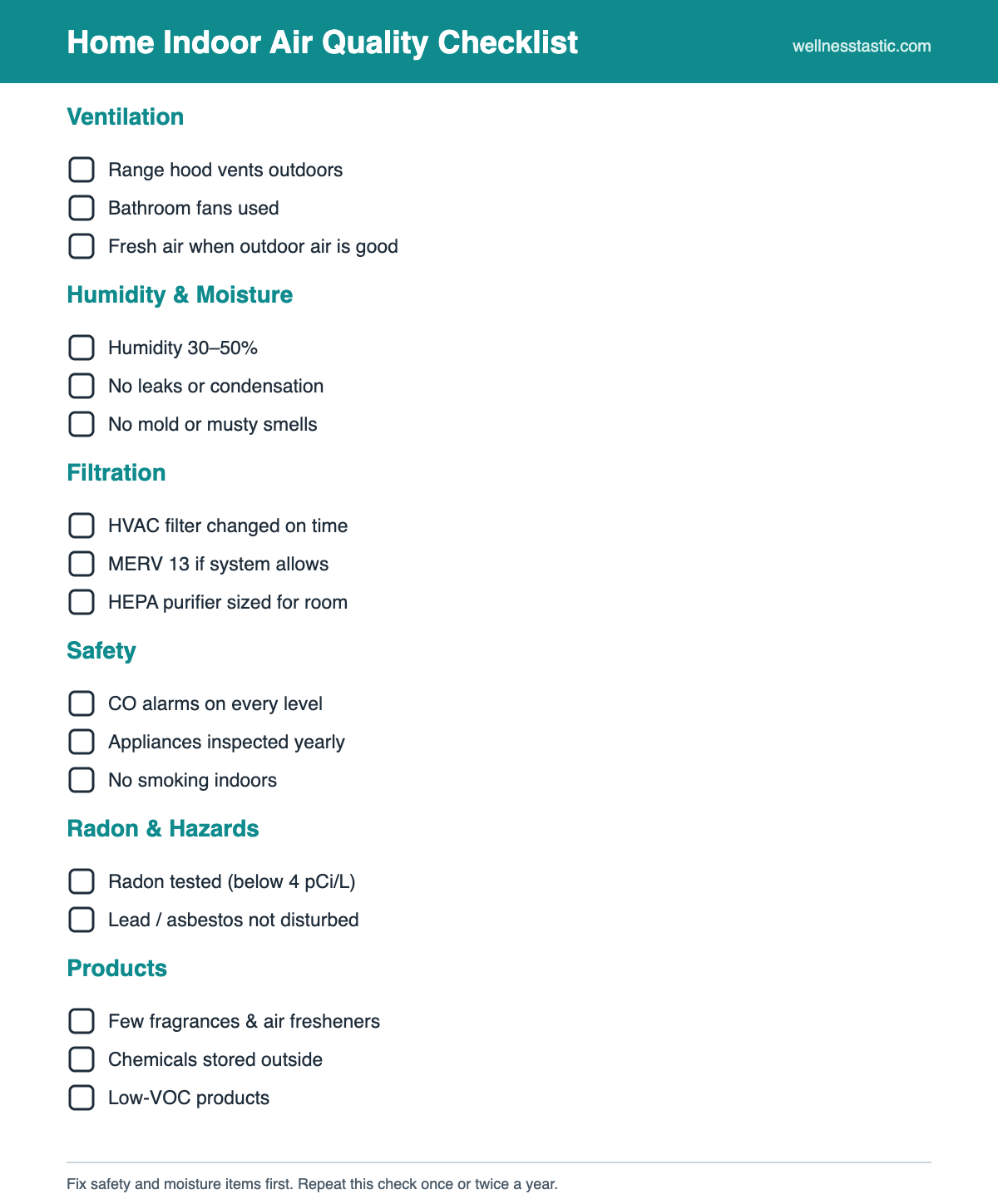
How to use this checklist: Tick each item your home already meets. Anything left unticked is a possible improvement. At the end, use the priority guide to decide what to tackle first.
Tools That Make the Checklist Easier
You can complete most of this home air quality checklist with your eyes and nose, but a few inexpensive tools give you real numbers:
- Hygrometer: measures humidity. Ideal indoor humidity is roughly 30–50%.
- Indoor air quality monitor: tracks PM2.5, CO2, VOCs, temperature and humidity. See our picks for the best indoor air quality monitors.
- Carbon monoxide alarms: essential safety devices for any home with fuel-burning appliances or an attached garage.
- Radon test kit: the only way to know your home’s radon level.
- Flashlight: for checking under sinks, in basements, attics and behind appliances.
Why Each Part of the Checklist Matters
Before you start ticking boxes, it helps to understand what each section is really checking.
Ventilation controls how quickly pollutants leave your home. Without it, particles from cooking, moisture from showers and CO2 from breathing build up. A home can have excellent filtration and still feel stuffy if fresh air is not getting in.
Humidity and moisture are closely linked to mold and dust mites. The EPA recommends keeping indoor humidity below 60%, ideally between about 30% and 50%. Moisture problems are often slow and hidden, which is why they appear on this checklist in several places.
Filtration removes particles that remain after source control and ventilation. A good HVAC filter cleans air throughout the house, while portable air purifiers focus on individual rooms.
Combustion and safety items protect against carbon monoxide and other combustion gases, which cannot be seen or smelled. These are the most urgent items on the list.
Radon and hidden hazards cover risks you cannot detect without testing. Radon in particular is common in many parts of the U.S. and can only be found with a test.
Products and chemicals are some of the easiest sources to reduce. Many households add VOCs and fragrance compounds to the air every day without realizing it. For more detail on each pollutant, see our guide to indoor air pollution.
Part 1: Whole-Home Checklist
Ventilation
- ☐ Kitchen range hood vents to the outdoors (not just recirculating).
- ☐ Range hood is used every time you cook.
- ☐ Bathrooms have working exhaust fans that vent outdoors.
- ☐ Bathroom fans are used during and after every shower.
- ☐ Windows open easily and are used for fresh air when outdoor air quality is good.
- ☐ Bedrooms do not feel stuffy in the morning, or CO2 readings stay reasonable overnight.
- ☐ Clothes dryer vents outdoors and the vent is clear of lint.
Humidity and moisture
- ☐ Indoor humidity stays between about 30% and 50% most of the year.
- ☐ No condensation regularly forms on windows or walls.
- ☐ No musty or damp smells in any room.
- ☐ No visible mold on walls, ceilings, window frames, grout or under sinks.
- ☐ No active leaks from roofs, pipes, faucets or appliances.
- ☐ Water damage is dried or repaired within 24 to 48 hours.
- ☐ Gutters and downspouts direct water away from the foundation.
Filtration
- ☐ HVAC filter is checked monthly and replaced on schedule (often every 1 to 3 months).
- ☐ HVAC filter has the highest MERV rating your system can handle (MERV 13 if compatible).
- ☐ Filter fits snugly with no gaps for air to bypass.
- ☐ Air purifiers, if used, are sized for the room and run consistently.
- ☐ Air purifier filters are replaced on the manufacturer’s schedule.
- ☐ Vacuum has a HEPA filter or sealed system.
Not sure about filter ratings? Read our guide to MERV ratings.
Combustion and safety
- ☐ Carbon monoxide alarms are installed on every level and near sleeping areas.
- ☐ CO alarms are tested monthly and batteries replaced as recommended.
- ☐ Furnace, boiler and water heater are inspected once a year.
- ☐ Fireplace and chimney are inspected and cleaned regularly.
- ☐ No unvented gas or kerosene heaters are used indoors.
- ☐ Generators, grills and camp stoves are never used indoors or in the garage.
- ☐ No one smokes or vapes inside the home.
Radon and hidden hazards
- ☐ Home has been tested for radon (and retested after major renovations).
- ☐ Radon level is below 4 pCi/L, or a mitigation system is installed.
- ☐ Older homes (built before 1978) are checked for lead paint before sanding or renovating.
- ☐ Suspected asbestos materials in older homes are left undisturbed until tested.
Products and chemicals
- ☐ Air fresheners, plug-ins and scented candles are used rarely or not at all.
- ☐ Cleaning products are simple and fragrance-free where possible.
- ☐ Bleach is never mixed with ammonia or other cleaners.
- ☐ Paints, solvents, pesticides and fuels are stored outside living areas.
- ☐ Low-VOC products are chosen for painting and new furniture.
- ☐ Any ozone-generating “air purifier” has been removed.
Part 2: Room-by-Room Checklist
Kitchen
- ☐ Range hood works and vents outdoors.
- ☐ Back burners are used when possible.
- ☐ No lingering cooking odors hours after cooking.
- ☐ Gas stove flames burn blue, not yellow or orange.
- ☐ No leaks or mold under the sink.
- ☐ Trash and food waste are removed regularly.
Bathrooms
- ☐ Exhaust fan works and runs for about 20 minutes after showers.
- ☐ No mold on grout, caulk or ceiling.
- ☐ Towels and bath mats dry quickly.
- ☐ No leaks around the toilet, tub or sink.
Bedrooms
- ☐ Bedding is washed weekly in hot water.
- ☐ Room does not feel stuffy in the morning.
- ☐ Humidity stays below 50% to discourage dust mites.
- ☐ Air purifier, if used, is quiet enough to run overnight and sized for the room.
- ☐ Pets sleep elsewhere if someone has allergies.
Living areas
- ☐ Floors and upholstery are vacuumed weekly with a HEPA vacuum.
- ☐ Surfaces are dusted with a damp or microfiber cloth.
- ☐ Candles and incense are used rarely.
- ☐ Shoes are taken off at the door.
- ☐ New furniture was aired out before use.
Laundry room
- ☐ Dryer vents outdoors and the duct is clean.
- ☐ Washer area has no leaks or musty smells.
- ☐ Scented detergents and dryer sheets are limited.
Basement
- ☐ Humidity stays below 60% (a dehumidifier is used if needed).
- ☐ No water stains, efflorescence or damp spots on walls or floors.
- ☐ No musty smell.
- ☐ Stored items are off the floor and not in cardboard boxes if damp.
- ☐ Radon has been tested.
Attached garage
- ☐ Door between the garage and house is kept closed and seals well.
- ☐ Cars are never left running inside.
- ☐ Fuels, paints and chemicals are stored in sealed containers.
Attic
- ☐ No signs of roof leaks or water stains.
- ☐ Bathroom and kitchen fans do not vent into the attic.
- ☐ No mold on roof sheathing.
- ☐ Insulation is dry and undisturbed.
Indoor Air Quality Maintenance Schedule
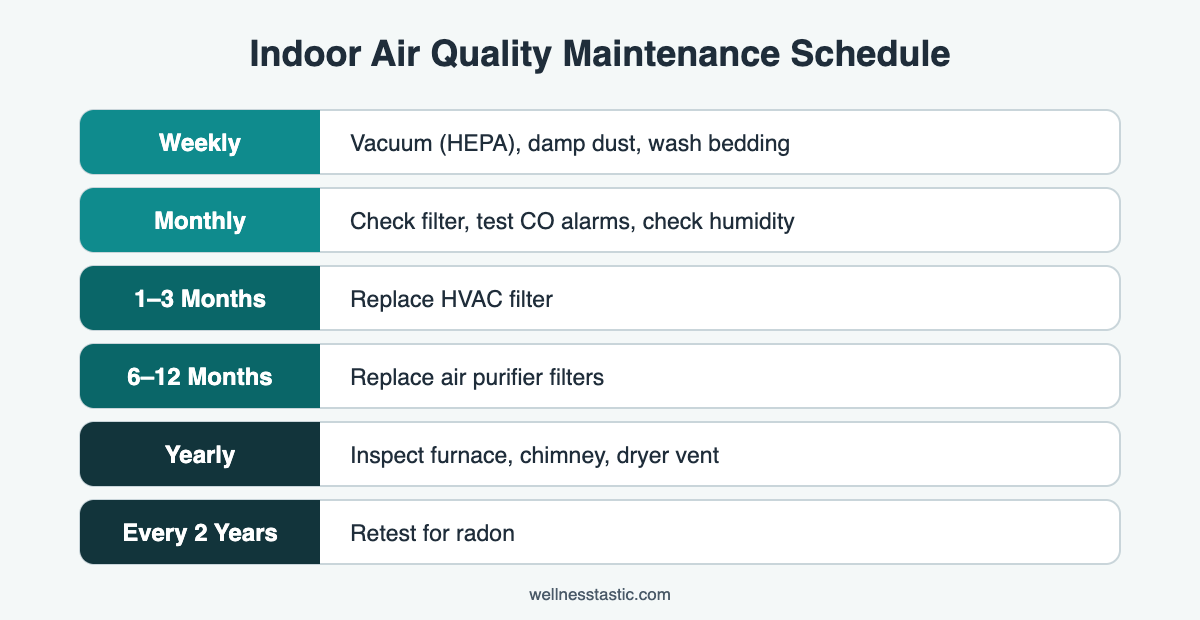
A healthy home checklist is not a one-time task. Use this schedule to keep your home’s air in good shape all year.
| How often | Task |
|---|---|
| Weekly | Vacuum with a HEPA vacuum, damp dust, wash bedding in hot water |
| Monthly | Check HVAC filter, test CO alarms, check humidity levels, clean range hood filter |
| Every 1–3 months | Replace HVAC filter (more often with pets or smokers) |
| Every 6–12 months | Replace air purifier filters as recommended, clean bathroom fan covers |
| Every year | Inspect furnace, water heater, chimney and dryer vent; check for leaks |
| Every 2 years (or after renovations) | Retest for radon |
| Seasonally | Adjust humidity control, check for condensation, deep clean |
Seasonal Indoor Air Quality Checklist
Spring
- ☐ Replace HVAC filter before cooling season.
- ☐ Keep windows closed on high pollen days.
- ☐ Deep clean carpets, curtains and upholstery.
- ☐ Check the basement and attic for winter leaks.
Summer
- ☐ Watch humidity and run a dehumidifier in damp areas.
- ☐ Check AC drain lines and drip pans for standing water.
- ☐ Prepare for wildfire smoke with spare filters and a HEPA air purifier.
Fall
- ☐ Schedule furnace and chimney inspections.
- ☐ Test CO alarms and replace batteries.
- ☐ Clean gutters to prevent water problems.
- ☐ Plan a radon test once windows are closed.
Winter
- ☐ Keep exhaust fans in use despite the cold.
- ☐ Open windows briefly for fresh air when safe.
- ☐ Watch for window condensation and adjust humidity.
- ☐ Clean and maintain humidifiers if you use them.
Scoring Your Results: What to Fix First
Once you have finished the indoor air pollution checklist, count the unticked items. Then prioritize them like this:
- Fix immediately (safety): missing CO alarms, unvented heaters, running engines in the garage, gas smells, radon above 4 pCi/L, indoor smoking.
- Fix soon (moisture): leaks, visible mold, humidity regularly above 60%, bathrooms without working fans.
- Improve next (ventilation and filtration): range hood use, HVAC filter upgrades, air purifiers in key rooms.
- Ongoing habits: cleaning routines, fewer fragrances, shoes off, low-VOC products.
If you ticked most items, your home is in good shape. If many items are unticked, do not worry. Start with safety and moisture, then work through the rest over a few weeks. Our step-by-step guide on how to improve indoor air quality covers each fix in detail.
Checklist for Buying or Renting a Home
Moving into a new place is the perfect time to check indoor air quality before you unpack. Use this quick air quality inspection checklist during viewings or on move-in day:
- ☐ Ask whether the home has been tested for radon and see the results.
- ☐ Look for water stains on ceilings, walls and under sinks.
- ☐ Notice any musty smells, especially in basements and closets.
- ☐ Check that the kitchen has a range hood vented outdoors and bathrooms have fans.
- ☐ Ask when the furnace and water heater were last serviced.
- ☐ Confirm CO alarms and smoke alarms are installed and working.
- ☐ Ask about recent renovations, new paint or new flooring.
- ☐ For homes built before 1978, ask about lead paint disclosures.
- ☐ Check the age and type of HVAC filter.
- ☐ Look for signs of pests, which may lead to pesticide use.
Renters can report leaks, mold and ventilation problems to their landlord in writing and keep a copy for their records.
When to Get a Professional Air Quality Inspection
This checklist covers what most homeowners can check themselves. Consider a professional air quality inspection if:
- You find mold larger than about 10 square feet or suspect hidden mold behind walls.
- Your home has had flooding or major water damage.
- Radon tests show elevated levels.
- You notice persistent odors or symptoms you cannot trace to a source.
- You are buying an older home or planning major renovations involving old paint or insulation.
- CO alarms sound or fuel-burning appliances show signs of poor combustion.
Look for qualified professionals such as certified radon measurement or mitigation providers, licensed HVAC technicians, and indoor environmental professionals for mold assessment.
Frequently Asked Questions
How often should I go through an indoor air quality checklist?
A full walkthrough once or twice a year is a good habit, ideally before winter and before summer. Use the maintenance schedule above for weekly and monthly tasks.
Can I check indoor air quality without special equipment?
Yes, many items on this checklist are visual checks for leaks, mold, ventilation and product use. However, a hygrometer, air quality monitor, CO alarms and radon test give you information you cannot get by sight or smell. See our guide on how to test indoor air quality at home.
What are the most important items on the checklist?
Safety items come first: carbon monoxide alarms, safe combustion appliances, radon testing and keeping smoking outside. Next come moisture problems, because they can lead to mold.
What should I do if I find mold?
Fix the moisture source first. Small areas can often be cleaned by homeowners with appropriate precautions, while larger areas or mold caused by contaminated water should be handled by professionals. The EPA’s mold guide provides detailed advice.
The Bottom Line
A simple indoor air quality checklist makes a healthy home manageable. Walk through your home, tick off what is already in good shape, fix safety and moisture problems first, and then work on ventilation, filtration and daily habits. Repeat the process once or twice a year to keep your home healthy.
Sources
- U.S. EPA: Care for Your Air, A Guide to Indoor Air Quality
- U.S. EPA: A Brief Guide to Mold, Moisture and Your Home
- U.S. EPA: What Is a MERV Rating?
This checklist is for general information only and is not a substitute for professional inspection or medical advice. See our Disclaimer.