Do air purifiers work, or are they just expensive fans? It is a fair question. The market is full of bold claims, from “removes 99.9% of everything” to “eliminates allergies,” and it is hard to know what to believe. The honest answer is that good air purifiers do work for specific jobs, especially reducing airborne particles, but they are not a cure-all, and they only deliver results when you choose and use them correctly.
In this guide, we look at what the evidence and expert guidance say about air purifiers, what they can and cannot do, who benefits most, why some people see little difference, and how to make sure your air purifier actually works. For product recommendations, see our guide to the best air purifiers for home.
Quick answer: Yes, air purifiers with true HEPA filters work well at reducing airborne particles such as dust, pollen, pet dander and smoke, when they are sized correctly for the room and run consistently. Models with activated carbon can also reduce some odors and gases. However, according to the EPA, no air cleaner removes all pollutants, and air purifiers cannot fix moisture problems, remove carbon monoxide or radon, or replace ventilation.
What the Evidence Says
The U.S. Environmental Protection Agency (EPA) explains that portable air cleaners can help reduce indoor airborne particles, especially when they have a high Clean Air Delivery Rate (CADR) for the room size. The EPA also notes that air cleaning is most effective when combined with source control and ventilation, and that no air cleaner removes all pollutants.
Research on HEPA air purifiers in real homes has consistently found meaningful reductions in indoor fine particles (PM2.5) when purifiers are properly sized and used. Health agencies also recommend portable HEPA air cleaners as one of the practical steps people can take to reduce indoor exposure during wildfire smoke events.
Where the evidence is more mixed is on direct health outcomes. Studies on allergy and asthma symptoms show varied results: some people notice improvements, while others see little change, often because their main triggers are not airborne or because other sources were not addressed. That is why it is important to treat an air purifier as one part of a broader plan, and to speak with a healthcare professional about health concerns.
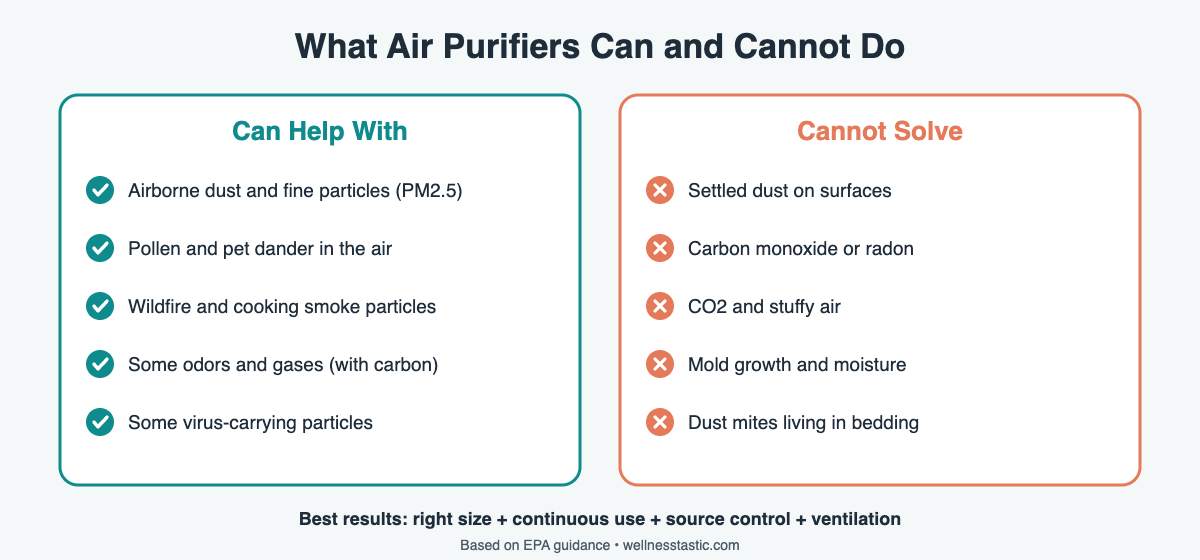
What Air Purifiers Can and Cannot Do
| Pollutant or problem | Do air purifiers work? | Notes |
|---|---|---|
| Airborne dust | Yes | HEPA captures airborne dust; settled dust still needs cleaning |
| Pollen | Yes, for airborne pollen | Keep windows closed on high-pollen days |
| Pet dander | Yes | One of the allergens purifiers handle best |
| Wildfire and cooking smoke particles | Yes | Choose a high smoke CADR |
| Smoke odor and VOCs | Partly, with enough carbon | Thin carbon layers saturate quickly |
| Mold spores in the air | Partly | Does not stop mold growth; fix moisture |
| Dust mites | Limited | Mite allergens settle quickly in bedding |
| Viruses and bacteria | Can help reduce airborne particles | Not a substitute for ventilation or other public health measures |
| Carbon monoxide | No | Use CO alarms |
| Carbon dioxide and stuffiness | No | Needs ventilation |
| Radon | No | Needs testing and mitigation |
Do All Types of Air Purifiers Work?
Not all air purifiers are equal. How well an air purifier works depends heavily on the technology inside:
| Technology | Does it work? | What for |
|---|---|---|
| True HEPA filtration | Yes, well proven | Airborne particles: dust, pollen, dander, smoke particles |
| Activated carbon | Yes, if there is enough carbon | Odors and some gases and VOCs |
| Ionizers | Partly | Some particles, but may produce ozone and deposit particles on surfaces |
| UV-C light | Limited in most home units | Targets microbes, but airflow is usually too fast for strong effect |
| Photocatalytic oxidation | Mixed evidence | Some gases; possible byproducts |
| Ozone generators | No, not recommended | May mask odors; ozone is a lung irritant |
When people ask “do air purifiers work,” the most reliable answer applies to HEPA air purifiers, ideally combined with activated carbon. Purifiers that rely mainly on ionizers, UV or ozone are where most disappointment and controversy come from. Learn more in our guide on how an air purifier works.
When Air Purifiers Work Best
Air purifiers deliver the most noticeable benefits in these situations:
- Wildfire smoke: a HEPA purifier in a closed room can substantially reduce indoor smoke particles. See our smoke guide.
- Homes with pets: dander stays airborne and is captured well. See our pet guide.
- Allergy-prone bedrooms: running a quiet purifier overnight reduces airborne allergens where you spend the most time. See our allergy guide.
- Homes near busy roads: outdoor pollution particles that enter the home can be reduced.
- Dusty homes: a purifier can reduce how quickly dust builds up. See our dust guide.
- Cooking-heavy households: purifiers help clear particles that escape the range hood.
Why Some People Say Air Purifiers Do Not Work
When people feel their air purifier “does nothing,” the cause is usually one of these:
- It is too small for the room. Many purifiers are sold with inflated room-size claims. If the CADR is too low, the air barely changes. Use our size calculator.
- It is not running enough. Particles are constantly released; purifiers work best running continuously.
- The filter is clogged or overdue. A dirty filter reduces airflow and cleaning.
- It is placed in a corner or behind furniture, which restricts airflow.
- Doors and windows are open, so the purifier is trying to clean the whole house or the outdoors.
- The problem is not airborne particles. Stuffiness (CO2), humidity, mold growth and dust mites need other solutions.
- It is not a true HEPA purifier, or relies on ionizers or gimmicks rather than proven filtration.
- The source is still active, such as indoor smoking or an unvented heater.
How Much Difference Should You Expect?
The size of the improvement depends on your home, the purifier and how you use it:
- Particle levels: a properly sized HEPA purifier in a closed room typically lowers airborne particle levels substantially, especially after spikes from cooking, cleaning or smoke.
- Visible dust: many people notice surfaces stay cleaner for longer, although regular cleaning is still needed.
- Odors: results depend on the amount of carbon; thin carbon layers may make only a small difference.
- How the air feels: if a room feels stuffy, that is usually CO2 and humidity, which a purifier will not change.
- Symptoms: changes vary from person to person and are not guaranteed; track them and discuss them with a doctor.
The clearest way to see the difference is to measure it, which is why we recommend pairing a purifier with an air quality monitor, at least for the first few weeks.
A Real-World Example
Imagine a 200 sq ft bedroom shared with a dog. The owner buys a small purifier advertised for “up to 800 sq ft” but notices no difference. When they check the specifications, the smoke CADR is only about 80 CFM, well below the roughly 130 CFM the room needs. The purifier also sits behind a nightstand, and the door stays open all night.
After switching to a purifier with a smoke CADR comfortably above 130 CFM, placing it in an open spot a few feet from the bed, closing the door at night and washing the dog’s bedding weekly, they notice less dust on surfaces, and their monitor shows particle levels dropping much faster after the dog comes in from outside. Nothing magical changed; the purifier was simply sized, placed and used correctly.
How to Make Sure Your Air Purifier Works
- Choose true HEPA or verified HEPA-grade filtration. See our HEPA guide.
- Size it correctly: the smoke CADR should be at least two-thirds of the room’s floor area. See our CADR guide.
- Run it continuously on auto or low, and turn it up when air quality worsens.
- Place it in an open spot in the room where you spend the most time.
- Keep doors and windows closed in that room while it runs, and ventilate at other times.
- Maintain it: clean the pre-filter regularly and replace filters on schedule.
- Add carbon if odors or smoke smell are a concern.
- Measure the results with an air quality monitor.
How to Measure Whether Your Air Purifier Is Working
The most reliable way to know whether an air purifier works in your home is to measure particle levels:
- Place an air quality monitor with a PM2.5 sensor a few feet away from the purifier.
- Note the reading with the purifier off, then switch it on and watch how quickly levels fall.
- Test during everyday activities, such as after cooking or when pets come inside.
- Compare readings over several days to see the overall trend.
Visible signs, such as a dirty pre-filter or less dust on surfaces, also show that the purifier is capturing particles.
Are Air Purifiers Worth It?
For many households, a properly sized HEPA air purifier is worth it, especially in the bedroom and in homes with pets, allergies, nearby traffic or wildfire smoke. Here is a simple way to weigh it up:
| An air purifier is likely worth it if… | It may be less useful if… |
|---|---|
| You live with pets or allergy-prone family members | Your main problem is stuffiness or high CO2 |
| Wildfire smoke or outdoor pollution affects your area | Your main problem is humidity or mold growth |
| You want cleaner air in a bedroom or home office | You will not maintain the filters |
| Cooking or dust is a regular issue | The room is far larger than the purifier can handle |
| You are willing to run it continuously | You cannot control a major indoor source such as indoor smoking |
Running costs are usually modest: electricity on low settings and filters every 6 to 12 months. Choosing a model with affordable filters makes a big difference over time.
Checklist: Choosing an Air Purifier That Actually Works
Before you buy, check that the purifier meets these basics. If it does, it is very likely to deliver real results:
- True HEPA or H13 filtration, clearly stated, not “HEPA-type.”
- A published smoke CADR, ideally AHAM Verifide, of at least two-thirds of your room’s floor area.
- Activated carbon if odors or smoke smell matter, with the carbon amount listed.
- No ozone: CARB certified, with any ionizer able to be switched off.
- Quiet low settings so you will actually leave it running.
- Affordable filters with a clear replacement schedule.
- A washable pre-filter if you have pets or a lot of dust.
For models that meet these criteria, see our best air purifiers guide.
Air Purifier Myths and Facts
- Myth: Air purifiers remove 99.9% of all pollutants. Fact: HEPA filters capture a very high share of airborne particles that pass through them, but no air cleaner removes all pollutants in a room.
- Myth: Air purifiers cure allergies or asthma. Fact: they can reduce airborne triggers, but they are not a medical treatment.
- Myth: Any purifier will do. Fact: filter quality and CADR make a huge difference.
- Myth: Ionizers and ozone purifiers clean better. Fact: the EPA advises against ozone generators, and ionizers can produce ozone.
- Myth: A purifier replaces ventilation. Fact: purifiers do not bring in fresh air or reduce CO2.
Air Purifiers vs Other Ways to Improve Indoor Air
| Approach | What it does best | Works with a purifier? |
|---|---|---|
| Source control | Stops pollution before it starts | Yes, and it should come first |
| Ventilation | Brings in fresh air and removes CO2, moisture and gases | Yes, they complement each other |
| HVAC filter (MERV 13) | Whole-home particle filtration when the fan runs | Yes, for whole-house coverage |
| Dehumidifier | Controls moisture, mold and dust mites | Yes, for damp rooms |
| Regular cleaning | Removes settled dust and allergens | Yes, essential |
The EPA recommends source control and ventilation as the first steps, with air cleaning as an additional tool. See our guide on how to improve indoor air quality.
Who Benefits Most From an Air Purifier?
- People with pets, especially in bedrooms
- Households with allergy-prone members (with medical guidance)
- People in areas affected by wildfire smoke
- Homes near busy roads or industrial areas
- People who work from home in small rooms
- Families who cook frequently, especially on gas stoves
Frequently Asked Questions
Do air purifiers really work?
Yes, HEPA air purifiers are effective at reducing airborne particles such as dust, pollen, pet dander and smoke when they are properly sized and used continuously. They do not remove all pollutants and are not a substitute for ventilation.
Do air purifiers help with allergies?
They can reduce airborne allergens, particularly pet dander and pollen, especially in the bedroom. Results vary between people. Talk to a doctor or allergist about your symptoms.
Do air purifiers help with dust?
Yes, they capture airborne dust and can reduce how quickly surfaces get dusty. Settled dust still needs to be cleaned.
How long does it take for an air purifier to work?
A properly sized purifier usually reduces airborne particle levels noticeably within the first hour. For best results, run it continuously. See our guide on how long to run an air purifier.
Can an air purifier make air worse?
Ozone generators and some ionizers can produce ozone, a lung irritant. Choose HEPA purifiers that meet CARB ozone limits, and keep ionizers switched off if you are concerned.
Do air purifiers help with mold?
Air purifiers with HEPA filters can capture some airborne mold spores, but they cannot stop mold from growing. The EPA emphasizes that controlling moisture is the key to controlling mold, so fix leaks and keep humidity in check first.
Should I run an air purifier with the windows open?
Generally, no. Air purifiers work best in a closed room. Ventilate by opening windows when outdoor air is clean, then close them and let the purifier run. During wildfire smoke or high pollen, keep windows closed.
The Bottom Line
So, do air purifiers work? Yes, for the right job. A true HEPA purifier that is sized correctly, placed well and run continuously can substantially reduce airborne dust, pollen, pet dander and smoke particles, and carbon filters can help with some odors. But air purifiers do not remove all pollutants, cannot fix moisture, CO2, carbon monoxide or radon, and work best alongside source control and ventilation. Choose wisely, measure your results, and you are likely to find that a good air purifier is well worth it.
Sources
- U.S. EPA: Guide to Air Cleaners in the Home
- U.S. EPA: Care for Your Air, A Guide to Indoor Air Quality
- AirNow.gov: Air Quality Index
- California Air Resources Board: Air Cleaners and Ozone
This article is for general information only and is not medical advice. See our Disclaimer and How We Research.